Living in the present

“Nobody lived in the past, if you stop to think about it. Jefferson, Adams, Washington—they didn’t walk around saying, ”Isn’t this fascinating, living in the past?“ They lived in the present just as we do. The difference was it was their present, not ours. And just as we don’t know how things are going to turn out for us, they didn’t either. It’s very easy to stand on the mountaintop as an historian or biographer and find fault with people for why they did this or didn’t do that, because we’re not involved in it, we’re not inside it, we’re not confronting what we don’t know—as everyone who preceded us always was.”

David McCullough, Knowing History and Knowing Who We Are

The David McCullough quote is from a piece he wrote in 2005 and I’ve included the link for it. A brilliant military strategist, Dr. Colin Gray, made a similar comment in one of his books about strategic planning, emphasizing that none of us knows the future and he cautioned against the human tendency of too harshly judging strategic planners in the past for decisions that turned out badly or assuming that they had to know, X,Y and Z would happen. He suggested that often people were operating in good faith and making decisions they believed would be successful.

Here’s a YouTube video of McCullough speaking about history and at 17:18, he makes the same point he made in that above quote about people did not live in the past:

It’s easy to be armchair critics, as I can attest to, because I’ve done plenty of that myself, but despite my judgmental habits, I’m trying to think more before writing blog posts. One thing it’s easy to do is to draw sweeping conclusions based on very tiny amounts of information and often even that information is just “so and so online said,” not verified in any way. Along with the sweeping conclusions it’s very easy to cherry-pick information that feeds our own beliefs and views.

An economic collapse, whether through a lot of unforeseen events or financial power players trying to manage a collapse they know is coming, really is an area I have no expertise on. My understanding of macroeconomics could fit inside a teaspoon, so I’ve been doing more reading.

Klaus Schwab, the World Economic Forum’s founder, influence-peddler among the world’s elites and present arch nemesis among the American right has been talked about frequently, so I read his book, The Great Reset, and while I found many of the ideas promoted disturbing, what bothered me the most was the certainty with which he presents all of their climate change policy assertions.

I still don’t understand all the intricacies of the “Great Reset’ agenda and here’s the thing, I believe most of the people who bought into these ideas truly believe their plans are for the good of all people and that the entire world will prosper and flourish. While I expect widespread chaos and that their plans will fail and cause massive hardship, I could be wrong. The other thing is all sorts of other events might happen that upend the Great Reset agenda completely and the world may be facing other unforeseen massive problems.

In my own life, I live a simple and modest life and hope I can keep doing so. I can’t plan for the collapse of the world economy, because I have no idea what events would unfold in such a global catastrophe like that. For me, it’s about living in the present, while trying to take practical steps like having food, water and some emergency supplies on hand, but it’s also about continuing to learn new skills and practice old skills.

These days meteorologists do a good job tracking storms, whereas in the olden days people near coasts didn’t have a week’s time to prepare for a hurricane or major storm. Currently, I’m watching Tropical Storm Ian, just as Hurricane Fiona battered Canada and going over my hurricane preparedness plans.

George Washington was planning out changes he wanted to make to his gardens back at Mount Vernon, while he was off fighting the Revolutionary War. He wasn’t planning to be the first president of the United States of America, which didn’t even exist yet. There are personal letters of Washington’s where he’s going over account books for his estate and concerned with personal family business during the war. He was living in the present.

I’ve watched YouTube preppers who fixate on all the terrible things they are sure are going to happen or that are “signs” that SHTF is imminent and then they’ll list the latest hyped up news (ZeroHedge is a source mentioned frequently with the most hysterical and alarmist predictions) and I’ve seen advice based on these alarmist news reports range from “pull all your money out of the bank” (panic-driven bank runs exacerbated the economic collapse during the Great Depression), to urging people to “pack up and move from these blue states immediately” or “get out of the cities.” I’ve seen videos urging people to get rid of all their paper money and invest it in gold and silver.

I don’t have a crystal ball and I’m not an expert on personal financial management, so I am hesitant to urge dramatic actions like that, which could cause a lot more financial problems for many people than it solves. I do believe, as a guiding principle that getting out of debt and living debt-free, is a better lifestyle choice, under any circumstance and having some emergency savings can turn a personal crisis into just an inconvenience. These two beliefs apply during times of calm and plenty and in times of chaos and scarcity.

A book, The Reshaping of Everyday Life: 1790-1840, by Jack Larkin, explains early America’s complex economics, after the American Revolution. There was little money in circulation, so most of the actual money flowed back to the cities and rural people lived under systems of “exchanges,” that were closely linked to their social interactions in communities. Some of their dealings involved simple bartering, but some involved systems of credit and IOUs, that could be “paid off” later in goods or services.

The monetary currency circulating varied too. Larkin wrote, “A bewildering variety of foreign coins circulated: Dutch rix-dollars, Russian kopecks, as well as French and English specie. Most of the coins Americans used were the silver dollar halves, quarters, eighths and sixteenths minted in Mexico and in the South American republics where silver was abundant.” This led to a lot of confusion, as most of the early Americans in the former colonies were still used to the British shillings.

The varied and diverse ways these early Americans conducted their business transactions came out of necessity, because very few people, even back then, were totally self-sufficient, even on the larger farms. There are also accounts of a divide between how Southerners and Northerners conducted business, where the northern way of writing down transactions conflicted with the Southern habit of a handshake and a man’s word being considered a sacred bond. People in early America, just like people throughout history in times of turmoil, self-organized and found ways to manage without some masterplan or people fixating ahead of time on how to prepare for every dire scenario imaginable.

These early Americans were dealing with unforeseen catastrophes on a regular basis. Illnesses swept through and could wipe out entire families. As the frontier moved westward, the settlers living closer to that edge faced skirmishes and massacres in battles with Native Americans. Every imaginable hardship and natural disaster hit and there was no 911 to call or FEMA and the American Red Cross to mobilize. These people had to pick themselves up and work together to salvage what they could and rebuild. They were living in the present, while trying to lay down foundations for their children and grandchildren.

Building more skills, and that means practicing old skills too, seems like it will be more useful for me than getting worked up about a world financial collapse or some other hyped news story, that I have no details or information to verify it.

In my next blog post, I’m going to write about basic sewing and make a few suggestions for supplies, beyond the little sewing kits they sell for a few dollars. Learning a few basic sewing skills is not nearly as daunting as many people make it. And just about anyone can master a few basics.

Leave a comment

Filed under American History, Emergency Preparedness, General Interest

Fall garden hits and misses

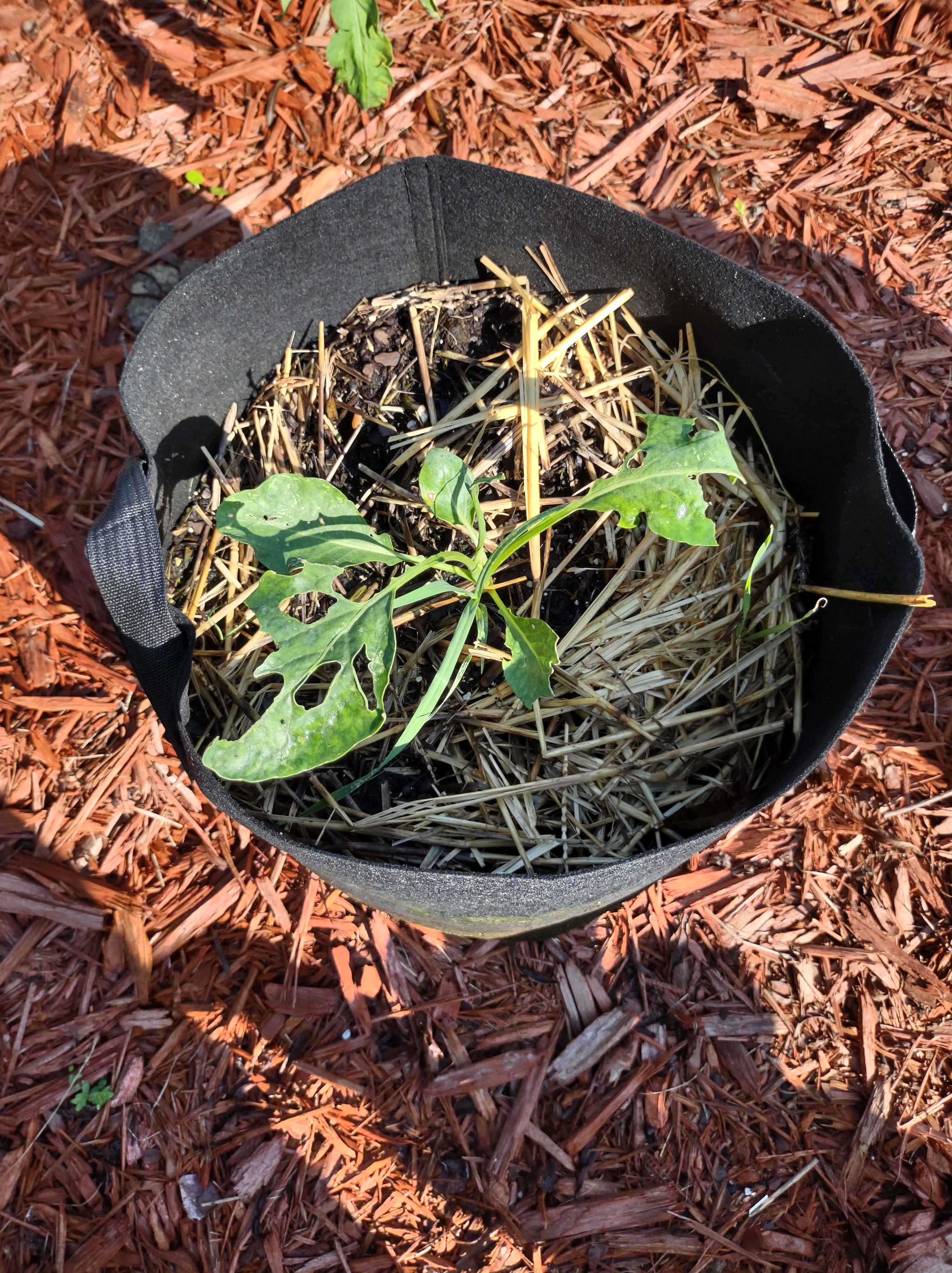
This is a short fall container garden update. Pictures give a clearer picture of how it’s still going with the bug and pest problems living in the GA swamps. While most of my plants are doing okay, I’ve got some that have succumbed to pests.

I have more tomatoes and cucumbers growing, more lettuce and kale, some red beets, onions, and a few other things, so I’ll see how this goes. I’m still trying to use and preserve even small amounts. Every little bit counts. There’s something to feeling more connection to food you grow yourself, even imperfect ones, over buying blemish-free perfect produce at the grocery store.

While I am still using a lot of grow bags, I did buy more larger pots on amazon and have started using those too. The grow bags work, but in my climate, with such high heat from late spring all the way into early fall, the grow bags dry out quickly and require a lot more watering than plastic pots. I do hope to get some raised beds together in the next year, but I will still continue with some container gardening too. With the recent weeks of rain, it brought home again how long most of my backyard stays swampy after rain and also memories of years ago struggling to grow an in-ground garden in my backyard, where it would be either too much rain or drought conditions.

Even in my backyard, though, there are areas that aren’t as swampy, so I haven’t rejected in-ground planting completely. I’ll keep trying different things and see what works and what doesn’t. I’ve been tossing around ideas for some flower beds in my front yard that incorporate herbs and some vegetables. I also might plant some blueberry bushes along the side of my driveway.

The biggest lesson I’ve learned from more gardening failures than I can count over the years is keep trying and when plants die, rather than get discouraged, try to figure out what went wrong. Then try something new or replant more seeds.

Just getting busy, instead of making excuses or making things too complicated, has become more of a mental roadblock for me to overcome in the information age. I often look at Pinterest perfect photos and awe-inspiring YouTube videos, then start thinking perhaps I need all these doodads before starting projects.

Growing up without all that information or access to so much stuff, I just learned to make-do with what we had and figured something out. I had a make-do mind-set all the way through raising my kids too, but since the internet, I’ve had to catch myself with creating these mental roadblocks. It wasn’t only my spelling that suffered in the digital age, since becoming reliant on spell-check, it was my can-do attitude too.

It’s getting very expensive to buy plants already started at the store, plus you can find so many different varieties of vegetables by buying seeds. The first photo is a red cabbage called Red Express, from Park Seeds and it’s supposed to have a compact growing habit, so I thought I’d try it in containers. I’ve already bought a lot of seeds for spring and plan to order a few more. I saved some seeds too, and I did buy the seed-saving book, Seed to Seed: Seed Saving and Growing Techniques for Vegetable Gardeners, that I saw several online gardeners mention, and it’s very helpful.

The sun will come out tomorrow wasn’t only for overly-cheerful Annie, it can be for all of us. Have a nice day.

Leave a comment

Filed under Uncategorized

Beware of “zero”

The first far-left “zero” movement I was aware of was the zero population movement, which gained popularity in the 1970s. My youngest brother bought into that completely. so I heard all I ever want to hear about that topic. When people get on board these far-left movements it becomes like a religion to them and they invariably zealously try to convert the entire world to their cause. Failing that, they try to force cultural and political change to impose their views on everyone.

That zero population movement is still enmeshed in the far-left mishmash of ESG (equity, sustainability and governance) goals, although most people, who aren’t leftists, probably weren’t paying much attention to the far-left movements beyond hearing about the green-deal, laughing at AOC or they remember a bit further back that the Obama administration pushed the green dreams.

In 2013, there was another leftist movement that I remember writing a blog post about – the global zero movement, which set as its goal the elimination of all nuclear weapons by 2030. President Obama supported this movement. In 2015, the UN General Assembly passed the 2030 Agenda and all of these fringe far-left movements, from the green-energy to the other zero movements, to the gender movements became neatly packed into the ESG framework that’s going to build the highway to Net Zero utopia.

With the green-energy transformation, the green movement now has Net Zero. Here’s an explanation of the term net zero from the University of Oxford (https://netzeroclimate.org/what-is-net-zero/):

“Net zero refers to a state in which the greenhouse gases going into the atmosphere are balanced by removal out of the atmosphere.” 

“The term net zero is important because – for CO2 at least – this is the state at which global warming stops. The Paris Agreement underlines the need for net zero. It requires states to ‘achieve a balance between anthropogenic emissions by sources and removals by sinks of greenhouse gases in the second half of this century’.” 

While the Biden administration flunkies keep yammering on about electric cars, the ESG goals include forcing people to completely change how they live – from what they eat, how much they eat, what temperature they keep their homes, how much they travel, how they travel, and it’s about forcing people to change what they think or be forced into compliance – to reach that magical Net Zero.

Where we’re headed is a Zero Freedom world, as the “experts” formulate what’s the perfect sustainable balance with their zero movements. If you think the zero population growth and the global zero movement to eliminate nuclear weapons by 2030 (that magical 2030 UN Agenda date again) disappeared, I think you’re wrong. With the war in Ukraine, back in July, Steven Pinker, a prominent Harvard scholar, was tweeting that Europe should unilaterally eliminate it’s nuclear arsenal. Here’s a quote from a Washington Examiner article:

“Those suggesting major changes to NATO nuclear deterrence might first want to consider Russian nuclear strategy.”

“Former Costa Rican President Oscar Arias and Jonathan Granoff of the anti-nuclear weapons Global Security Institute fail this test. Seeking a negotiated end to the war in Ukraine, Arias and Granoff call for NATO’s preparation to withdraw “all U.S. nuclear warheads from Europe and Turkey, preliminary to negotiations [over the war in Ukraine]. Withdrawal would be carried out once peace terms are agreed between Ukraine and Russia.” Chiming in on Monday, Harvard scholar Steven Pinker suggests that this is a “bold idea” because nuclear weapons are “militarily useless, ineffective deterrents … [and] recklessly dangerous.”

Back in July, you might also remember President Biden stating that there was zero inflation

Zero holds some mystical power among the left. Even with that zero population growth movement, it wasn’t just about trying to control the number of births. There were people in that movement wanting to have some controls on death too, which opens up a whole other kettle of fish.

All of these leftist “zero” movements involve allowing a group of experts/central planners to drain the lifeblood out of personal choice. If I hear any liberals mentioning “zero,” I cringe and know they’re going to be proposing another radical program that makes absolutely zero sense. My ears perk up, though, because zero with them also means they want to nullify all of our personal liberty and leave us with zero power whatsoever.

Definitely, beware of “zero.”

Leave a comment

Filed under General Interest, Politics

Some critical needs to survive

This post is going to be about a few things I think might become critical needs to survive and thrive, as the green-energy transformation (collapse of the world economic systems as we know them) speeds up. My list isn’t your usual list of food, water, and ability to defend yourself, your family and your home. There are literally dozens upon dozens of online sources and books on emergency preparedness, survival, gardening, and farming available that can provide better information on those topics than I can. The things I’m going to talk about again, don’t cost anything, except working hard to develop critical-thinking skills.

Information

Reliable and actionable information is vital to help us make decisions and respond, especially in a crisis. The first thing I’m going to mention again is learning to critically analyze information. According to polling and viewership stats on public trust in news media, across the board, trust in news media is at an all-time low.

Yet, just as people say they don’t trust certain news media, most people still get news from various news sources and this holds true across the political spectrum.

For instance, many Trump-supporters completely distrust mainstream (liberal) media and they’ll rush to distrust FOX News or any right-leaning news source, if that news source reports anything negative about Trump. Often, Trump will tout some new right-wing news media source and many of his supporters will gravitate there. Some people on the right get their news only from certain right-wing online sources or pundits, whom they trust.

On the left, this same phenomenon plays out with choosing news sources too. Recently, CNN’s new management fired some big name people, who were rabidly and openly anti-Trump. One of those people was a hard news reporter, who tweeted hate-filled anti-Trump diatribes for several years. Many liberals are outraged at CNN for firing these very biased CNN personalities. People on the left, who hate Trump, likewise gravitate to only left-wing online sources and the more they hate Trump, the further left they move in their news source choices.

If you gather your news only from sources that align with your partisan politics and trust them completely, that’s called confirmation bias. In a rapidly changing environment, relying only on information that feeds your own prior beliefs and values can leave you very ill-informed and it can lead you to make important decisions based on inaccurate or totally false information. It can also leave you blind to a whole lot of other events and information that could better inform you about what’s happening.

If you place your trust in personalities, by trusting only certain pundits or online influencers and make decisions based on their advice, it could easily lead to some disastrous decisions in a crisis. Many pundits and online influencers engage in a whole lot of confirmation bias too, but they also make money hyping stories, that are speeding down the internet superhighways, to attract an audience. Drama attracts viewers and keeps them coming back for more.

In the old days many people relied on a trusted family friend or someone locally, when making major financial decisions, but millions of people now trust online influencers or popular pundits over people in their own lives. In a crisis, local events happening can be way more critical and important in your daily life and how well you survive and thrive, than listening to news sources, who have no idea exactly what’s happening where you live. It’s important to figure out some local news sources and try to build some local community.

Developing a wider circle of information-gathering might be useful too. I think it’s wiser to gather information from across the political spectrum, compare it and also work to develop local sources. I also try to completely read through news articles, rather than react to headlines, because often important information is buried deep in news articles. Often, I jot down notes of things I want to look into a bit more.

Survival is local

Local news can be harder to find these days, since local newspapers are a dying entity, but even talking to neighbors, the guy at the gas station or people at local businesses might be more useful than news sources from across the country or across the world. When I was growing up in rural PA, the local diner was the information hub and my father liked to stop by there almost daily to hear about what was going on.

Finding reliable local information will be more valuable than knowing about some global shortages and all the global events playing out. Finding the supplies and things we need to survive closer to home in a global financial crisis will be critical. We’ll all likely have to shorten our own family’s supply chain a great deal in a global economic crisis, as big corporation supply chains we rely on sputter and falter.

Knowing about events that are happening closer to home matters immensely with personal and home security decisions. For instance, if major civil unrest breaks out in some urban areas, but things in your area are calm and safe, then reacting as if it’s unsafe to go out in public where you live or deciding it’s time to hunker down would not be an informed decision. It would be overreacting to media hype and a failure to gather reliable and actionable information for your location. Remaining as resilient and able to move about freely, rather than rushing to hunker down, makes more sense than self-limiting your personal liberty based on fear and lack of reliable local information. I suspect with the pandemic craziness there will be some people, who voluntarily live hunkered down, out of fear, for years to come.

Know Thyself

In life you’ll encounter many types of people and it’s much easier accurately assessing other people’s personality, character flaws and behavior than it is our own. The road to self-awareness is hard and most people, avoid being completely honest about their own short-comings, failures and mistakes.

It’s a continual work in progress to face up to your own mistakes and flaws. It’s even harder to work to change them. And it’s much easier to assess blame on other people and events rather than face the truth. Learning to face the truth is hard.

Most of us like to be right and we like to be vindicated when other people challenge our views or criticize us. A lot of people will do a circle the wagon approach, trying to find a group that uncritically supports their views and they in turn will do the same thing for them. In the online world, just like the real world, there are cliques (communities), where no disagreements or criticisms are tolerated and even saying you disagree with anything is deemed “trolling.” Often others will rush to condemn the “trolls,” but when I read comment sections it’s like all or nothing – any comment that isn’t 100% in lockstep is labelled trolling and there’s a circle the wagon attitude.

Surrounding yourself with only people who agree with you completely can lead to a failure to honestly assess yourself, your ideas, your plans. It’s fine to find like-minded people to try to work together on things that matter to you. Even I would look for someone interested in needlework to form a sewing circle, but insulating yourself from other ideas and views can lead to stagnation in your thinking. It can also make you weak and unable to adapt to chaotic times. Being open to new ideas and being willing to admit you were wrong are two important survival habits to develop.

A couple years ago I made a statement to my youngest daughter that I am a very flexible person. She told me there are lots of words she’d use to describe me, but “flexible” isn’t one of them. She was being totally honest and once I thought about it, I knew she was right.

I am very set in my ways, very hard-headed about “following the rules,” have very strong opinions on right and wrong and often I cling to ways and things whose time has passed. I am still clinging to my landline phone, still clinging to my older TVs, that aren’t smart TVs and therefore using cable. I am thinking about buying a newer TV and ditching cable, but I’m still very attached to my landline phone. I do have a cell phone, but hate using it. I prefer to use a hand grater rather than my electric food processor and the list goes on. I’m like this about many things – I don’t want to adapt rapidly and in truth, I’m definitely not very flexible. Being flexible can be a very good trait in rapidly changing times. And, yes, I know I can be too judgmental too, as my family tells me regularly, especially when I reject completely the latest liberal culture war crap they tell me about (ok, I believe rejecting that is a good thing – that’s where I stand and I won’t change).

Avoid the drama

Finding some calm and inner-peace, even in bad times will help you weather the worst storms. My late husband had this totally irreverent sense of dark humor that would end up making me laugh, even in really bad times. A lot of soldiers are like that and that ability to find ways to relieve stress helps people through the hard times.

Social media and news media overflow with drama, distractions and endless rabbit holes to grab our attention and never let go. Finding ways to limit our news consumption and social media consumption can be hard, but working on breaking free of the drama and distraction will give us more time to think about other more important things. I struggle with this too, because of my being a news junkie. And unless you want to live like Alice in Wonderland, it’s best to avoid rabbit holes, especially the most alarmist, the-sky-is-falling ones.

The media is also full of soap opera news that can waste your time and energy. I didn’t watch even one minute of the Johnny Depp/Amber Heard trial and what I did learn was from my adult kids wanting to tell me about it. I told them I don’t care about it at all and I still don’t care.

Right now the news media is in a Royal Frenzy. I admired Queen Elizabeth II in many ways, but I’m not into monarchy. I wrote two blog post on King Charles III, because he’s relevant in relation to the great reset events and I wanted to be clear that despite the media gushing about him, his history is that of being closely connected with Klaus Schwab and a committed green-agenda zealot, in my opinion. I don’t care about the minute-by-minute royal reporting and I don’t care one iota about Harry and Meghan or William and Kate or any of the other royals. I do admire Kate’s fashion sense though.

We’ve had a lot of rain where I live and I’m more concerned about paying attention to the weather right now than caring about what’s going on with the royals.

If I want to escape, I’m planning to get back to my crafting and needlework, plus I have piles of books I want to read.

Leave a comment

Filed under Emergency Preparedness, General Interest

Another architect of the Great Reset

In my short post on King Charles III and his being an ardent environmentalist and supporter of the WEF Great Reset, it was more than just John Kerry, President Biden’s climate czar, showing up in Scotland this past week that led me to that conclusion. Here are a couple links to King Charles III, then the Prince of Wales, throwing his full support behind the WEF’s Great Reset plan since 2020, before the Schwab book was even published. He was involved in the WEF circle formulating the Great Reset plan and he’s very influential among the climate change elites, as is his brother, Prince Andrew. Here are a couple links to news articles from the past few years about his views:

From Vanity Fair, May 22, 2020: Is Prince Charles Using the Pandemic to Take on Capitalism? Here’s a quote from this article:

In January, Charles started a partnership with the organization called the Sustainable Markets Initiative, and he used a panel discussion at Davos to talk about how he thought capitalism needed to “reset” in order to prevent the worst effects of climate change. Now he’s applying that same logic to the aftermath of coronavirus.”

“According to the Telegraph, Charles has been working with Klaus Schwab, the WEF’s founder, on projects to help shape recovery from the pandemic.”

From The Guardian, June 3, 2020: Pandemic is chance to reset global economy, says Prince Charles.

Here’s a link to Sustainable Markets Initiative, which Charles started in January 2020. And here’s the link to the partners page: https://www.sustainable-markets.org/about/partners/

So, once again timelines matter. The WEF and elites were planning this Great Reset before the global pandemic, as this Vanity Fair article states that Prince Charles was working with Schwab on a “Great Reset” in January 2020. When the pandemic started, it sure looks to me, like they decided to use that crisis as a means to accelerate their great reset plan.

Here’s a Bank of America newsroom notice from September 21, 2020 : The Sustainable Markets Initiative Launches RE:TV: “Speaking today at Climate Week 2020, HRH The Prince of Wales launched RE:TV, a new platform to showcase solutions working to accelerate a more sustainable future.”

So forgive me if I’m not getting on board with the media-driven gushing, the pomp and circumstance of a royal funeral, and the media effort to hype King Charles III, as some great stabilizing force in the UK. He’s an environmental extremist, who will wear the crown of one of the most influential monarchies in the world, and he was closely involved in the creation of the WEF Great Reset plan. In fact, he’s part of the inner-circle of influential elites, who came up with this plan.

Instead of “God Save the King,” I expect very soon many British people will be opining, “God Save Us from this Environmental Extremist.”

2 Comments

Filed under General Interest, The Great Reset

Fearless embrace of progress

I’m kind of torn with how to write this blog post, but I want to write it and try not to be disrespectful about Queen Elizabeth II passing away.

I admired Queen Elizabeth II in many ways, but her children not at all. Her passing seems very much like the passing of a generation and the close of an era.

Today, King Charles III gave his inaugural address and it was well-written, dignified, carefully constructed and delivered. In that speech he said, “In her life of service we saw that abiding love of tradition, together with that fearless embrace of progress, which make us great as Nations.”

King Charles III has been a zealous environmentalist and green dream proponent for years, so it will be interesting to see how the green proponents try to use the British national sentiment about the queen passing and try to channel it toward embrace of going along with the green energy transformation. It will also be interesting to see if the new king takes a decidedly more overt posture in pushing the green agenda, by trying to sell it as not political or ideological and more as patriotic duty.

Here’s a quote from an ABC report:

“John Kerry, the U.S. special envoy for climate, said he hopes Charles will continue speaking out about climate change because it is a universal issue that doesn’t involve ideology. Kerry was in Scotland to meet with the Prince of Wales this week, but the session was canceled when the queen died.”

I expect Hollywood-type productions trying to sell the great reset in the UK by tying it to being like the late queen and her “fearless embrace of progress.” Here’s John Kerry:

Climate change is very much political and ideological and it’s an issue being pushed by globalist zealots. I suspect King Charles III and others in the royal family may push the green-energy transformation in ways the late queen would never have considered.

I’ve made a mental note of that phrase, “fearless embrace of progress,” because I expect iterations of that to be repeated a lot in the UK by people pushing the great reset agenda.

Leave a comment

Filed under General Interest, The Great Reset

Short PA historical note

In my first militia post, I mentioned my direct ancestor being “tasked” to recruit men for a militia. The reason my ancestor was tasked was because in PA, as the frontier expanded, setting up legal jurisdictions was a high priority. First there were a couple forts set up in that area, then the Northampton County Court was erected and townships were established. One of the first officials appointed in those newly established townships was the Constable, who was responsible for administering law and order. My direct ancestor was appointed the first Constable of Chestnuthill Township. So, when there was a need to raise a militia, the Constable was tasked with that duty.

Each colony had its own quirks and rules, but establishing law and order and a structure for the “common defense” under the rule of law was of the utmost importance.

That ends my PA history lesson. Have a nice day.

Leave a comment

Filed under American History, General Interest

The second part on militias

Here goes with why I decided to write about militias. Going back to the Tea Party movement among some of the GOP a decade ago, there was a resurgence of “let’s find our inner-George Washington” or “let’s become like the American patriots who founded our republic” type sentiments hyped. That’s all well and good, except many of the people who jumped on that bandwagon never cracked a book on early American history in their life and their fervor came from listening to right-wing pundits.

Alongside that Tea Party movement, a strain of wild conspiratorial thinking grew – all centered on President Obama – from right-wingers believing he was not an American citizen (the birther craziness), to some believing he was a Manchurian Candidate. Donald J. Trump embraced the Obama birther conspiracy theories and moved from NY liberal into hobnobbing with some people within right-wing, anti-Obama pundit circles. Btw, Obama’s mother was an American citizen, so wherever her son was born, he was entitled to American citizenship.

That same sort of pundit-driven hype that drove the Tea Party movement happened again with the populist Trump movement and while I do understand the concerns and some of the issues that galvanized the Trump movement, a lot of it smacked of the shallow celebrity worship, I expect on the left. I was supportive of the Tea Party movement and that “let’s find our inner-George Washington” was where I’d been since my teens in the 1970s. I was not on the Trump train.

Now, the hard part to try to put into words – how I feel about J-6. I found the events of that day appalling. I found Trump’s behavior as president disgraceful and I believe his conduct pushing that Stolen Election effort to try to stop Congress from carrying out its constitutional duty of certifying the electoral college vote, a dereliction of duty. However, I do not believe the Trump supporters (and whoever else was part of that crowd) were taking part in an insurrection.

Many things can be true at the same time, yes, there were likely FBI informants mixed into that crowd and yes, there were likely some left-wing troublemakers there too. That said, a large part of that crowd was just ordinary Americans, who believed Trump’s lies. He used those people. I believe it’s likely there were Democrats working to try to facilitate mayhem that day too and the glaring lack of adequate security at the Capitol raises all sorts of questions, in my mind.

The one death that day was a young woman, Ashli Babbitt, a 14-year Air Force vet, who had become a very devoted, very online Trump-supporter, who believed all of Trump’s “stolen election” hoopla. From statements her family made to the press in the immediate aftermath, before right-wing lawyers steered her family to legal action, the picture that emerged was of someone who truly believed she was going to Washington to do her patriotic duty and “stop the steal.” I’m not going to argue whether the officer who shot and killed her fired in haste, but I will say she was trying to crawl through a shattered window, after being ordered to stop.

To this day Trump still tries to reignite that same sort of rage about a stolen election and even yesterday he was posting on social media that Biden should be removed from office, because the election was stolen and that he should be president. Our constitutional system has no mechanism for that to happen. Period. If Biden is removed from office, resigns, or dies in office, then Kamala Harris, the vice-president, will be sworn in as president and I support sticking to the constitution, not making up crap to suit partisan political agendas. Trump’s entire effort to “stop the steal” was made-up crap. There was no constitutional process to stop Congress from certifying the electoral college vote, once the states certified their electoral votes.

In 2016, there were some Dem pundits and lawyers, who believed Russia helped Trump steal the election and online they were floating postponing Trump’s inauguration until the “Trump/Russia Collusion” was investigated, but that effort got nowhere. Instead, the Dem #Resist effort to delegitimize and try to destroy Trump’s presidency, by any means necessary, began. In 2020, Trump borrowed from the Dem playbook and attempted his “Stop the Steal” effort.

That brings me to the present and the Biden administration hype about “MAGA Republicans” and smearing just about anyone on the right as a threat to our democracy, coupled with all the extreme green-energy transformation and all the new ESG rules that are being pushed. Many Americans on the right feel like our constitutional system is under attack and I’ve heard warnings about “civil war” from both sides of the aisle. About a year ago, there was a spell, where a right-wing pundit was pushing the idea of a “civil divorce.”

Currently, I’ve seen a lot of online commentary from the right about “preparing to defend”… your home, community, your way of life, America writ large, etc. I’ve listened to these ideas being presented various ways from basic “be prepared to defend your home,” in case of civil unrest or civil breakdown, all the way to ideas being floated that, despite the euphemistic wording, sound like talk about planning a General Petraeus-worthy COINista effort (counter-insurgency type effort)… in America.

While I find it perfectly fine to prepare to defend your home, all of these efforts, outside the government system, to organize and plan for supplanting domestic policing or national defense or whatever these people think they’re planning, are not only problematic, it’s likely going to justifiably lead to FBI effort to infiltrate and monitor that group quickly. And again, I agree with the FBI monitoring groups that start planning military-type operations inside America or planning to create their own law enforcement. Heck, I’ve even had concerns over the years with some of the neighborhood watch efforts, that have sprung up in various places. I like a governmental system in place and clear rules, not some random groups making up their own rules.

Once again, the militias in early America operated within a legal system, under the auspices of the Royal crown. During the Revolutionary War, the militias who joined the Continental Army operated under that framework and General George Washington established rules quickly – and there were court martials aplenty. Here’s a link to more information on General Washington in the American Revolution: https://www.mountvernon.org/george-washington/the-revolutionary-war/timeline/

We should all be doing whatever we can to bolster civil order, the constitution and good citizenship, I believe, rather than spending so much time getting worked up every day by the latest online rumor to sweep through right-wing social media or be hyped on some right-wing news site or by some right-wing pundit. This is where the staying calm part matters.

Let’s suppose the economy starts going through even more dire major problems and all sorts of really bad things begin to happen. I expect Dem-run states and cities, who embraced all the green-energy crazy (not to mention the “defund the police” insanity) to fare much worse than red states, who don’t go along with that. Pulling together to try to work to keep as much of America functioning, keep the people calm and working together, keep emergency services functioning – within the system, makes more sense than a bunch of random groups of angry men, who have half-baked COINista ideas wanting to take charge.

There sure seem to be a lot of people who declare “America is over!” or “We’re doomed!” while life is still going along for most of America – granted the inflation is really hurting millions of people and it’s getting hard, but stores are still open and most of the country is still working. The place that’s looking like the biggest train wreck so far is CA, where the far-left crazy has led them to want to lead the country off the green-energy cliff.

Even the American founding fathers borrowed heavily from English law and traditions – they didn’t try to throw out the baby with the bath water. Preserving things is easier than trying to rebuild things after total devastation and that’s why violence should be the absolute last resort. Watching the J-6 violence and the violent BLM rioting has left me wondering why so many people could get caught up in a mob mentality so easily.

Communities all over America can use volunteers to help out, so if you want to save America, that’s a positive step in the right direction and it’s more productive than running around with guns in ghillie suits or camo.

5 Comments

Filed under Uncategorized

I can’t believe I’m writing about militias

This post is going to be about militias in America and my thoughts on a topic that’s being bandied about a lot lately – “civil war.” I might end up breaking this into more than one post, because I’ve got a lot of thoughts on this subject and although I might step on a lot of male egos, my intent isn’t to criticize any particular person, it’s to speak about ideas and approaches here. My intent also isn’t to try to silence anyone, because I’m rather a free speech zealot.

Lately, some Dems and even top level FBI officials have been labeling right-wing Americans as “domestic terrorists,” and the Biden administration has been spouting this all-encompassing term, “MAGA Republicans,” to broad-brush Americans with right-wing political beliefs as a threat to democracy. That demagoguery is totally reprehensible. Reacting to that and also to the Biden administration big green-energy/great reset transformation going on, I’ve seen some ideas that I think are total crazytown stuff being floated among some online right pundits/preppers/survivalists and most of it comes from men.

I believe some of the ideas on the right, although being hinted at and floated wrapped in euphemistic language, would be as destructive as the left’s green-energy/great reset crazytown policies. None of these more extreme ideas, from the left or right, leads to saving our republic or saving our democracy, or whatever euphemisms people choose to use to describe saving America. They lead to more chaos, irreparable divisions, and a destruction of both our republic and the representative democratic norms we value. They don’t lead to return to some bygone halcyon days of glory, the right dreams about or to the utopian system where equity, sustainability and ideal governance (ESG) people on the left blabber on about. I’ve written about the left’s insanity, so this post is going to be about some right-wing ideas I’m concerned about.

My interest in militias in America began in my teens, during the American Bicentennial. I’ve mentioned in other posts how 1976 ignited my interest in early American history, the American Revolution, and the formation of our constitutional republic.

A direct ancestor of mine was a captain of a militia in the Northampton territory in northeastern PA. Around 1774 he was tasked with recruiting 82 men, which he did without a problem. When my ancestor moved into that area of PA, it was a move over the Blue Mountain to an area that was an ancient Lenni Lenape (Delaware Indian) village, called Meniolagomeka, and the natives were forced out.  As a teen, a history I read, translated that village name as meaning the “fat-lands,” and it was rich farmland.

I think there’s a lot of misunderstandings about those early militias, because they weren’t just random people decided to form a militia. They were organized through governmental structures in the American colonies. The British colonies operated under a charter system decreed by the King of England. Even the earliest British settlers were financed and governed through various set-ups, but they were all under the British charter system. In previous posts, I’ve mentioned the first volume of the John Marshall set, The Life of George Washington, as an excellent history, full of details on the settlement of the American colonies. These early militias operated under the rule of law.

Here’s an article from the Revolutionary War Journal, History of Early Colonial Militias in America, which explains the how and why militias were utilized in early America:

“It was what the English government chose to do from the first chartered settlements in North America. England did not have the manpower or money to provide for the protection of her growing colonies on the mainland.  She was stretched thin, maintaining her growing fleet and by garrisoning her island colonies in the West Indies from the threat of her old rivals, France, Spain, and The Netherlands. Add the strife of civil war with the Cavaliers and Roundheads who were literally bashing heads, and the new American colonies quickly became low on the British agenda. However, the threat from intrusion on the mainland by England’s enemies, including the indigenous peoples already habituating the land, was a concern. A solution was sought and found in the very first settlements.  The charters of the Royal Providences, which would ultimately become the thirteen colonies of the Americas, were given authority to organize for their own defense.  Henceforth, the militia, organized and managed by local provincials, emerged in the shadow of British oversight and blessings.”

Settling the American West in the late 1800s and early 1900s presented more dilemmas for the defense of those early settlers, with the scarcity of law enforcement, and the vast spaces between homesteads and “towns,” which in many cases were just a few buildings. Challenges came in many forms, from battles between settlers and Native Americans, range wars and feuds over control of open ranges, water rights disputes and the US Army was deployed to far-flung forts on the frontier, to help protect settlers. There are many accounts of vigilante justice in the settling of the American West, but as soon as some law and order could be established through a governmental system, settlers embraced that.

Fast forward to modern history and back in the 1990s, there were three major “militia” type events, the Ruby Ridge siege (1992), the Waco siege (1993) and the Oklahoma City bombing (1995), that sparked a focus on right-wing extremism. in America. The Janet Reno run DOJ, in the Clinton administration made hunting down right-wing militias a top-tier FBI mission, while the 1993 World Trade Center bombing perpetrated by an Islamic radical was downplayed by the Clinton administration.

When 9/11 happened, the Bush administration focus shifted to Islamist terrorists, but within the FBI, I’ve often wondered if they ever shifted away from that 1990s “right-wing extremism” focus, of acting like there were right-wing militias around every corner and behind every tree in flyover country.

During the Obama administration, the DOJ shift in focus went back to seeing dangerous right-wing extremists everywhere and of course, there was Janet Reno’s DOJ sidekick, Eric Holder, now running the DOJ. It became all too common when an Islamist-inspired terrorist attack to occur in the US for the FBI to go to great pains to insist the motive was unknown, yet they had been aware of that person before the attack. Then we kept hearing about “lone wolf” attacks, as if these homegrown Islamist terrorists just became radicalized out of thin air. Added to this there was a concerted political messaging effort in the Obama administration and liberal media to pretend these Islamist-inspired attacks had nothing to do with a radical religious ideology.

So, it was no surprise really in 2016, when Hillary Clinton was running for president that all of a sudden some new and dramatic “right-wing threat” was being hyped by the Clinton campaign and liberal media – the looming threat of the “alt-right.” A few fringe far-right loons suddenly were being hyped by Hillary Clinton and the liberal media as being a massive threat and Hillary deliberately tried to paint all Trump supporters as Deplorables” and “alt-right extremists.”

So, now with this Biden administration/liberal media hype, smearing Trump supporters with an even broader brush, as “MAGA Republicans,” it feels like we’re right back to 2016 Dem spin mode. What’s disturbing though is it seems to me that the FBI has gone along with facilitating the Dem spin smear games – for decades. Current FBI director, Chris Wray, has consistently downplayed Antifa and left-wing domestic violence and focused on domestic right-wing extremism. And certainly, the FBI has left no stone unturned trying to track down every person who was at the US Capitol on Jan.6 2021.

I’m going to end this post here, because I want to delve into J-6 a bit more and the current things, that made me decide to write about militias in America.

3 Comments

Filed under American History, General Interest

A bit more on my last post

I’ve spent a good bit of time trying to figure out the WordPress “autosaving” problem that I’ve been having, where I can’t edit or publish my posts lately, so I decided to retype the blog post into a new post and see if I could publish it – that worked, although there’s a shading in the background for part of the post that I didn’t put there and I have no idea how to remove.  I also decided to leave part of the post off and I’m going to add that here.

I know a lot of people aren’t familiar with the military and many women just automatically veer away from military topics, but a lot of ways of thinking that military planners and thinkers use can be applied to life in general – and they don’t involve violence or brute force.  Often military people use the term, force multiplier, and here’s a quick definition from Wiktionary:

“Noun[edit]

force multiplier (plural force multipliers)

  1. (military) A factor, such as better positioning or equipment, which increases a unit’s combat potential, allowing it to fight on a par with a larger force.”

As odd as it may seem military strategy and concepts can be applied to your own life to help plan, prepare and organize.  Businesses often borrow those military concepts and retool them to improve how their businesses organize and operate.  I like using military strategic concepts in my thinking, because they have been tested under the most extreme and difficult human endeavor – war – and they work.

Being able to still find some quiet resolve and good cheer, no matter how chaotic and crazy the world gets, is a huge force multiplier when all sorts of powerful people and entities are trying to implement and sell dramatic changes in the world.  The noise from all that chaos, as experts and politicians flood the zone with fear-dripping hot takes, dire warnings, crazy policy decisions and most of all more “spin word games” can not only leave you scared, it can leave you immobilized.  The liberal media does these repetitive messaging spin games, where they repeat the same spin words and phrases constantly, to condition you into adopting and buying into their deliberate language manipulation. 

It’s terrible to feel powerless to change anything, so don’t let anyone make you feel powerless, because the minute you buy into that, you’ve surrendered.  Each of us can still carve out our own bits of self-autonomy and personal agency, by being committed in our beliefs, by sticking to our values and by not allowing all of the rapid changes bombarding us to scare us into panic or disarray.

Knowing what you believe and staying calm – no matter how crazy things get can also be a huge force multiplier, for not only you, but for your family and if you work on building a circle of like-minded friends and community, well, that increases your ability to not jut survive, but to thrive.  Don’t forget how to smile and laugh.  Life without some lightness and joy can feel crushing.

Even in the worst of times there are usually a few practical things people can do to better their chances of survival.  Throughout history people have had to deal with devastating natural disasters, political turmoil, economic devastation, famine, plagues, and they didn’t have even a fraction of the material goods most of us take for granted.

Yes, we are in unchartered times with very big events, that could upend our way of life, playing out, but each day we have, where we can still set out to prepare, organize, work on some new skills and projects, is a day we won.

Try to look for the good.  I’m trying to work on “something that I can do” and feel that each day of hope is a day I’ve used as a force multiplier in combatting the forces (these can be politicians, media, even people you know, who try to deflate your efforts or spread doom and gloom) trying to spread fear or pushing me to buy into things that I do not believe. 

Taking that Edward Everett Hale idea about Ten Times One Is Ten, is about being a force multiplier – one person’s generosity and kind heart changed the lives of ten people, who did not even know each other or that he had helped so many other people.  Everyone can work to be a force multiplier for spreading kindness, lending a helping hand and being a good citizen. 

Hale’s religious and patriotic writings were intended to spread not only Christian values, but also civic virtue.  Up until the 1960s in America, teaching good citizenship, based on instilling values (civic virtue) was considered an integral part of children’s education.  We can all work to fill in those gaps in our own education and in those of our children. 

For me, I know I believe in God, I know I believe in the oath I swore to defend the Constitution, against all enemies, both foreign and domestic.  I know I believe in the right to free speech and peaceful assembly.  I could go on and list the right to self-defense and the other rights guaranteed to me as a law-abiding American citizen. 

And beyond these, I believe love can defeat hate and most of all I believe truth is more powerful than even the most sophisticated spin information war apparatus in the world.  Even the tiniest spark of truth can defeat miles of the darkness of lies.  And if each of us works to spread a tiny spark of truth, well, the darkness of lies doesn’t stand a chance. 

Each of us has to decide what we believe and wear it as a sort of coat of armor against all the crazy spin word games and other craziness hitting us the minute we turn to news media or social media these days.  We can even choose not to give so much of our time to so much darkness.  Each of us has the power to limit a lot of the chaos and political noise in our lives and we have the power to focus on the “something that I can do” every single day.

Leave a comment

Filed under Uncategorized