Category Archives: Food for Thought

The sound of angels’ wings

Moving away from politics for a change, here’s a very interesting article from The Atlantic, “Hearing the Lost Sounds of Antiquity,” explaining how researchers are melding cutting edge technology with historical research to recreate the sounds from history, even sounds from the fourth century:

“History is mostly silent to us now.

Thousands of years of human stories have been told in paintings, and sculptures, and sheet music, and text; in shards and shells, and other fragments of things left behind. But because the history of recorded sound is only 160 years old, the original sounds of the distant past are lost to time.”

The article explains the technology used to recreate the lost sounds from history, but also offers some exciting ways the researchers believe their work could lead to new ways to understand history, beyond reading dry old histories or studying crumbling architecture:

“The data showing what happened to the chirp in each part of the church is fed to a computer, which then registers the impulse response for the unique space. And here’s where it gets really interesting: Once you have a building’s impulse response, you can apply it to a recording captured in another space and make it sound as though that recording had taken place in the original building.

“So you can take chanters with the original [Byzantine era] music and put them in a studio that has no acoustics,” Kyriakakis said. “They can sing a chant, and then we can process it … and all of the sudden we have performances happening in medieval structures. It’s like time travel to me.”

The implications go far beyond the ancient world. Kyriakakis, Donahue, and Gerstel imagine creating a catalog of impulse responses for historic buildings, then recreating the sounds of those structures in what would be, essentially, a museum of lost sound. With an integration of virtual reality technology, visitors could even get the experience of how the sound would have changed as people moved through a given space. (Theoretically, they could share these recordings online, too, but both Kyriakakis and Donahue say it’s harder to render the sound authentically over headphones. They talk more about the idea in a USC Engineering podcast.)

The museum they’re envisioning would include churches, like the ones they’ve already mapped, but other structures, too—everything from ancient theaters and the Parthenon (an experiment that would also require mathematical modeling to bring back the missing part) to modern baseball stadiums and train stations.  “If we open up this idea,” Kyriakakis told me, “there’s no limit as to what can be measured and recreated.””

Now, consider researchers in a free society devoting energy to something that benefits everyone, while in other parts of the world we have a retrogression taking place where all the worst horrors of barbarism and depravity are embraced by religious zealots and their view on preserving history is to loot and then destroy ancient sites:

“So why is Isis blowing to pieces the greatest artefacts of ancient history in Syria and Iraq? The archeologist Joanne Farchakh has a unique answer to a unique crime. First, Isis sells the statues, stone faces and frescoes that international dealers demand. It takes the money, hands over the relics – and blows up the temples and buildings they come from to conceal the evidence of what has been looted.”

Okay, I promised this wasn’t going to delve into politics, so let me end here before launching into a foreign policy rant and let’s think about how these researchers recreating sounds from antiquity have actually come up with a sound in ancient cathedrals referred to as:

““They also discovered something that we call slap echo,” Donahue added, “when you have walls fairly close to one another and the frequencies go back and forth. It goes ta-ta-ta, ta-ta-ta, ta-ta-ta, ta-ta-ta, ta-ta-ta. [In the ancient world,] they described it as the sound of angels’ wings.””

http://www.theatlantic.com/technology/archive/2016/02/byzantine-angel-wings/470076/

The sound of angels’ wings…….. now that’s pretty amazing!


1 Comment

Filed under Food for Thought, General Interest, History

Virtue is necessary in a Republic

Sometimes things seem so perfectly timed that it reaffirms my faith in God. At the top of my home page I have The American Minute linked under the heading American Inspirations.  Here is today’s:

    Society…must repose on principles that do not change.” – wrote Montesquieu in Book 24 of The Spirit of the Laws.

Montesquieu was a French political philosopher whose books were read by Catherine the Great of Russia, banned by Louis XV of France and praised in England.

He greatly influenced America’s founders.

In 1984, the American Political Review published “The Relative Influence of European Writers on Late 18th-Century American Political Thought,” written by Donald S. Lutz of the University of Houston, and Charles S. Hyneman.

After reviewing nearly 15,000 items written between 1760 and 1805, Lutz and Hyneman discovered that the writers of the Constitution quoted Montesquieu more than any other source except the Bible.

Montesquieu divided governments into three categories, describing what principle each rely upon:

Republics, most prevalent in northern European Protestant countries, rely on Virtue;

Monarchs, most prevalent in southern and western European countries, rely on Honor; and

Despots, most prevalent in Islamic countries, rely on Fear.

“Republic” is a “popular government” where people rule themselves, being conscious that each citizen will be held accountable to a God who wants them to be fair.

“Monarch” is a king with a conscience, being limited by laws, traditions, religion and the noblemen class.

“Despot” is defined as someone who rules according to his whims and caprices, exercising absolute and arbitrary power: absolute, meaning the moment they say something it is the law; and arbitrary, meaning no one can predict what he will say next.

Montesquieu understood that man’s nature was inherently selfish and, opportunity provided, any person could be tempted to accumulate power and ultimately become a despot.

Montesquieu explained that once virtue is gone, a republic will transition from “popular” to a despot, who usurps power and rules through fear:

“It is the nature of a Republican government that…the collective body of the People…should be…the Supreme Power…

In a Popular state, one spring more is necessary, namely, Virtue…

The politic Greeks, who lived under a Popular government, knew no other support than Virtue…

When Virtue is banished, ambition invades the minds of those who are disposed to receive it, and avarice possesses the whole community…

When, in a Popular government, there is a suspension of the laws, as this can proceed only from the corruption of the republic, the state is certainly undone.”

Montesquieu continued:

“As Virtue is necessary in a Republic…

so Fear is necessary in a Despotic government: with regard to Virtue, there is no occasion for it…

Fear must therefore depress their spirits, and extinguish even the least sense of ambition…

Of a Despotic government, that a single person…rule according to his own will and caprice…

He who commands the execution of the laws generally thinks himself above them, there is less need of Virtue than in a popular government…”

Montesquieu added:

“Such are the principles…of government…

in a particular Republic they actually are…Virtuous…

in a particular Despotic government by Fear.”

In contrasting a moderate Monarch or Republic with a Despot, Montesquieu wrote in The Spirit of the Laws, 1748:

“A moderate Government is most agreeable to the Christian Religion, and a despotic Government to the Mahometan…

The Christian religion is a stranger to mere despotic power.

The mildness so frequently recommended in the Gospel is incompatible with the despotic rage with which a prince punishes his subjects, and exercises himself in cruelty.

As this religion forbids the plurality of wives, its princes are less confined, less concealed from their subjects, and consequently have more humanity: they are more disposed to be directed by laws, and more capable of perceiving that they cannot do whatever they please.

While the Mahometan princes incessantly give or receive death, the religion of the Christians renders their princes…less cruel. The prince confides in his subjects, and the subjects in the prince.

How admirable the religion which, while it only seems to have in view the felicity of the other life, continues the happiness of this!…

It is the Christian religion that…has hindered despotic power.”

Montesquieu continued:

“From the characters of the Christian and Mahometan religions, we ought, without any further examination, to embrace the one and reject the other:

for it is much easier to prove that religion ought to humanize the manners of men than that any particular religion is true.

It is a misfortune to human nature when religion is given by a conqueror.

The Mahometan religion, which speaks only by the sword, acts still upon men with that destructive spirit with which it was founded.”

Of the Christian religion, Montesquieu examined:

“When the Christian religion, two centuries ago, became unhappily divided into Catholic and Protestant, the people of the north embraced the Protestant, and those of the south adhered still to the Catholic.

The reason is plain: the people of the north have, and will forever have, a spirit of liberty and independence, which the people of the south have not; and therefore a religion which has no visible head is more agreeable to the independence of the climate than that which has one…

When a religion is introduced and fixed in a state, it is commonly such as is most suitable to the plan of government there established.”

Montesquieu compared Lutheran and Calvinist countries:

“In the countries themselves where the Protestant religion became established, the revolutions were made pursuant to the several plans of political government.

Luther having great princes on his side…an ecclesiastical authority…while Calvin, having to do with people who lived under republican governments…

Each of these two religions was believed to be perfect; the Calvinist judging his most conformable to what Christ had said, and the Lutheran to what the Apostles had practiced.”

Warning of the abuse of power when concentrated, Montesquieu introduced the revolutionary concept of separating the powers of ruling into three branches: legislative, executive and judicial.

These three branches would selfishly pull against each other to prevent one from overpowering the others – thus using power to check power.

The brilliance of this is equivalent to a Sunday school teacher giving an assignment – ‘design a system of government where sinners keep other sinners from sinning.’

Montesquieu wrote:

“Nor is there liberty if the power of Judging is not separated from Legislative power and from Executive power.

If it were joined to Legislative power, the power over life and liberty of the citizens would be arbitrary, for the Judge would be the Legislator.

If it were joined to Executive power, the Judge could have the force of an oppressor.

ALL WOULD BE LOST if the same…body of principal men…exercised these three powers.”

James Madison echoed this in The Federalist No. 51:

“Ambition must be made to counteract ambition. The interest of the man must be connected with the constitutional rights of the place… If angels were to govern men, neither external or internal controls on government would be necessary.”

In The Spirit of the Laws, 1748, Montesquieu wrote:

“I have always respected religion; the morality of the Gospel is the noblest gift ever bestowed by God on man.

We shall see that we owe to Christianity, in government, a certain political law, and in war a certain law of nations – benefits which human nature can never sufficiently acknowledge.

The principles of Christianity, deeply engraved on the heart, would be infinitely more powerful than the false Honor of Monarchies, than the humane Virtues of Republics, or the servile Fear of Despotic states.”

In his Considerations on the Causes of the Grandeur and Decadence of the Romans, 1734, Montesquieu wrote:

“It is not chance that rules the world. Ask the Romans… There are general causes, moral and physical… elevating it, maintaining it, or hurling it to the ground…

If the chance of one battle-that is, a particular cause-has brought a state to ruin, some general cause made it necessary for that state to perish from a single battle. In a word, the main trend draws with it all particular accidents.”

In the beginning of The Spirit of the Laws, 1748, Montesquieu wrote:

“God is related to the universe as Creator and Preserver; the laws by which He created all things are those by which He preserves them…

But the intelligent world is far from being so well governed as the physical…

Man, as a physical being, is like other bodies governed by invariable laws.

As an intelligent being, he incessantly transgresses the laws established by God, and changes those of his own instituting.

He is left to his private direction, though a limited being, and subject, like all finite intelligences, to ignorance and error…hurried away by a thousand impetuous passions.

Such a being might every instant forget his Creator; God has therefore reminded him of his duty by the laws of religion.”

Baron Montesquieu died on FEBRUARY 10, 1755.

Montesquieu wrote in The Spirit of the Laws, 1748:

“The Christian religion, which orders men to love one another, no doubt wants the best political laws and the best civil laws for each people, because those laws are, after (religion), the greatest good that men can give and receive.”

And speaking of lost virtue in a republic, I am going to quote from Machiavelli’s “Discourses on Livy“:

“A republic may, likewise be brought back to its original form, without recourse to ordinances for enforcing justice, by the mere virtues of a single citizen, by reason that these virtues are of such influence and authority that good men love to imitate them, and bad men are ashamed to depart from them.”

-from Book III, Chapter 1 — For a Sect or Commonwealth to last long it must often be brought back to its Beginnings

Leave a comment

Filed under American Character, American History, Culture Wars, Food for Thought, General Interest, Public Corruption, The Constitution

Self-help projects: an American tradition

“I award him my ultimate insult: He is no gentleman.” – Kinnison

If you’re new to my blog, you might think the above quote comes from another century, but rest assured it’s from a true gentleman, who comments here occasionally.  Few men today in America even think or put forth the effort to develop the character of a “gentleman” and society suffers for their scarcity.  Vulgar behavior, gratuitous violence, disrespect and violence toward women and children fill that void.  Now the counterpart to gentlemen used to be “ladies”, but the desire to redesign gender, social order, the workplace and even the bedroom make even uttering the word “lady” an insult to the modern-day feminist woman.  So, here we are with the rules of civil behavior tossed to the garbage heap.

With the new year comes the usual resolutions, almost invariably focused on healthy-living and getting your life organized.  Along with the resolutions we’re inundated with self-help advice from experts on how to turn those resolutions into reality.   Well, as for me, I am going to keep working on forgiveness and I added forbearance to my list.  And I sure need to also work on the healthy-living and getting organized too.

Although ladies and gentlemen are a rarity, a few still exist in America and they’re almost exclusively found within the ranks of the US Armed Forces (both active and retired).  With the social engineering there, they’ll be extinct shortly, but let’s take a little trip back in time and look at two of America’s founding fathers and how they made character development an integral part of their daily lives and in typical American fashion, they did it as a self-help project, without any formal instruction.

First up, my favorite founding father, George Washington, America’s first President, commander of the Continental Army, that secured our liberty, farmer,  and self-taught gentleman.  Sure, he was a slave-owner and he wasn’t some perfect person, but he achieved a great deal in his life worth emulating.  Since everyone likes visuals more than reading, here’s a National Geographic documentary and as with everything in America these days, the comment section runs on and on with partisan diatribes about the video – on the right, it’s called a liberal witch hunt to denigrate the founding fathers, and on the left, you can find charges about his owning slaves disqualifying him as worthy of any place in history.  Here’s the video:

What I really wanted to focus on is how George Washington made it a point to copy and study a common guide for manners and decorum,  Rules of Civility, that Jesuit tutors had used from the late 1500s onward, to train young boys of the wealthy.  Young George got a hold of a copy and carefully copied all 110 rules and he studied them.  Americans come by their self-help penchant honestly, because it’s been a part of America from the very beginning.  This is the land of “you can become anything you want to be” and George Washington became the father of our country.  His immense popularity could have made him king, but he insisted on being a President, who served the Republic and then retired.

The “Rules of Civility” is available free online at many sites. Here are a couple links:

http://gwpapers.virginia.edu/documents/the-rules-of-civility/

http://gwpapers.virginia.edu/documents_gw/civility/civility_transcript.html

If you’d like to read more about the Rules of Civility, I recommend Richard Brookhiser’s slim book, which offers an excellent introduction and interesting commentary about the various rules.

Next up Benjamin Franklin, statesman, inventor, scientist, publisher, revolutionary, and self-help guru too.

Benjamin Franklin described his self-help regimen as the 13 Virtues. He came up with his plan when he was 20 years old and he devoted a week to each of the 13 virtues, in an ongoing cycle. He described keeping a chart of his progress

For more reading on Benjamin Franklin here’s a link to his autobiography:

http://www.let.rug.nl/usa/biographies/benjamin-franklin/

3 Comments

Filed under American Character, American History, Food for Thought, General Interest

Merry Christmas!!!

Wishing everyone a very Merry Christmas!

I particularly love Steve McCann’s story, “Saved By Christmas”, and this year he’s updated it a bit.  His wonderful, inspiring true  story of a war refugee, experiencing the spirit if Christmas for the first time, will touch your heart:

“During the Christmas season, a kindly man dressed in a black suit came to see the boy.  He was the pastor of the local Catholic parish.  The priest took him to the rectory for lunch, and then next door to a place he had never been — a church.  The small and intimate space was decorated for Christmas.  It was the most astounding sight the boy had ever seen.  The lights, the colors, the atmosphere spoke to him of something he had never experienced: peace and tranquility.  But what caught his attention was a group of statues and a spotlight shining on a baby in a manger.

The frail boy, the inner spirit that had seen him through so much now depleted, stood before the statues.  He gazed at the serene face of the woman dressed in a blue robe looking lovingly at a baby in a makeshift crib. Was this the image of a mother? A mother he had never known?  Staring into the eyes of the infant in the manger, he felt a presence, as if an unseen hand was touching the very core of his being.  As a tear rolled down his cheek, the boy whispered: “Hilf mir” (help me).”

1 Comment

Filed under Food for Thought, General Interest

What he should have said

Here’s what President Obama should have said on Sunday night.  Sen. Ben Sasse from Nebraska articulates who we’re fighting and what we are fighting for. (H/T Truth Revolt.org)

6 Comments

Filed under American Character, Culture Wars, Food for Thought, Foreign Policy, General Interest, Military, Politics, Terrorism, Uncategorized

You’ve got to stand for something

Plenty of home truths in this song worth thinking about!

Leave a comment

Filed under Food for Thought, General Interest

Freedom is special and rare

Stephen Moore at National Review reminds us of what Americans have to be thankful for, invoking President Ronald Reagan’s farewell speech:

“We’ve got to do a better job of getting across that America is freedom — freedom of speech, freedom of religion, freedom of enterprise. And freedom is special and rare. It’s fragile; it needs protection. So, we’ve got to teach history based not on what’s in fashion but what’s important — why the Pilgrims came here, who Jimmy Doolittle was, and what those 30 seconds over Tokyo meant. You know, four years ago on the 40th anniversary of D-Day, I read a letter from a young woman writing to her late father, who’d fought on Omaha Beach. Her name was Lisa Zanatta Henn, and she said, “We will always remember, we will never forget what the boys of Normandy did.” Well, let’s help her keep her word.

If we forget what we did, we won’t know who we are. I’m warning of an eradication of the American memory that could result, ultimately, in an erosion of the American spirit. Let’s start with some basics: more attention to American history and a greater emphasis on civic ritual.

And let me offer lesson number one about America: All great change in America begins at the dinner table. So, tomorrow night in the kitchen, I hope the talking begins. And children, if your parents haven’t been teaching you what it means to be an American, let ’em know and nail ’em on it. That would be a very American thing to do.”

Let’s all start by doing that this Thanksgiving.

Read more at: http://www.nationalreview.com/article/427666/give-thanks-life-in-america-follow-reagan


6 Comments

Filed under American History, Culture Wars, Food for Thought, General Interest

The Islamic Civilization Circle of Life

Each time an Islamic terror attack occurs, reporters  take to the airwaves and print media scribbles on to report, explain, and ostensibly to inform us about the event. Political leaders, likewise rush to make declarations, lambast those with opposing views, or opine that we must act “NOW”!   Along with this predictable reaction comes the dire predictions of larger, more violent attacks by Islamic terrorists in the offing. So, let’s explore the “Circle of Life of Islamic civilization”.

Today’s post is going to be links to other people’s writings, where you can read at your leisure. JK provides copious links to my blog and often very important ones get buried in blog post comments, never receiving the attention they deserve. Nightwatch, another source, which JK recommended to me when we met, provides another important rich resource for understanding of events around the world. Nightwatch is a subscription service, but well worth it.  G. Murphy Donovan continues to write in clear, honest, stark terms about  what to make of the Islamic war against Western civilization,  so I want to add his link too.  I leave it for you to decide on the basic question of whose understanding of  this Islamic war is correct, President Obama and his “No Islam to see here” assertion, that these are the acts on “lone terrorists” and small groups of haters or the Global Jihad as part of an organized “living system” theory, which transcends individuals and rises to the level of a civilizational conflict.

Under the Obama-type understanding, Islam plays no role in the terrorist acts perpetrated against Western targets. These are just “violent extremists” – acting out of malevolence, but no higher-purpose.  You watch people state repeatedly that they are “martyrs for Islam,”  yet the American political Left insists there is no Islam in Islamic terror.  Minta Marie Morze explains why in “A Naked Phrase Goes Clothes Shopping”:

People wonder why the President and his Administration won’t use the phrase “Jihadi violent extremism” or “Muslim violent extremism”. Even in the SOTU, he used the term “violent extremism”. He has said elsewhere that he is going to convene an international conference on “Violent Extremism”.

From the SOTU:

“. . . and assisting people everywhere who stand up to the bankrupt ideology of violent extremism.”

While there are many reasons for the Administration to insist on these terms and against the others, against any term relating to Islamists, I believe that a major reason for the omission—a very, very important reason—is simply this:

If you use the phrases “Jihadi Violent Extremism” or “Muslim Violent Extremism”, and if you call for an international conference to deal with the problem, then Islamist Violence/Terrorism will be what it is about. If you simply say “violent extremism” and “violent extremist”, you can have conferences and make laws and policies and regulations about generic “Violent Extremists”. Then, at any time, by inserting numerous qualifiers before the term, you can make the laws, regs, and policies turn, with full force of the law, against all of the people and groups on the Right, all of those “fearful and reactive” people who hurt the Progressives.

“Pro-Life Violent Extremists”
“Tea Party Violent Extremists”
“NRA Violent Extremists”
“Right-Wing Violent Extremists”

See how easy it is? Now all the laws and regs and policies made to deal with “violent extremism” apply to these factions too!

A naked phrase can be dressed in any attire you choose to clothe it in. Just select the necessary qualifier. After all, note how the Administration’s spokespeople carefully say things like, “There are many people who use violence to further their cause”, and other such phrases. (It’s called “priming the pump” or “preparing the ground” or “working the room”.)

Minta’s explanation explains why Hillary Clinton refused to utter the words “Islamic terror” and tenaciously clung to the “violent extremism” lingo in the Dem debate Saturday night and as she stated in the previous Dem debate, she considers Republicans her enemy, not Islamic terrorists.  In her comments, she often posits that within the Republicans are bastions of “violent right-wing  extremists” and President Obama brushed rural Pennsylvanians, of which I am one, in one broad stroke as  “clinging to their guns and religion”.

So, let’s move on to the big picture, where the “Circle of Life of Islamic civilization” forms the framework from which to understand what in the heck is going on.  Often, Westerners will say things like, “Why do they hate us?” or “What are we doing to make them react like that?” (note the accepting blame mentality).  The November 15th Nightwatch explains that the terrorists involved in the actual terrorist attacks form only a cell within a much larger system:

“France-Islamic terror:  Special comment: The Islamic terrorist attacks on 13 November reinforce several attributes about terrorism that should be well known.  Most important is that the attacks were a product of a living system. The news analysts talked about a network, but that word is too limited and anodyne to be a metaphor for a living system devoted to death.

Before the investigations are complete, many dozens of people will be found to have supported the attack preparations. Well-planned and executed terrorist attacks always are the products of a living system.

According to Miller, in Living Systems, every biological system performs 20 separate functions that are essential to sustain life. In every human body, different organs are specialized to perform the functions. In human groups, including a terrorist group, individuals perform one or more of the functions.

The attackers represent only one of the 20 functions. Unknown additional people, usually invisible to the police, perform the other 19 functions that the group requires. The French and Belgian police are rounding up those others now.

The French bombing of Syria betrays some understanding of the relationships in a living system. Communications between the attackers and the Islamic State of Iraq and the Levant (ISIL) in Syria is enough to justify a retaliatory attack to assuage public outrage a bit.

Nevertheless, ISIL operatives outside Syria and Iraq behave as independent actors, deriving guidance more than material support from the ISIL leadership. The more sinister parts of the living system are being found in Europe. These terrorists were locals. The specific targets were locally determined.”

Source: Nightwatch

JK mentioned a 2005 Foreign Affairs article,  “Blowback Revisited”, in a comment yesterday, which chronicles the back story on  the current crop of Islamist terrorists Europe and the United States must confront.  If you don’t subscribe to Foreign Affairs, they allow you to register and view one free article a month.  Here’s where we’re at today:

The byline starts:

TODAY’S INSURGENTS IN IRAQ ARE TOMORROW’S TERRORISTS

Here’s the key takeaway:

“Several factors could make blowback from the Iraq war even more dangerous than the fallout from Afghanistan. Foreign fighters started to arrive in Iraq even before Saddam’s regime fell. They have conducted most of the suicide bombings — including some that have delivered strategic successes such as the withdrawal of the UN and most international aid organizations — and the Jordanian Abu Musab al-Zarqawi, another alumnus of the Afghan war, is perhaps the most effective insurgent commander in the field. Fighters in Iraq are more battle hardened than the Afghan Arabs, who fought demoralized Soviet army conscripts. They are testing themselves against arguably the best army in history, acquiring skills in their battles against coalition forces that will be far more useful for future terrorist operations than those their counterparts learned during the 1980s. Mastering how to make improvised explosive devices or how to conduct suicide operations is more relevant to urban terrorism than the conventional guerrilla tactics used against the Red Army. U.S. military commanders say that techniques perfected in Iraq have been adopted by militants in Afghanistan.”

The article closes:

“The lesson of the decade of terror that followed the Afghan war was that underestimating the importance of blowback has severe consequences. Repeating the mistake in regard to Iraq could lead to even deadlier outcomes.”

G. Murphy Donovan perfectly describes the Western response to the threat we now face in a  searing piece, “Friday the 13th in Paris” :

“No matter the body count or venue, Europe and America refuse to recognize jihad as a global Islamic assault. And as with the Charlie Hebdo atrocity, the best response that Francois Hollande and France can muster now is a karaoke Marseillaise, a knee-jerk hymn to irrelevant if not discredited notions of liberté, égalité, and fraternité.

Fey responses to terror are now routine in the West. Call it cultural appropriation. Summary executions are accepted by Islamist butcher and infidel victim alike. Atrocity has been routinized, now hallmarks of 21st Century practices in the East and tolerance in the West. Suicide bombers and their victims are joined by the same moral vacuity. The former have no moral compass and the latter are loath to exert any prudence.

Excuses are epidemic. Bernie Sanders on the looney Left actually believes that global warming and ISIS are wingmen. The Sanders pronouncement is of a piece with team  Obama’s flawed assessments where ISIS has been described as the “junior varsity.”

Exaggerating a threat might be a no lose hedge but underestimating an existential threat can be fatal. Just ask Paris.”

GMD brusquely sweeps the cobwebs out of the corners of timid reactionary thinking and lays out the reality of Islamic civilization devoid of the burka of political correctness:

“For those with the attention span to notice, global Islamic terror is the most obvious symptom that globalization is not working. Democratic civility and “one-world” comity are not ascending stars, especially in the Muslim world. Societies that venerate 7th Century absolutist monoculture or cult prophets are impervious to fact or reason – much less democracy.

With the possible exception of Kurdistan and a few of the former Soviet Muslim republics, the Ummah is morphing into universal dystopic theocracy. (my highlight)

The quest for Islamic monoculture is facilitated by three trends: a weak or indecisive West, dishonest assessments of the threat, and a generation of leaders in the West who fail to appreciate or defend the virtue, indeed, superiority of their own culture. Indeed, of the three, the most pernicious is the last, the notion that all cultures and religious beliefs are morally equivalent.”

I’ll close with a link to a video on Living Systems Theory:

And in keeping with my Disney theme,  above at minute 5:38 there’s a slide on the Circle of Life from the animated Disney movie, “The Lion King”.  Below you can watch the entire “Morning Lesson with Mufasa”:

When my children were young, my younger sister came to visit and The Lion King was a hit then.  She observed that she thought that movie was too violent for children.  One can only wonder what children in war-torn Syria or downtown Paris think about the world they live in…

3 Comments

Filed under Culture Wars, Food for Thought, Foreign Policy, General Interest, History, Islam, Military, Politics, Terrorism

Short Veterans Day Tribute

1 Comment

Filed under American Character, Food for Thought, General Interest, Military

Recipe for disaster

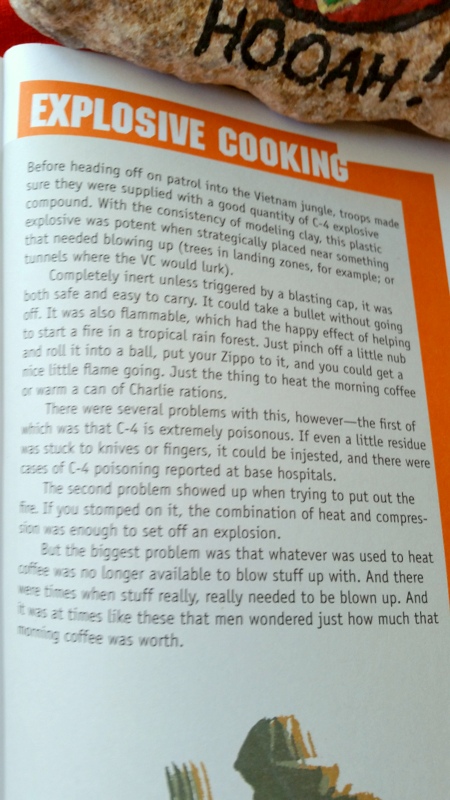
20151017_121905-1

This is a page from one of my cookbooks, “How To Feed An Army: Recipes and Lore from the Front Lines”, which offers stuff like this “recipe for disaster”. Not sure if this information is true, but it’s the type of information which feeds folk lores… The HOOAH! rock is real for sure – it’s my husband’s from Mojave Strike ’95 and served as a handy paperweight to hold the book open.

Thinking about the “facts”, from which Charles Krauthammer, forms his opinions and beliefs made me wonder about all this, because I believe that in 1998, when I posted messages on the Excite message boards, that I was cast as a right-wing extremist or threat of some sort.  I believe that  from those comments, my identity was investigated and they came upon a retired general who hates me – yes, he truly does.  He gave me such an angry glare at a brigade picnic after Desert Storm that I was literally frightened.  He went on to become a general.

A few years after Desert Storm I found out that “some letters from some wife” caused a big stink after Desert Storm and the person trying to ferret information out of me, the paid volunteer coordinator for this post, informed me that she was close friends with that general’s wife. After this conversation, I was treated like a pariah among the other “leaders’ wives” and I began to ponder the “letters” she mentioned. By this point, my husband was a sergeant major. I wrote letters to my husband’s company commander during Desert Storm, to inform him about what was happening with the wives, back in Germany. My husband was a first sergeant at this time. These were personal letters, snarky in the extreme, and never intended to become public. I believe the husband of the woman, mentioned as petitesouthernbelle in my Messages of mhere saga, submitted those letters with his after action reports – that would be my husband’s battalion commander.

When this volunteer coordinator began talking to me, I mentioned knowing petitesouthernbelle from Desert Storm and this woman informed me that she is good friends with the queenoftherock and that she heard petitesouthernbelle didn’t do much to help families during Desert Storm – which is a complete and total lie. So, this is how catty gossip makes and breaks reputations. I believe that during Desert Storm, as the queenoftherock informed me several times, that she informed her husband that I was not cooperating when I told her to go ahead and tell her husband, but I wasn’t doing what she said – things like relay bomb threat information via a wives phone roster…

Now, this whole thing about “moderate Syrians” vs Al Qaeda/ISIS nuts made me wonder how the CIA goes about determining that.  I know that no one asked me anything before I was attacked in my own home, on American soil.  Of course, my husband, who thinks that general’s stuff doesn’t stink, would never believe this highly-regarded commander would participate in some sleazy attack on a homemaker, but I believe he did.  I believe this is the truth.

Since 1999, I have been trying to prove this, because if I had not fought back and gotten lucky, I would not be free today, but instead would be locked up in a state mental institution.  My crime was making fun of thatwitch2016 and her sewer rats’ lame legal arguments.  And of course, I referred to her husband as BJ Clinton, in my usual snarky manner, so of course, that assuredly helped seal my fate as part of the “vast, right-wing conspiracy”. 

My goal is not that dish best served cold – revenge, but “justice”, because the powers of the Presidency and Army assets should not be used to attack American citizens over comments on a message board, especially when those comments were about following the rule of law, insisting that no one is above the law and arguing that lying under oath is unacceptable, no matter what the nature of the case. However, in a case on sexual harassment, one would expect questions of previous questionable sexual conduct to be reasonable.

I intend to seek the TRUTH, wherever it leads.

Leave a comment

Filed under Food for Thought, Messages of mhere, Military, Politics, Terrorism, The Constitution