Category Archives: Food for Thought

Looking for a Savior in all the wrong places

The above MSNBC interview features J.D. Vance, author of Hillbilly Elegy: A Memoir of a Family and Culture in Crisis, a book that is part, starkly honest portrayal of his life as a poor “white trash” hillbilly growing up in the Rust Belt today, and part social policy analysis. In the book, Vance mentions “learned helplessness” as a looming problem in the economically depressed town in the Rust Belt, where he grew up.  He chronicles, in a very personal way, the current plight of the families of those who were part of the Appalachian migration out of the Appalachian Mountain communities to northern industrial cities in the first half of the last century, often referred to as the Hillbilly Highway.

His story is meant to open discussions about government social policy, local community actions, but most of all, he is hoping that the American families in crisis, at the heart of the cultural crisis in America, take a hard look at themselves and begin the painful, difficult process of changing how their own families treat each other.

That change requires unlearning “helplessness”, but also learning to quit blaming big government, big business, big bankers, nefarious Mexicans and Chinese, Obama  and Muslims, and other mythical scapegoats.  Quit looking for a new big government program or an American strong man promising to make your life or your community better!   You are responsible for the choices you make, but if you have managed to get your life on track, the responsibility doesn’t end there.  You have to try to help guide your own families and communities, especially children at risk, to learning to be productive and American success stories too.

Vance writes honestly about his mother’s drug addiction and the impact it had on him and his sister, but it also affected his grandparents and extended family too.  One addict or alcoholic in a family can create endless chaos and upheaval, both emotional and financial.  These people are like ticking time bombs, ready to tear apart their family and themselves, over and over.   The news clip above offers a shocking glimpse into the opioid  epidemic in America today.

Change begins first in our own hearts and then within our families and communities.

In many posts I’ve highlighted Trump’s populist appeal, his skillfully latching onto patriotic themes, spanning the globe from Mexico to China for foreign scapegoats abroad, evil domestic “establishment” politicians at home and of course, The Left, as the cause of all the failures in American communities.  Many Americans see Trump as hearing their pain and expressing their anger, but I want to move away from Trump and this election, to delve into the state of way too many American families, like the one Vance grew-up in.
wp-1477107842006.jpg

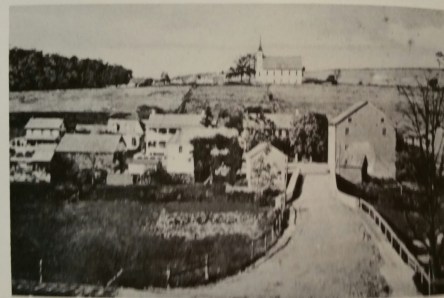
Above is an early photo of Kunkletown, PA, the village where I grew-up.  We lived on the outskirts of the village further off to the left side of where that photo ends.  Behind where the photographer was positioned, is part of the Blue Mountain range, which is the eastern edge of the Appalachian Mountain range.  The village had a few more buildings off to the left and right, when I was growing up, but not much more.  My family was a typical blue-collar, rural family in the Pocono Mountains in northeastern PA.  In the late 90s, my husband, kids and I had gone to visit my family and as my husband drove around winding roads in the mountains, one of my sons, who was around 11 or 12 at the time, said, “Mom, your family is kind of like northern rednecks.”  My first reaction was angry pride in my family, but when I thought about his words, I knew they were true.

I love my family, I am proud of my PA German heritage, and I am especially proud of my parents, who were very hard-workers, dedicated to family, drank alcohol only at social occasions and then sparingly, ran an organized home, lived frugally and within their means, did not tolerate drama in our home, instilled values in us, but most of all they lived their values through constant example.  Sure, my family had conflicts, problems, and many flaws, because no one has a “perfect” family, but I never doubted that my parents would care for us and do their very best to provide for us.  I never once doubted that they put caring for their family over their own wants and desires – they made sacrifices constantly to provide for us.

The things that bind strong families together go much deeper than blood, they are love and respect for each other, and building trust within the family.

My parents told all six of us, my three sisters and two brothers, that in America all things are possible if you work hard.  Coupled with that complete faith in the American Dream was faith in God, but also the constant reminders that we needed to help other people and that America isn’t just about “rights”.  My parents believed being an American imposed on all of us a “duty”  to be good citizens and good neighbors. This combined message of “civic duty” and the Christian message of being “good neighbors” is what built American communities.  That isn’t to say America can’t be inclusive and respectful of other religions, it’s a historical statement of how most rural communities and small town America were built.

The anger stewing among America’s poor is very real, but the scapegoating other groups, the latching onto federal government panaceas and the complete abdication of taking personal responsibility for ourselves, our families and our own communities, is destroying not only the American spirit, but also real American lives.

Vance survived a home in crisis, having a mother who had a drug addiction problem, run-ins with the criminal justice and social services systems, and whose lifestyle led to a revolving door of “father” figures moving in and out of his life.  He credits his loving, albeit dysfunctional in many ways, grandparents with saving him from ending up a high-school drop out.  He also credits the Marine Corps for instilling strong values that helped him become a stronger, more resilient person.  His story offers many insights as to what is really ailing America and it’s not just closing factories, corrupt Washington, or bad trade practices.

My husband survived a troubled childhood, eerily similar to, but, perhaps more stark than the one Vance recounts.  Interestingly enough, my husband’s alcoholic mother, grew up in West Virginia.  As Vance talked about his crazy grandmother’s rants and profanity-laced language, I kept thinking, “She talks just like my late mother-in-law.”

My goody-two shoes upbringing didn’t prepare me for my mother-in-law’s flowery language, where two of her favorite phrases were, ” Shit in your hat and pull it down over your ears.” and her version of “go to hell” was, “Up your giggy hole, bitch!”  I sat there dismayed and confused with many of her phrases, and after the first time she said that, when I was alone with my husband,  I asked him, “What on earth is a giggy hole?”  My mother considered “fart” a cuss word and we weren’t allowed to say that.  I tried to teach my children to say, “pass gas” and they told me even their teachers say “fart” and refused to believe me that “fart” is a vulgar word.

Besides all the “crazy” things and rough talking, Vance’s grandmother, instilled a belief in him that he could do anything and she also talked about her dream of becoming a lawyer when she was young.    My mother-in-law, besides the obvious problems that hit you in the face quickly, was a very smart woman and at some point in her life, she read a lot.  It always amazed me that she would rattle off the answers to Jeopardy questions on TV, before even the best contestants could open their mouths.  She would have choice words for the contestants who missed questions.  She also did the crossword puzzle in the newspaper every day, in very little time.  Occasionally, she would ponder out loud about a word she was struggling over, but invariably within a few minutes she’d have the answer.

I once asked my mother-in-law how she knew all this stuff and she gave me this confused look and said, “Everyone knows this!”  I didn’t know many of these things and I read constantly.  I’ve often wondered what my mother-in-law’s dreams were when she was young, before having 7 children, with only 2 having the same father, I believe.  My husband related that one sibling died young, so I am not sure about the paternity of that one.  My husband’s father left when he was 5 years old and he never saw him again.

Like the Marines helping Vance escape his troubled childhood, the Army provided my husband a way to escape his life, growing up poor in downtown Baltimore.  I suspect that my neck of the woods in PA was an anomaly in the 60s and 70s when I was growing up. It was the backward, west end of the county, where a small enclave of  PA Dutch people, most related to each other, were clinging to their rapidly evaporating community.  Drugs were prevalent when I was in high school in the 70s and the area has a lot of resorts and also an invasion of people from New York and New Jersey, who decided to move to the Poconos and commute to work in the city.

This urban invasion completely changed the culture in the area.  In high school, we were disparagingly called “farmers” by our rival high school team, from a more populated area of the county.  However, the dwindling family farm culture had been eroding for a large part of the last century.  Most of the people, to include my parents, commuted to other areas in PA to work, with few actually working on farms in my childhood.
wp-1477106414390.jpg

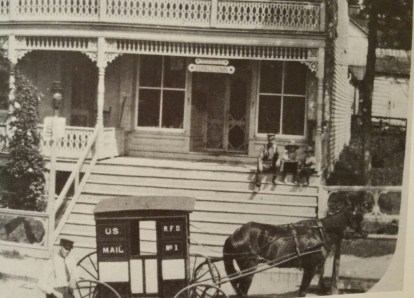
My paternal great-grandmother lamented selling their farm and moving to “town”, which was Kunkletown (a village with a church, a general store, a gas station, a post office,  and a few local businesses) and that was before my father was born in 1929.   The above photo is the post office in Kunkletown, PA, with my great-grandfather behind his horse and mail cart,  He  was one of two rural route mail carriers, when the rural routes were started in 1912.  See, not only John Kasich has a family member with claims to being a postman…   While compiling a history of Kunkletown during the American bicentennial in 1976, local historical sleuths found this record of my great-grandfather’s, January 1912 route stating he delivered 4 registered letters, 757 letters, 369 postal cards, 1802 newspapers, 538 circulars, and 442 packages.  He collected 4 registered letters, 640 letters, 206 postal cards, 2 newspapers, 10 packages and 36 money orders.  Guess reading newspapers was popular in the backwoods.  That post office was still the post office when I was growing up in the 60s and 70s.

The problems Vance relates experiencing growing up in the Rust Belt in Ohio, now are the same ones afflicting the poor white working class in the Poconos, in small towns, in rural America, but also in inner-city poor black communities too.

What is ailing America most is too many Americans started believing they are the downtrodden victims of a system stacked against them.   Much of the “learned helplessness” is the result of liberal government policies, academia and educational system indoctrination and Hollywood and media brainwashing.  Celebrities and flaky TV “experts”, televangelists and assorted “experts” exert more influence over many Americans’ lives than these Americans’ own families or local civic and religious leaders do.  Americans have bought into trusting the advice of total strangers over people in their own families or communities.  This “learned helplessness” belief rears itself in endless strings of lies, way too many people tell themselves and their families, about why their lives are an endless, downward trajectory of personal and financial train wrecks.

As one who has lived through some personal train wrecks and even spent years making excuses for some of my bad decisions, I’m not trying to judge other people who are struggling or acting like I have all the answers. All I can say is that in my life, at 56, one thing I’ve learned to do is to try to quit making excuses when I make mistakes, admit to them quickly, then try to fix them and avoid making the same ones in the future. Sometimes I succeed, sometimes I fail, but in the end, I blame myself for the outcome – not the “system is rigged or against me”.  Even when I have been treated “unfairly”, I keep working at forgiveness and not letting anger rule my life.  That forgiveness part is the hardest, but by focusing on looking for positive things, it helps me move past anger.

Vance penned an opinion piece in the New York Times, “The Bad Faith of the White Working Class,” June 25, 2016, where he writes about “paranoia replacing piety” in some Christian groups in America. He states, “A Christianity constantly looking for political answers to moral and spiritual problems gives believers an excuse to blame other people when they should be looking in the mirror.” Expanding on that thought, Vance writes:

“This paranoia harms the most vulnerable Christians the most of all. A few months ago I visited with a few teachers from my old high school and asked them how we might give kids in our community a better shot — at a good job, perhaps, or at least a peaceful family life. The mood grew somber. One told me that after a student, a bright young man from a “rough home,” stopped showing up to class, she drove to his house on a school day to check on him. She found him and his seven siblings home alone, her promising student too preoccupied with tending to his brothers and sisters to care much about school. A younger teacher, listening intently, sighed: “They want us to be shepherds to these kids, but so many of them are raised by wolves.”

In the white working class, there are far too many wolves: heroin, broken families, joblessness and, more often than we’d like to believe, abusive and neglectful parents. Confronted with those forces, we need, most of all, a faith that provides the things my faith gave to me: introspection, moral guidance and social support. Yet the most important institution in our lives, if it exists at all, encourages us to point a finger at faceless elites in Washington. It encourages us to further withdraw from our communities and country, even as we need to do the opposite.” (my highlight)

This post has run much longer than I intended, sorry about that.  In my next few posts I want to delve into the history of faith in America, where Gladius has so generously given me permission to pull whatever I want from a sermon he gave to his Baptist church this past 4th of July, to highlight the faith of our Founding Fathers.  Then I want to write a post about the things I learned about American culture working in Wal-Mart many years (leaving in 2015).

5 Comments

Filed under American Character, American History, Culture Wars, Food for Thought, General Interest, Politics

More Home Truths

G. Murphy Donovan penned a very thoughtful and thought-provoking essay, “Whence Wisdom?”, at the New English Review, prodded by a young man’s question at a dinner with friends:

“I had dinner the other day with a family that was about to launch their son towards college. As the evening drew to a close, their first born asked me if I had any words of wisdom about school to share as he left home for the first time.

Wisdom, thought I?  Now there’s an asset in short supply today, if not words, then surely the quality of wisdom. I believe I coughed up a few clichés, something about maturity being a journey “from me to thee.”

The written word is often the corrected and amended version of the spoken. A few days later, I sent the aspiring scholar what follows below, a personal appraisal of schools, education, and the pursuit of wisdom.”

Whence Wisdom? by G. Murphy Donovan

He ventured way beyond a few clichés, offering up some cold slab home truths, while cracking quite a few eggheads’ flighty theories and pieities.

Leave a comment

Filed under Culture Wars, Education, Food for Thought, General Interest

The “War about Words” (Part 1)

wp-1469293605061.jpg

“What exactly would using this label accomplish? What exactly would it change? Would it make ISIS less committed to trying to kill Americans? Would it bring in more allies? Is there a military strategy that is served by this? The answer is none of the above. Calling a threat by a different name does not make it go away. This is a political distraction.”

http://www.npr.org/sections/thetwo-way/2016/06/14/482041137/president-obama-slams-yapping-over-radical-islam-and-terrorism

Words matter.

Words give meaning to what we believe, think, hope, dream, in essence to who we are. Words matter a great deal in our interactions with others, but they matter infinitely more to political leaders, especially the one joined at the hip to his teleprompter.

I’m going to divide this post into two parts.  This first part is just a short , okay on rereading this, I admit it’a lonnng, rambling commentary on Leftists in America defining events, creating phrases to alter perception of events,  and editing out key information to alter official documentation of events, all to create a version of events that fits their political agenda.  The second part, well, I want to discuss some things I’ve been thinking about in regards to leaders trying to control what people think.

Years ago, I read a book, “The Words We Live By: The Creeds, Mottoes, And Pledges That Have Shaped America”, by Brian Burrell, that I had signed out at my local library.  A few years ago, I was thinking about that book and ordered it. Brian Burrell related how he began his journey into collecting and studying the history of “the words Americans live by” watching and then later helping his father collect the words and messages on public monuments, tombstones, on buildings, etc.   His father’s interest in these words spurred an interest and hobby in Burrell as a young boy, which he pursued into adulthood and ended up writing a book about these words.

wp-1469293684019.jpgwp-1469295951044.jpg

Above: A book my mother sent me when I was a young soldier in Germany in 1980.  She added a four-leaf clover that my father found, because he was an expert at finding four-leaf clovers.  As a child, when my brothers and sisters and I were crawling around on the ground in a clover patch searching for a four-leaf clover, my father stood there and within a few seconds he would lean down and find one.  He said, “You need to stand back and look at the entire patch.”  That is big picture/little picture;-)

I’ve been not only fascinated by words from my earliest memories, but intimidated by words.  I admire great orators and people with perfect elocution.  Being a life-long recovering stutterer, with bouts of sudden relapses, I stick to safe, easily pronounced words and avoid public-speaking at all costs, knowing the chances of turning into a blubbering mass of incoherent muck is very high.  As a child I spent time almost every day studying the dictionary.  I loved Eliza Doolittle in “My Fair Lady” and could relate to her joy at mastering, “The rain in Spain stays mainly in the plain.”   One of my sons returned from a trip to PA recently where he had visited my family and he came bearing gifts, among them was a cookbook compiled by my childhood church and another old dictionary, which one of my sisters felt sure I’d like.

Growing up, our elderly pastor’s wife, a lovely Jewish lady educated at Columbia’s Teachers College, devoted a great deal of time trying to instill in me an appreciation of opera, classical music, the arts and learning in general.   That a Jewish young lady  from New York City could fall in love and marry a backwoods Protestant pastor and settle happily into a PA Dutch rural community is one of those quintessential American stories.

wp-1469295413134.jpg

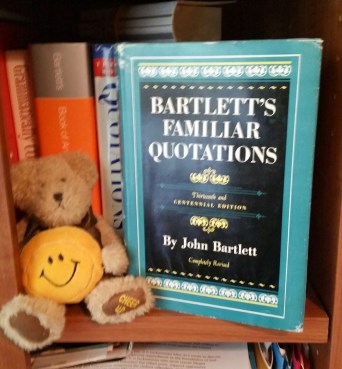
The parsonage was right across the road from my childhood home, making our pastor’s wife our next-door neighbor too. I felt like I had been blessed with another grandmother to have her as our neighbor growing up, with her treating my brothers and sisters as part of her family and her devotion to taking me under her wing, to teach and guide me.  She kept reminding me that I needed to always pursue a classical liberal education.  She let me borrow her copy of Bartlett’s Quotations many times and she often would hand me slips of paper where she had jotted down memorable quotes that she thought I would find interesting and like Burrell’s father and his notebook of American words, my pastor’s wife urged me to keep a notebook of quotes.  I still have that notebook and I still jot down quotes often.  I also listen carefully to the words political leaders use, but what you need to beware of always is the words they refuse to use and try to banish others from using.

Written words often stick in my mind for years and listening to President Obama and his entire administration explain their concerted purge of any mention of Islam and Jihad from the military and federal government terrorism training and the insertion of Muslim Brotherhood-affiliated “Islamic experts” into government positions to guide (control) the “narrative”, well, it’s obvious some words matter a great deal to President  Obama too.

This book on words that shaped America came to mind when I listened to President Obama and Hillary try to trivialize the importance of the words we use to describe the radical Islamic terrorists, who have declared jihad  on America.   Of course, President Obama, CAIR and many others, who refuse to use the phrase “radical Islamic terrorism”,  also rush to insist those engaged in committing murderous acts of terrorism against Americans, while proclaiming they are waging jihad, aren’t really Islamic.  They  say this, while, many revered Islamic scholars in the Muslim world praise these acts as totally in keeping with Islamic law.

Throughout the past seven years of the Obama administration, reports occur with alarming regularity about incidents of military training documents being purged of any references to Islamic terror, Christian evangelicals and former American soldiers being listed as likely potential “right-wing terrorists”,  an actual act of Islamic terrorism at a US military installation being dubbed “workplace violence”, official documents and videos being edited, more than 50 intelligence analysts in Iraq claiming higher ups are altering their reports to feed the Obama “narrative“, WH administration staffers engaged in rewriting their version of events into a “narrative” to fit their political agenda, and even the administration sending the national security adviser to the Sunday morning talk shows to cast an American soldier, who deserted his unit in Afghanistan, as an “American hero”.

President Obama’s angry scold, about which words we use to describe the latest act of radical Islamic terrorism on June 12, 2016, at the Pulse nightclub in Orlando,FL.,  matters a great deal, because a full-court effort has ensued, with many leftist publications, pundits and the White House determined to cast doubt on this being a “radical Islamic terrorist” attack.  When the DOJ tries to edit the 911 tapes, then rewrites the transcript, omitting  the terrorists’s pledge of allegiance to ISIS and a full-court effort plays out where a new “narrative” is advanced, to deceive the American public, it’s obvious some words matter a great deal to President Obama.

In two weeks time the media, in collusion with the Obama administration muddied the information about the Orlando shooting to the point that reading many left-wing pundits and publications, it seems like they hold Christian haters responsible for the Orlando shooting and not the radical Islamic terrorist.  The Obama administration could take a disgraced and dishonorable soldier, SGT Bergdahl, and with the full power of the commander-in-chief’s office, attempt to convince the American people this soldier served with “honor and distinction”.  The bold-faced lying and rewriting the “narrative” (the official record)  by the highest level of our government should alarm every American.

Years ago, many of us were dismayed by Obama’s “hope and change” and “fundamental transformation” hollow phrases gathering wings and lofting his rapt followers into flights of fancy and head-in-the-clouds euphoria.  Over seven years later, hearing President Obama dismiss which words are used to describe “radical Islamic terrorist” attacks in America, it  seemed not only disingenuous, but downright deliberately deceitful.  His relentless “War about Words” during his tenure as President really has led to a “fundamental transformation” of  America.  We now have Americans firmly entrenched into tiptoeing through an ever-changing minefield of words that are dangerous to use in public and words you must use to avoid public ostracism.  Washington DC initiated a new speech code for the workplace to show sensitivity to transgenders, with made-up words, like ze and zir that they insist workers use.  Facebooks has over 50 gender choices to choose from and old relics, like me, still live in a world where gender is based on human biology.  The insistence on specific new pronouns all workers in Washington DC should use, with the guide being for  Washington DC  employers to be the trainers and implementers of this new speech code, replete with examples of “best practices” to avoid offending transgender people offers an example of the brave, new world American leftists are imposing on  Americans.  The Leftist War about words blows hot across America.

Alas, many Republicans and conservatives aren’t immune from being easily conned by demagogues either.  “How could so many supposedly smart, independent-minded Americans fall for Obama’s hollow rhetoric?”, many Republicans and conservatives lamented, then along came Donald J. Trump selling the American Dream encapsulated in the hollow phrase, “Make America Great Again!” In even greater dismay, many Republicans and conservatives began to see fellow Republicans and conservatives fall under the spell of Trump’s reality-TV style demagoguery, presented in fast-talking, brash NY street tough antics.

Trying to explain this dichotomy of Americans who boldly proclaim their principles and independent-thinking, then become devoted followers of obvious con men and demagogues, I remembered  this book by Brian Burrell.  He relates DeTocqueville’s observations on Americans from 1831 and perhaps this American characteristic still gets passed on in our cultural DNA. DeTocqueville identified the American reliance on “experts”, that still persists today:

“On his visit to the United States, Tocqueville noticed that the Americans he encountered tended to exhibit two opposing tendencies: they did not want to be told what to do or think, and yet their collective will could easily be rallied behind certain carefully chosen words, to which he gave a name.  “In the United States, Tocqueville concluded, “the majority undertakes to supply a multitude of ready-made opinions for the use of the individuals who are thus relieved from having to form opinions of their own.””

pages 4-5, The Words We Live By: The Creeds, Mottoes, And Pledges That have Shaped America, by Brian Burrell

This word game charade goes much deeper than President Obama and it goes far deeper than just the debate over what to call the terrorists who scream, “Allah Akbar!

Today, the FBI questioned Hillary Clinton for 3.5 hours according to the news reports and here again is a politician who plays endless semantics games.  She’s married to the former President who turned parsing into a deluxe linguistics game of charades…… “that depends on what is, is”.  Hillary has been at pains to explain the FBI investigation as a benign “security review” today.  Here’s an ABC report on her campaign’s statement:

Hillary Clinton gave a “voluntary interview” to the FBI today regarding her email arrangements while she was secretary of state, her campaign says.

“Secretary Clinton gave a voluntary interview this morning about her email arrangements while she was Secretary,” spokesman Nick Merrill said. “She is pleased to have had the opportunity to assist the Department of Justice in bringing this review to a conclusion. Out of respect for the investigative process, she will not comment further on her interview.”

http://abcnews.go.com/Politics/hillary-clinton-voluntary-interview-fbi-emails-campaign/story?id=40301595

The political Left in America has been waging a war about words for decades. President Obama and Hillary Clinton didn’t invent this game, in fact, the strategy of people in power, to control what people do, think, write and say is part of the history of the world’s tyrants and it’s one that Americans took a stand against from the beginning of our republic.  Americans refuse to  bow to rulers and we refuse to allow the government to control our speech.  Whenever  people in power exert a great deal of effort into controlling which words, not only the government uses, but which words the media uses, which words students and teachers can and cannot utter, and even policing the words they deem as “hate speech”, beware!

Americans have been conditioned to believe they are so unique and safe from despotism, that they have no idea how quickly FREEDOM can be lost.

Americans need to be constantly vigilant about those in power creating their own version of history, as part two of this “War about words” will be about some of history’s lessons learned in the long record of those with power trying to control what other people not only do, but what they can say and think.

Finally, one of my favorite quotes is from the 1902 American novel, The Virginian by Owen Wister,  that I’ve loved for decades, because it speaks to so many American themes that are near and dear to my heart, the battle between good and evil, the matter of seeking justice, the American scorn for elites and social snobbery, the American spirit of rugged individualism, the belief in pulling yourself up by your own bootstraps and our eternal optimism and can-do spirit.  Plus, there’s a charming love story running through the novel too.  And of course, The Virginian became the stereotype for the American cowboy and I just adore American cowboys, past and present;-)  The quote goes to this warning about being careful what you let other people convince you to think and believe:

“When a man ain’t got no ideas of his own, he’d ought to be kind o’ careful who he borrow ’em from.”


6 Comments

Filed under American Character, American History, Culture Wars, Food for Thought, General Interest, Politics, Uncategorized

“American identity”

vintage-patriotic-american-flag-god-bless-america

Today is almost over, but I wanted to mention that today was Flag Day and I came across this passage from the Roger Kimball book, “The Fortunes of Permanence: Culture  and Anarchy in an Age of Amnesia”,  that eloquently expresses the hope for America:

Here individuals of all nations are melted into a new race of men, whose labours and posterity will one day cause great changes in the world. —J. H. St. John de Crèvecœur, Letters from an American Farmer, 1782

The one absolutely certain way of bringing this nation to ruin … would be to permit it to become a tangle of squabbling nationalities. —Theodore Roosevelt, Autobiography, 1913

A FEW YEARS AGO, on a trip to Maryland, I stopped at Baltimore Harbor with my wife and five-year-old son to see Fort McHenry, the site, in September 1814, of the Battle of Baltimore, a decisive episode in the War of 1812. It was a glorious spring day: the sky was an infinite azure punctuated by a flotilla of stately white clouds. Our first stop was a modern outbuilding adjacent to the eighteenth-century fort. We crowded into a small theater with about thirty fourth-graders and their teachers to watch a short film. Among other things, we learned about the origins of the war, about how the British took and burned Washington, about how at last a thousand U.S. troops under George Armistead at Fort McHenry successfully defended their bastion against the British naval onslaught, saving Baltimore and turning the tide of the war.

It was (as the Duke of Wellington said of Waterloo) “a damn nice thing— the nearest run thing you ever saw.” The British ships, anchored out of range of Armistead’s cannons, pounded the fort with mortar and Congreve rocket fire over the course of twenty-five hours. Sitting on a truce ship behind the British fleet was a young American lawyer and amateur poet named Francis Scott Key. He watched as the battle raged, dappling the night sky with noisy coruscations.

Sometime before sunrise, the bombardment suddenly stopped. Key was uncertain of the battle’s outcome until dawn broke and he saw the American flag fluttering boldly above Fort McHenry. (When he had taken command, Armistead asked for an extra large flag so that “the British would have no trouble seeing it from a distance.”) There would be no surrender. The Brits abandoned their plans to invade Baltimore. The war would soon be over. As soon as he caught sight of Old Glory, Francis Scott Key began scribbling what would become “The Star-Spangled Banner” on the back of a letter. He finished it in a hotel in Baltimore a day or two later. The poem was an instant hit and was soon set to “The Anacreontic Song,” an eighteenth-century English drinking tune. It became the official national anthem in 1931.

The film ended and strains of the song began floating out from the loudspeakers— softly at first, then louder and louder. Everyone in the room scrambled to his feet.

O say, does that star-spangled banner yet wave
O’er the land of the free and the home of the brave?

The schoolchildren stood reverently, each with his right hand over his heart. A floor-length curtain wheeled back, flooding the room with light. There was Fort McHenry. And there, rising above it, was the American flag, waving gently in the breeze. With the possible exception of our son, who was busy attacking The Enemy with his toy F14, there wasn’t a dry eye in the house.

Of course, that calculated piece of theater was in part an exercise in sentimentality. Is that a bad thing? Wallace Stevens may have been right that, in general, “sentimentality is a failure of feeling”— a sign of counterfeit emotion rather than the real thing. Nevertheless, there is a place for a bit of affirmative sentimentality in the moral economy of our society. Among other things, it provides emotional glue for our shared identity as Americans. These days, perhaps more than ever before, that identity needs glue. As we contemplate the prospects for America and its institutions in the twenty-first century, it is not only particular cultural and social institutions that deserve scrutiny. What we might call the institution of American identity— of who we are as a people— also requires our attention.

Kimball, Roger (2012-07-04). The Fortunes of Permanence: Culture and Anarchy in an Age of Amnesia (Kindle Locations 754-793). St. Augustine’s Press. Kindle Edition.

Leave a comment

Filed under American Character, American History, Food for Thought, General Interest

A wider view

Leave a comment

Filed under Food for Thought, General Interest

A day to remember

2 Comments

Filed under American Character, American History, Food for Thought, General Interest, Military

Freedom isn’t free

Memorial Day image

Leave a comment

May 30, 2016 · 9:16 am

The American Spirit


Here are a few more links about that “American spirit”:

“My Bondage and My Freedom” – one of the finest autobiographies in American history, as Frederick Douglass describes his journey from slave to a free man in America

Looking Back at Lewis and Clark – an essay by David M. Lenard, published at The American Thinker, September 2, 2012

The Journals of the Lewis and Clark Expedition -By the University of Nebraska, where the intro states, “This website makes available the text of the celebrated Nebraska edition of the Lewis and Clark journals, edited by Gary E. Moulton. Moulton’s edition — the most accurate and inclusive edition ever published — is one of the major scholarly achievements of the late twentieth century.”

Survival: The Mind-set – a LB post from December 26, 2012

Self-help projects: an American tradition – a LB post I wrote January 3, 2016

To mark my first year of U.S. citizenship, I read Alexis de Tocqueville’s “Democracy in America.” Turns out, it explains everything” – a Washington Post article by Carlos Lozada, December 20, 2015

Democracy in America – Alexis deTocqueville, classic on what being American is all about, the Lozada article above contain a link to amazon.com to purchase a copy, but save yourself the money, because you can find Vol 1 and Vol 2 free at gutenberg.org.  Here’s another pointer, as a frequent amazon.com shopper, scroll through the entire listing for old books – often a free version is way down the list;-)

2 Comments

Filed under American Character, American History, Culture Wars, Food for Thought, General Interest

Hitch America’s wagon to a star again

“Hitch your wagon to a star”   – Emerson

I’m backkk, lol. Lately, I’ve been spending a good bit of time reading the articles at National Review Online as The Trump Divide within the GOP deepens and hardens. So many of the writers there keep making the compelling case for why Donald Trump should NEVER be the GOP candidate, but along with those arguments, some of their writers went beyond that to highlight what America is and isn’t.

Kevin Williamson penned an excellent piece today, “What John Adams Knew,” highlighting that America is a republic, not a democracy:

“John Adams hated democracy and he feared what was known in the language of the time as “passion.” Adams’s famous assessment: “I do not say that democracy has been more pernicious on the whole, and in the long run, than monarchy or aristocracy. Democracy has never been and never can be so durable as aristocracy or monarchy; but while it lasts, it is more bloody than either.” Democracy, he wrote, “never lasts long. It soon wastes, exhausts, and murders itself. There never was a democracy yet that did not commit suicide. It is in vain to say that democracy is less vain, less proud, less selfish, less ambitious, or less avaricious than aristocracy or monarchy. It is not true, in fact, and nowhere appears in history. Those passions are the same in all men, under all forms of simple government, and when unchecked, produce the same effects of fraud, violence, and cruelty.”

Read more at: http://www.nationalreview.com/article/432941/donald-trump-populist-demagogue-john-adams-anticipated

Regular LB readers will be familiar with my republic vs. democracy concern too, which I expressed in  a January blog  post, “On America’s side”:

  “A couple weeks ago my 10 year old granddaughter, a very bright student enrolled in the gifted program at her public school, mentioned something she learned at school, which I told her is not correct and what she learned really plays into the problems plaguing America and it also speaks to our future.  My granddaughter said, “America is a democracy.”  Reflexively, I corrected her and said, “No, America is a republic!”  Thus began a stream of back and forth, because as of yesterday she told me that her teacher still says, “America is a democracy.”  I told her again that her teacher is mistaken, because assuredly, America is a republic, set up as a constitutional federal republic.   However, watching the demise of federalism and the reliance on pop culture and public opinion polls to silence dissenting opinion, I’m wondering if America has descended into that hellish, brutish state where on the whims of ginning up anger and use of slick mass media manipulation (propaganda) to sway the mob,  the only thing that matters is the “majority rules”.”

Kevin D. Williamson has been joined in expanding on what “America” is, with an excellent post by Ian Tuttle, “Go-Getters, Gone?”  Tuttle showcases the American spirit through the words of a pioneer woman, Lodisa Frizzell, making the journey from Illinois to California in 1852:

“That this journey is tiresome, no one will doubt, that it is perilous, the deaths of many testify, and the heart has a thousand missgivings, & the mind is tortured with anxiety, & often as I passed the fresh made graves, I have glanced at the side boards of the waggon, not knowing how soon it might serve as a coffin for some one of us.”

Mr. Tuttle’s piece carries a Marco Rubio quote that really deserves wide-reading, because “Little Marco,” as the vile Donald Trump (you know the vulgar jerk, whom Rudy Giuliani last night on Hannity described  as “gentlemanly), explained this American spirit so eloquently, that I apologize for using so much of Mr. Tuttle’s article here, but I’m still going to post Marco Rubio’s words and at the same time urge you to go to NRO and read Tuttle’s wonderful piece:

“We are a hopeful people, and we have every right to be hopeful. For we in this nation are the descendants of go-getters. In our veins runs the blood of people who gave it all up so we would have the chances they never did. We are all the descendants of someone who made our future the purpose of their lives. We are the descendants of pilgrims. We are the descendants of settlers. We are the descendants of men and women that headed westward in the Great Plains not knowing what awaited them. We are the descendants of slaves who overcame that horrible institution to stake their claim in the American Dream. We are the descendants of immigrants and exiles who knew and believed that they were destined for more, and that there was only one place on earth where that was possible.”

Read more at: http://www.nationalreview.com/article/432928/americas-pioneer-spirit-dead-gone

Amen, Mr. Tuttle and thank-you Senator Marco Rubio for once again trying to hitch America’s wagon to a star.


Leave a comment

Filed under American Character, American History, Culture Wars, Food for Thought, General Interest, Politics

For the girls, mostly

The cathedral theme in my previous post brought to mind this video I saw circulating on facebook recently.  Warning to men, agnostics, atheists and even those who hate schmaltzy stuff,  this is a female-empowerment, feel-good message with a strong religious message tossed in too:


1 Comment

Filed under Food for Thought, General Interest