“My first full year as a citizen of the United States was also the year Donald Trump made nativism a viable political project. It was the year college activists battled racism with their own peculiar intolerance. It was the year Rachel Dolezal was redefined, Atticus Finch rewritten, Caitlyn Jenner revealed. It was the year police shootings became viral, mass shootings became daily and same-sex marriage became law. It was a year America did little else, it seemed, than fight over values, identity, premises.
It’s exhausting, being American. Seriously, do you folks do this every year?
I’m not a recent arrival. I graduated from college here, got married here, built a family here. But only with citizenship did I grasp the distance I’d always kept. I left my native Peru behind 27 years ago, but whenever this country seemed too painful or complicated, I’d shake my head sagely. Estos gringos locos. Except now everything about the place — its virtues and excesses, its history and future — is all mine, too. For the first time, I feel the glorious burden of being American.
To carry it, I’ve realized I need help. Sure, I passed the citizenship test, even practicing the list of 100 questions with my kids. (They’ll ace elementary school civics now.) But for the advanced coursework, my instinct was to turn to a book. What could I read that would guide me through the chaos that is democracy in America?
Fortunately, there’s this little book called “Democracy in America” — written 175 years ago by, of all people, some know-it-all foreigner.”
This 2005 piece in The Smithsonian by Charles C. Mann offers a fascinating look at the Native American and European relationship at the time of the Pilgrims’ arrival. (H/T to the Fabius Maximus blog, where I came across this link)
Oddly enough a history written by John Marshall of George Washington began with volume 1 of the 5 volume set devoted to the European experience in America, does exactly what Mann’s rich tapestry approach does – it offers a complicated and complex history in rich, vivid colors rather than bland, oversimplified loose threads offered in school textbooks, unconnected to any picture at all. When you start to see the threads woven together, all of sudden history comes alive as a fascinating magic carpet ride.
Stephen Moore at National Review reminds us of what Americans have to be thankful for, invoking President Ronald Reagan’s farewell speech:
“We’ve got to do a better job of getting across that America is freedom — freedom of speech, freedom of religion, freedom of enterprise. And freedom is special and rare. It’s fragile; it needs protection. So, we’ve got to teach history based not on what’s in fashion but what’s important — why the Pilgrims came here, who Jimmy Doolittle was, and what those 30 seconds over Tokyo meant. You know, four years ago on the 40th anniversary of D-Day, I read a letter from a young woman writing to her late father, who’d fought on Omaha Beach. Her name was Lisa Zanatta Henn, and she said, “We will always remember, we will never forget what the boys of Normandy did.” Well, let’s help her keep her word.
If we forget what we did, we won’t know who we are. I’m warning of an eradication of the American memory that could result, ultimately, in an erosion of the American spirit. Let’s start with some basics: more attention to American history and a greater emphasis on civic ritual.
And let me offer lesson number one about America: All great change in America begins at the dinner table. So, tomorrow night in the kitchen, I hope the talking begins. And children, if your parents haven’t been teaching you what it means to be an American, let ’em know and nail ’em on it. That would be a very American thing to do.”
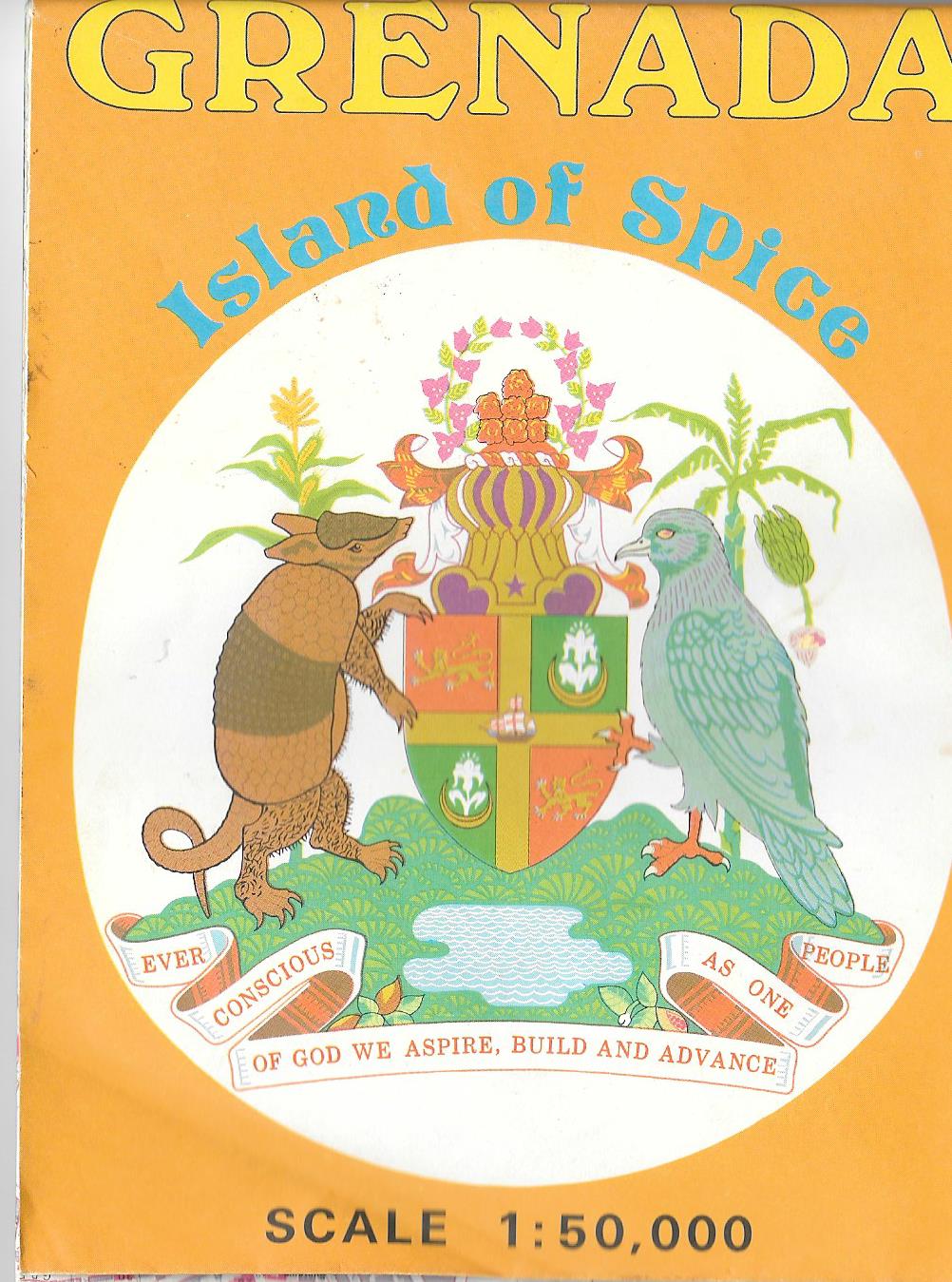
In comments on my previous post I mentioned this Grenada tourist map, which my husband acquired in 1983, when he deployed to Grenada. He and his friends found this map description of the population, “120,000 warm and friendly people.”, hysterically funny – as they were being shot at:
All of this yammering about “Syrian moderates” brought this map to mind. Sorry for the small text to the right of the map cover – technical difficulties as usual, but at least I am managing to get some photos and stuff uploaded these days – a slow, difficult slog for me, I assure you!
Robert Tracinski at The Federalist penned a very good read: “Donald Trump vs. James Madison”. He delves into the faction issue and states:
“Politically speaking, the conservative “base” is a minority faction. Our views—and I certainly include myself among the most radical small-government advocates—are shared by somewhere between 10% and 40% of the public, depending on the issue. But a lot of the base is bitter that we haven’t been able to dictate policy as if we command upwards of 60% of the vote.
Their beef isn’t with the Republican Party, it’s with the whole American system of government. Their enemy isn’t Mitch McConnell. It’s James Madison. If you’re the sort of person who uses “cuckservative” as an epithet for anyone who settles for less than what you imagine the right kind of strongman could deliver, then I’ve found your ultimate nemesis. James Madison is the original “cuckservative.”
The Father of the Constitution wrote the rulebook for the American political system, and he specifically wrote the rulebook for what’s supposed to happen to political factions. He explained this in The Federalist No. 10. Everyone should read this essay and thoroughly understand it, and almost no one does. But you can’t understand politics and can’t do politics until you do.”
Tracinski points to The Federalist No.10, so let me add the title of No.10 -“The Same Subject Continued: The Union as a Safeguard Against Domestic Faction and Insurrection”. I mentioned in a recent post that there is no excuse for failing to understand the basics of our own governmental structure. If you’re online, you can access fathoms deep sources of history, literature, science – all for free. Hillsdale College put together a series of short lectures on The Federalist Papers earlier this year. You just sign-up and watch them at your leisure.:
“My son,” said the Norman Baron, “I am dying, and you will be heir
To all the broad acres in England that William gave me for my share
When we conquered the Saxon at Hastings, and a nice little handful it is.
But before you go over to rule it I want you to understand this:
“The Saxon is not like us Normans. His manners are not so polite.
But he never means anything serious till he talks about justice and right.
When he stands like an ox in the furrow with his sullen set eyes on your own,
And grumbles, ‘This isn’t fair dealing,’ my son, leave the Saxon alone.”
—RUDYARD KIPLING, 1911
Hannan, Daniel (2013-11-19). Inventing Freedom: How the English-Speaking Peoples Made the Modern World (p. 91). HarperCollins. Kindle Edition.
Coming from a blue-collar background, I do understand the rise of populist icons, like Sarah Palin and Donald Trump, among working class Americans, who aren’t going to assiduously study issues, read history or pay any attention to renowned pundits like George Will, with his use of words most of these people have never even heard, let alone know their meaning. These are the people I grew up around and as one of my sons, as a precocious12 year-old informed me, many years ago while on a visit to the backwoods of PA, “Mom, your family is kind of like Northern rednecks.” There you have your explanation for the rise of Donald Trump and Sarah Palin before him.
In my many years online, I have been banned two times from posting comments on two blogs, The American Thinker and The Last Refuge Blog, one years ago and one just recently. After my experiences posting on the Excite message boards way back during the Clinton impeachment, these days I don’t venture to other sites very often to post comments, preferring to stay here at my own backwoods blog, to ramble to my heart’s content. The past few days, I spent some time at National Review posting under my long-time user name, mhere (my little inside joke on the Russian word for peace) and at The American Thinker under the name, susanholly. I was observing the comments from the devoted Trump supporters and thinking about the Trump supporters’ views.
This Trump phenomenon hearkened back to the Sarah Palin flirtation with a 2012 run for President and that is where I got banned from The American Thinker, for commenting on Sarah Palin wallowing (and making big money) in the reality TV trash culture, while bashing the decline in American culture. I hadn’t written any cuss words or called any other posters names, just expressed my opinion, that she is a populist, self-promoter more than she is a staunch conservative standard-bearer.
Often Palin lands on the right side of conservative issues, but she can’t offer more than trite slogans and appeals to emotion to support her views. Her supporters adore her and any venue where she ends up looking stupid, gets turned on the reporter asking the question, like Katie Couric asking Palin what newspapers and periodicals she reads to stay informed, in that famous interview before the 2008 election. Palin couldn’t even list any and to this day she insists that was a gotcha question, when in fact it’s a fair and very pertinent question. Instead of learning from that failure, Palin doubled down on her attacks against the “lamestream” media and her supporters do the same. Charles Krauthammer fell prey to vicious attacks from Palin supporters for his comments in a Dec 2010 appearance on Bill O’Reilly (at minute 2:50), for suggesting that Palin should have spent the past two years acquiring policy expertise. Krauthammer committed the ultimate sacrilege for insisting the Couric interview questions during the 2008 election were not gotcha questions :
Daniel Hannan, in his book, Inventing Freedom: How the English-Speaking Peoples Made the Modern World explains this gap between the elites and ordinary people perfectly:
On July 3, 1940, Admiral Sir James Somerville issued the saddest order of his career. France had been occupied by the Nazis and was required under the armistice terms to transfer its Mediterranean fleet to German command. The British couldn’t allow such a development: Italy had entered the war on Hitler’s side, and control of the Mediterranean was at stake.
Winston Churchill ordered a larger British force to confront the French fleet off the Algerian naval base of Oran. The French admiral, Marcel-Bruno Gensoul, was given three options: to take his ships to British waters and carry on the struggle; to remove them from the theater of operations and keep them in the West Indies for the duration of the war; or to scuttle them.
All three options were turned down and, as the sultry day wore on, a final ultimatum was issued and rejected. At last, Admiral Somerville ordered his ships to shell the French fleet, the only occasion the British and French navies have exchanged hostile fire since Trafalgar. For ten minutes, great geysers of water shot into the sky, soon joined by black smoke from the battleship Bretagne, which was badly hit. No fewer than 1,297 Frenchmen were killed and 351 injured, by far the worst naval losses suffered by France during the war. There were no British casualties.
Somerville was sickened by what he later called “the most unnatural and painful decision” of his life. He passed a grim and silent evening in the mess, where many of his officers had tears in their eyes. But he couldn’t help noticing that, on the lower decks, a very different attitude prevailed, most sailors cheerfully declaring that they “never ’ad no use for them French bastards.”
It was an extreme illustration of an age-old social divide. The English (and later British) upper classes tended to be Francophone and Francophile. Yet theirs was a minority tendency, one that opened them down the centuries to accusations of being effete and unpatriotic.
That class division can be traced right back to the Norman Conquest, which placed England under a French-speaking aristocracy. It was to be more than three centuries before English again became the language of Parliament, the law courts, the monarchy, and the episcopacy. Certain parliamentary procedures are still, a millennium after the Conquest, conducted in Norman-French. The Queen’s approval of legislative bills, for example, is announced with the phrase “La Reine le veult.”
The native English, disinherited and resentful, projected their resentment onto French-speakers in general. The popular stereotype of the Frenchman closely resembled the radicals’ stereotype of the aristocrat: mincing, epicene, sly.
Even today, most Britons suspect (with good reason) that their elites are more Europhile in general, and more Francophile in particular, than the country at large. By “Europhile,” they don’t simply mean readier to accept EU jurisdiction, though that belief is demonstrably accurate. “Europhile” has wider connotations: of snobbery, of contempt for majority opinion, of the smugness of a remote political caste.
The extraordinary thing is that we can find no period in the past nine hundred years when such a sense was absent. The linkage between French manners and upper-class decadence has been made in England (then Britain, then the Anglosphere as a whole) by every generation.
Hannan, Daniel (2013-11-19). Inventing Freedom: How the English-Speaking Peoples Made the Modern World (pp. 92-93). HarperCollins. Kindle Edition.
In the day, weren’t Old Hickory and the Jacksonians “mad as hell?” Jacksonian Democracy was fueled by a righteous indignation — as is today’s liberty rebellion.
When we consider the struggle for freedom (and it’s been ongoing since the Revolution), we need to consider how past movements are amalgamated, synthesized. Today’s liberty rebellion resembles the Jacksonian but has many fathers. Expressions for liberty change, somewhat, to fit the times, but the core principles remain. Liberty is still man’s natural state. Humanity’s direction (as epitomized in the American experience) struggles toward achieving this birthright. It’s nearly instinct.
Though the focus is on Trump, some conservatives — and more Republicans — are unsettled by the liberty rebellion. It’s too Jacksonian in profile for whiggish conservatives — it’s raw, coarse, and full of the frontier; it discounts government more than they’d care. They are the George Wills of the world.
By the 1820s, these tensions fed into a many-sided crisis of political faith. To the frustration of both self-made men and plebeians, certain eighteenth-century elitist republican assumptions remained strong, especially in the seaboard states, mandating that government be left to a natural aristocracy of virtuous, propertied gentlemen. Simultaneously, some of the looming shapes of nineteenth-century capitalism—chartered corporations, commercial banks, and other private institutions—presaged the consolidation of a new kind of moneyed aristocracy. And increasingly after the War of 1812, government policy seemed to combine the worst of both old and new, favoring the kinds of centralized, broad constructionist, top-down forms of economic development that many thought would aid men of established means while deepening inequalities among whites. Numerous events during and after the misnamed Era of Good Feelings—among them the neo-Federalist rulings of John Marshall’s Supreme Court, the devastating effects of the panic of 1819, the launching of John Quincy Adams’s and Henry Clay’s American System—confirmed a growing impression that power was steadily flowing into the hands of a small, self-confident minority.
Daniel Hannan and J. Robert Smith clearly lay out this common man vs the moneyed elite sentiment, which transcends centuries in American society as surely as in British society. At the turn of the 20th century novelist Owen Wister, dedicated his popular novel, “The Virginian”, to his close friend, President Theodore Roosevelt. “The Virginian” introduced America to the iconic cowboy, bold, brave, unfettered by Eastern elite snobbery. This is one of my favorite American novels and I often cite a quote from it too: “When a man ain’t got no ideas of his own, he’d ought to be kind of o’ careful who he borrows ’em from.” Wister perfectly describes the class gap between the self-made Western cowboy as he prepares to go East to meet the family of his new bride, a New England schoolmarm from a blue-blood family:
“Why, I have been noticing. I used to despise an Eastern man because his clothes were not Western. I was very young then, or maybe not so very young, as very–as what you saw I was when you first came to Bear Creek. A Western man is a good thing. And he generally knows that. But he has a heap to learn. And he generally don’t know that. So I took to watching the Judge’s Eastern visitors. There was that Mr. Ogden especially, from New Yawk–the gentleman that was there the time when I had to sit up all night with the missionary, yu’ know. His clothes pleased me best of all. Fit him so well, and nothing flash. I got my ideas, and when I knew I was going to marry you, I sent my measure East–and I and the tailor are old enemies now.”
Bennington probably was disappointed. To see get out of the train merely a tall man with a usual straw hat, and Scotch homespun suit of a rather better cut than most in Bennington–this was dull. And his conversation–when he indulged in any–seemed fit to come inside the house.
Mrs. Flynt took her revenge by sowing broadcast her thankfulness that poor Sam Bannett had been Molly’s rejected suitor. He had done so much better for himself. Sam had married a rich Miss Van Scootzer, of the second families of Troy; and with their combined riches this happy couple still inhabit the most expensive residence in Hoosic Falls.
But most of Bennington soon began to say that Molly s cow-boy could be invited anywhere and hold his own. The time came when they ceased to speak of him as a cow-boy, and declared that she had shown remarkable sense. But this was not quite yet.
Donald Trump, part and parcel, a creature of that wealthy, elite class that his supporters loathe, has managed to transcend his personal history and take on an outsider personna, carefully-crafted to tap into this populist sentiment of his supporters, many who like Palin, rail against the Washington elites, big-money interests, mainstream media and most especially those they deem RINOs. I was called a pinkie wagger a couple times yesterday while commenting, for holding a different view of Trump. Most of these people will not be swayed by smart punditry, as Kevin D. Williamson and Jonah Goldberg are finding out, nor will they bother with George Will or Charles Krauthammer, because what is happening is they are closing ranks and it is very much a class struggle. The more information you provide to show Trump flip-flopped or discredit his vague policy ideas, the more they will hunker down, fuming about “pinkie-waggers” and elitists. In fact, here’s Sarah Palin’s interview, commiserating still over those unfair media gotcha questions, with Trump. He, being asked what his favorite Bible verse is, fits her definition of a gotcha question… Truly, he said his favorite book after the Bible was his own book, “The Art of the Deal”, so asking him what his favorite Bible verse was an attempt at a gotcha question???. You can watch the entire Palin interview of Trump, replete with their mutual adoration society, but very slim on policy or insights on anything more than how they understand how ordinary people feel: Video here.
Partisan political ideology aside, America remains torn apart by factions and this Trump phenomenon must be forcefully exposed as just that – a populist movement centered on a personality more than firm American founding principles. They may rally under “freedom and liberty” slogans, but there is no firm principled core to the Trump campaign, because his campaign centers on emotion and ginning up a mob tactics. In every other breath he spouts his polls numbers as vindication that he is right. Poll numbers don’t make you right. He should hone his arguments in well-thought out, clear sentences.
America needs to hold all of its presidential candidates’ feet to the fire. Expecting intelligent, well-reasoned arguments and explanations for their policies and ideas, should be the standard we demand. We need leaders who read extensively, who will study issues carefully and at the heart, being President is the highest political office in the land, so demanding a president who has mastered government policy issues is a must. Expecting that all of our elected officials, both in Congress and the President possess an in-depth understanding of The Constitution, a breadth of knowledge on US history and a strong foundation on foreign policy issues should be our minimum expectation.
Education is free in America! Accept no excuses! I possess no college degree, but I devoted my life to reading as much as I can in my spare time. I have signed out books from Army post libraries, public libraries, purchased many books and even borrowed books from friends. The ability to access information and learn is limitless in our internet age. Assuredly, there are gaps in my education, as my blog will surely affirm, but if someone points out something they think I need to read or points out an issue where what I have written is totally misguided or ill-informed, I don’t get angry. I get reading and try to learn more. We must all start demanding excellence, not only from our leaders, but from ourselves as well. America should be admired for it’s educated citizens, not considered as the home of ignorant, loudmouth, vulgar slobs!
Trump is a smart man, who has been fabulously successful. He can afford the best speech coaches, writers and political advisers. Showing up for a debate unprepared is not to be cheered, it’s a show of arrogance and self-conceit. Ronald Reagan wrote his speeches out on index cards. A poster yesterday told me I was supposed to infer what Trump was saying in his ramblings . Absolutely, dead wrong!!! The President represents all of us to the entire world and he/she must be a person with clear ideas, excellent public-speaking ability and our American message must reverberate, clear, concise and leave no doubts! Perhaps, Trump will devote the energy to study policy and perfect presenting his vision for America, and prove that he is the best candidate to represent all of us. And that’s the key, the President of the United States is not just the President of his partisan followers; he is the President of ALL Americans.
To put America on the right track, every American should read President George Washington’s Farewell Address and understand that railing about partisan political views is fine, but to “make America great again” we need to unite as one nation, bond by common values, and that remains the challenge none of the Presidential candidates has spoken to. Factions will destroy our Republic and President Washington warned that it is the “duty of a wise people to discourage and restrain it.”
FOX News moved to hypothetical situation to drill down on Trump’s illegal immigration plan this week. Bill O’Reilly asked Donald Trump about a hypothetical illegal immigrant couple with two children who are American citizens and whether Trump would deport them (at minute 7:34 in this YouTube video). Trump insists he will deport them and then bring them back in an expedited fashion.
Megyn Kelly hit Ted Cruz with this same kind of question and he didn’t answer it, but instead laid out a rather comprehensive list of measures to take to secure the border and deal with illegal immigration.
Trump’s fans will cheer that he stayed tough on illegal immigration, but the truth is Trump does not seem to know anything about The Constitution and frankly every American should have learned this in junior high civics class. Trump has NO authority to deport American citizens! NONE! And even if he thinks he can get the 14th Amendment repealed or Congress to write a new law, the FACT is every anchor baby currently in the US is now, and forevermore, will remain a US citizen. A fundamental founding principle in The Constitution is we will not have any ex post facto laws. Cruz, being a brilliant constitutional scholar knows this, but Trump and his angry followers don’t really care about The Constitution, it seems – only on and on spewing about Mexicans and other foreigners.
To make America great again, I suggest, every Trump supporter start learning about America’s founding principles. We are a Republic, not a banana republic.
Even though I like to think of myself as not a rush to judgment type of person and a recurring theme in my posts has been, “Get to know people, not about people”, which almost always comes from sources other than the people in question.”, this past week I read General Stanley McChrystal’s new book, “Team of Teams: New Rules of Engagement for a Complex World”, beginning with some negative preconceived notions about General McChyrstal. The Rolling Stones article, “The Runaway General” years ago left me with a vastly different impression of him as a leader than I hold now after reading his truly fascinating and brilliant book. He’s well on his way to winning my heart and mind and that’s no exaggeration!
I began reading his new book, expecting the usual, boring leadership prescriptions and a whole lot of detailed daring war stories to stir patriotic fervor, but instead General McChrystal offers some of the most brilliant, innovative, bold, and I might even say, radical, ideas ever put forth by an American general. Every chapter left me rethinking some of my cherished beliefs and considering new ways of approaching old problems. This book puts me in mind of sitting down and pondering Malcolm Gladwell’s books, where even if you don’t accept all of his conclusions, just exploring his fascinating ideas, forcing you to look at things differently, leaves you better off than when you started.
So far on amazon.com the book has a 5 star rating and I’d give it 6 stars if I could. In fact, I liked it so much, that I’m going to order his previous book, “My Share of the Task: A Memoir”, which I skipped over last year, because of opinions I formed from news reporting years ago.
“A Nation Greater than We Deserve” by David French
“To say that we can’t repay our debt to these warriors is not to say that we shouldn’t be good stewards of the fruits of their sacrifice. Indeed, the knowledge that all of our lives and opportunities are to some degree blood-bought should sanctify them for even our most secular citizens. Honor sacrifice by tending to the tree of liberty, by building something in your own turn that is worth defending.”


 libertybelle diaries