Category Archives: American History

“Domestic Propagandists”


wp-1482153142675.jpg

Decided to make another one of these quilt design plastic canvas tissue box covers for my friend.  This design is called Arrowhead… a perfectly named American pattern.

wp-1482154530964.jpg

This pattern leaflet has 8 different quilt designs.

wp-1481647930697.jpg

This pattern is called Log Cabin, another perfectly named American quilt pattern.

Quilting had been done all around the world, but industrious and frugal early American women turned quilting into a distinctive American needle art form. These early Americans carefully saved small fabric scraps from old clothing and blankets, which they pieced together into blocks.  They arranged the blocks into a quilt and often used solid color strips, called “sashing,” between the blocks,  “to frame” them.  Slave women quilted too and studying the history of African-American quilting is a neglected area of quilt history, that has gained attention in recent years.

wp-1482154602308.jpg

On the left, in the background of my tissue box cover photo, in my row of books, next to my book about Samuel Adams, there’s a gap.  Sorry the previous sentence sounds like a “in the library, next to the desk” clue leading you to the murder weapon, in a “Whodunit” mystery, but I assure you, it led to a book about an important American patriot in our nation’s fight for Independence: Thomas Paine.

After President Obama mentioned “Domestic Propagandists”, in tones that sounded like he was referring to “Domestic Terrorists” over the weekend, well, I pulled out my book, “46 Pages: Thomas Paine, Common Sense, and the Turning Point to Independence” by Scott Liell.  I had purchased this book a few years ago and hadn’t read it yet, but I started reading it last night… in between stitching this tissue box cover and tweeting.  I’m quite the multi-tasker these days, lol.

“Domestic Propagandists” indeed, LOL.  All I can say to that is, “Yankee Doodle Dandy!”

Have a nice day and maybe after today the Queen Hillary coup attempt to overthrow The Constitution will be over.

Leave a comment

Filed under American History, General Interest

Mixed potpourri

wp-1477628355558.jpg
A dollar of cheer – yep, a decorative box from the Dollar Store to hold junk on my desk.

There’s still more of Buddy’s 4th of July sermon I want to incorporate into another blog post, but first I need to do some more research, reading and pondering.  I spend a lot of time “pondering”.   While I ponder that, here are some thoughts from this election.  This post is a mixed potpourri of thoughts – no cohesive theme.

The media, popular blogs and news sites are even more tiresome than the candidates, for instance, Drudge is running the same agitprop game for Trump against Hillary, that he ran against the GOP candidates in the primary.  It’s amazing to behold.  In a change from Drudge’s onslaught of posting photos of Hillary looking demented or decrepit, today he had a collage of Hillary the guzzler/alcoholic-themed photos.

The mainstream media keeps running non-stop “news” stories about “Trump the Sexual Predator” and then you have conservative news sites hyping “Bill Clinton the Sexual Predator”.  The Free Washington Beacon has a story interviewing Dolly Kyle, a woman who claims to have had an affair with Bill Clinton many years ago.  The irrelevancy and sheer cattiness of Kyle’s attack is stunning and one wonders what the point is to print this sort of garbage:

“Kyle’s most memorable run in with Bill and Hillary Clinton revolved around Hillary’s poor hygiene.

“I picked Billy up at the airport and he had this dowdy-looking middle-aged woman with him … this woman was Hillary,” Kyle said. “Hillary, I thought was a Hillary impersonator. Because she looked so bad and she smelled so bad I just didn’t believe this was Hillary.”

Hillary’s bad odor and unkempt appearance were what Kyle claimed she remembered most, thinking Bill Clinton was playing some sort of “sick joke” on her.

“I couldn’t imagine why Billy would haul such a person in the plane with him in public. She was wearing a misshapen, brown, dress-like thing that must have been intended to hide her lumpy body. The garment was long, but stopped too soon to hide her fat ankles and her thick calves covered with black hair,” Kyle said.

“I noticed that the woman emitted an overpowering odor of perspiration and greasy hair. I hoped that I wouldn’t gag when she got in my car. The sandal-shod woman with lank, smelly hair stood off to the side and glared at everyone.””

http://freebeacon.com/politics/hillary-the-warden-clinton-smells-bad/

This extremely, full-bitch mode, catty attack is from the 1970s, just as Trump’s bimbo eruption is bimbos from years ago.  This Kyle woman was having an affair with a married man,  and that decades later she’s tossing this dirt out into the public square, speaks volumes about her character.  That news sites run this, as if it’s newsworthy, speaks to their lack of integrity too.  On the other side, days ago, Gloria Allred was wheeling out another woman who claims that Donald Trump treated her disrespectfully and like a sex object… that woman is a porn star…  Here we are, subjected to the geriatric Viagra generation’s sex stories.   Along with trying to go the low road of all-out scorched earth, for the media and online sites, all of this garbage is meant to garner clicks and attention.
Sex sells.

The scorched earth campaigns being waged by both Hillary Clinton and Donald Trump truly  disrespect the American people and are a national embarrassment.

I am reading some of the Pamphlet Debate from 1764-1775, which I have in a 2-volume set, because so many of the stirrings among the American people today and their discontent with Washington echo popular sentiment that brewed for the years leading up to the American Revolution.

I see some historical parallels in the rise of individual bloggers online, often writing anonymously, as being very similar to the pamphlet writers leading up to the American Revolution. This pamphlet debate preceded the Debate on The Constitution, which took place years later where the people, both for and against The Constitution, once again waged a war for the hearts and minds of the American people via pamphlets and newspapers.

These early American writers also often used pseudonyms.  So, political blogging using pseudonyms follows a long American tradition.  I actually went with my pen name as a combination of my affection for The Federalist Papers and my affection for historical romance novels.  There’s a Julia Quinn series, set in Regency England, where an anonymous writer, Lady Whistledown,  is publishing “titillating and intriguing society gossip”, which plays into the plots.  None of Lady Whistledown’s gossip comes anywhere near to this gutter politics election.

Gordon S. Wood, Brown University’s professor of history, emeritus, edited this 2-volume set and he states that the revolution was created in the minds of American rebels long before 1775.  The discontent rippling in both the outer edges of the left and right, which led to Sanders and Trump being able to gain traction, has been brewing for years too.

Military adventures, from ancient times to the present, while offering new territory and riches or securing some vital geopolitical advantage, are always expensive and almost always lead to a country incurring large war debts. In 1765, the British enacted The Stamp Act, which was very unpopular in the American colonies, but was intended to pay off war debt from The Seven Years War and fund security needs in the British North American colonies.

In the present, we have gone through more than a decade of endless war, with no real gain for America in any way – certainly no gain in national security. We have endured 8 years of increasing government programs with the exorbitantly expensive Affordable Healthcare Act, but that was preceded by an economic downturn, trillions in debt through the bail-outs and prior to that GWB doing his prescription drug program, in the midst of very expensive military operations in Iraq and Afghanistan.

The looming debt crisis coupled with a stagnant economy and the fractured polity in Washington is fomenting widespread discontent, but even worse, distrust in our government’s ability to govern.

For the past year, the common refrain to justify the anger that feeds the Trump movement, BLM, Sanders supporters, and other Americans feeling mistreated disgusts me.   Each person railing should be asked what they have actually done to make their own life, their families’ lives and their community a better place.  People throughout the ages always look to some mystical leader to create, to borrow President Obama’s, parting the waters promise, “Change you can believe in.”

No one person or leader can “make America great again” or  turn an angry person, who feels his/her life  a train wreck into a success.  Only you can change your own life and establish order in it and only people in their own communities can establish the social structure and actions to restore broken communities.

Russelk Kirk explains social order in terms everyone can understand:

“Like many other concepts, perhaps the word “order” is best apprehended by looking at its opposite, “disorder.” A disordered existence is a confused and miserable existence. If a society falls into general disorder, many of its members will cease to exist at all. And if the members of a society are disordered in spirit, the outward order of the commonwealth cannot endure.

We couple the words “law and order”; and indeed they are related, yet they are not identical. Laws arise out of a social order; they are the general rules which make possible the tolerable functioning of an order. Nevertheless an order is bigger than its laws, and many aspects of any social order are determined by beliefs and customs, rather than being governed by positive laws.

This word “order” means a systematic and harmonious arrangement—whether in one’s own character or in the commonwealth. Also “order” signifies the performance of certain duties and the enjoyment of certain rights in a community: thus we use the phrase “the civil social order.””

Kirk, Russell. The Roots of American Order (Kindle Locations 389-397). Intercollegiate Studies Institute. Kindle Edition.

November 8th won’t resolve anything.

Washington can’t fix what’s broken in America, only millions of Americans across America, committing to change their own lives, families, and communities can do that.  However, some honorable leaders assuredly could help inspire and guide Americans in this process.  Money and more “programs” can’t fix social problems – only people can do that.

It’s highly unlikely, that either Trump or Hillary will be able to move the country toward any sense of unity or common purpose – both are clueless, corrupt, lack any historical vision, and beyond that both have narcissistic personalities, that repel people from being able to trust in their integrity. Either one bodes poorly for America’s future. Hillary will be consumed by fall-out from her emails (especially foreign blackmail) and Republicans determined to expose her corruption. Trump will be easily manipulated by America’s adversaries, continues to prefer waging war against Republicans, meaning he will never be able to unify even his own party, let alone Democrats or the country. His hubris, coupled with his disdain for actually studying policy and penchant for rash, incendiary statements, dooms him as a leader.

Two toxic leaders, who are both neck deep into wholesale public corruption,  are the choices.  American discontent and virulent factions  assuredly will continue to percolate, but I hope they don’t boil over.  Trying to keep a positive attitude is a challenge where the media and these two vile candidates have turned watching the news so cringe-worthy, you feel like you need a shower afterwards.

I kind of like looking at my Dollar Store box, with the metallic gold lettering and cheerful yellow bird.  I keep it here on my desk to cheer me up every day… and remind me to: “Be grateful for every day!”

America needs voices of hope and inspiration… but absent that we can always laugh:

There’s a whole bunch of these “epic rap battle” videos on YouTube, like Joan of Arc vs. Miley Cyrus or Dr. Seuss vs. Shakespeare, etc., etc.

4 Comments

Filed under American Character, American History, Culture Wars, General Interest, Politics, Public Corruption

America: Our Ordered Liberty Roots

The Liberty Bell

The previous two posts dealt with cultural chaos and chaos in too many homes across America.  This post is going to be more a big picture of America’s founding, both political and cultural.   This will take two posts.  In this post I’d like to cover some basic American history and relate some examples of “selfless sacrifice”, an alien core civic value to probably most Americans today, but completely still understood by almost every member of the US Armed Forces.  Then in the next post, I’m going to attempt to explain some small steps, using more personal examples, that I believe, might help America become a united country again and help alleviate some of the cultural chaos.

The picture above is The Liberty Bell, located in Philadelphia, PA and considered an iconic symbol of American liberty.  In the 1830s, abolitionist societies in America adopted the Liberty Bell as a symbol for freedom too.  The inscription on the Liberty Bell speaks to the Christian faith of America’s founding fathers:

“The Pennsylvania Assembly ordered the Bell in 1751 to commemorate the 50-year anniversary of William Penn’s 1701 Charter of Privileges, Pennsylvania’s original Constitution. It speaks of the rights and freedoms valued by people the world over. Particularly forward thinking were Penn’s ideas on religious freedom, his liberal stance on Native American rights, and his inclusion of citizens in enacting laws.

The Liberty Bell gained iconic importance when abolitionists in their efforts to put an end to slavery throughout America adopted it as a symbol.

As the Bell was created to commemorate the golden anniversary of Penn’s Charter, the quotation “Proclaim Liberty throughout all the land unto all the inhabitants thereof,” from Leviticus 25:10, was particularly apt. For the line in the Bible immediately preceding “proclaim liberty” is, “And ye shall hallow the fiftieth year.” What better way to pay homage to Penn and hallow the 50th year than with a bell proclaiming liberty?”

http://www.ushistory.org/libertybell/

Just as keeping order in your family and community is the way to assure everyone can live peacefully, the same applies to government too.  Sure, all sorts of governmental structures exist and most people survive, even under the most oppressive governmental systems, but America is unique in world history.   Our founding fathers sat down and devised a governmental system based on a careful study of history, weighing pros and cons, while determined to create a system of government that completely deviated from history, by establishing a government run as a bottom-up system, where the people control the government rather than the government controlling the people.  We have a republic, where checks and balances were carefully incorporated into The Constitution, and where the rule of law was established to protect individual liberty, while establishing laws necessary to maintain social order.  We have a system of:

Ordered Liberty: freedom limited by the need for order in society

Russell Kirk, in his 1974 book, The Roots of American Order, describes the influence of Hebraic Covenant and Law to the American social order and the thinking behind the American founding fathers when setting up The Constitution.  Kirk writes:

“Throughout western civilization, and indeed in some degree through the later world, the Hebraic understanding of Covenant and Law would spread, in forms both religious and secular. The idea of an enduring Covenant, or compact, whether between God and people or merely between man and man, took various styles in various lands and ages; it passed into medieval society through Christian teaching, and became essential to the social order of Britain, from which society most settlers in North America came. This concept and reality of Covenant was not confined to those American colonies—notably the New England settlements and Pennsylvania— which were fundamentally religious in their motive. Like the people of Israel and Judah, the Americans broke solemn covenants repeatedly; but like Israel, America nevertheless knew that without a covenant, the people would be lost.

And from Israel, even more than from the Roman jurisconsults, America inherited an understanding of the sanctity of law. Certain root principles of justice exist, arising from the nature which God has conferred upon man; law is a means for realizing those principles, so far as we can. That assumption was in the minds of the men who wrote the Declaration of Independence and the Constitution of the United States. A conviction of man’s sinfulness, and of the need for laws to restrain every man’s will and appetite, influenced the legislators of the colonies and of the Republic. Thomas Jefferson, rationalist though he was, declared that in matters of political power, one must not trust in the alleged goodness of man, but “bind him down with the chains of the Constitution.”

A principal difference between the American Revolution and the French Revolution was this: the American revolutionaries in general held a biblical view of man and his bent toward sin, while the French revolutionaries in general attempted to substitute for the biblical understanding an optimistic doctrine of human goodness advanced by the philosophes of the rationalistic Enlightenment. The American view led to the Constitution of 1787; the French view, to the Terror and to a new autocracy. The American Constitution is a practical secular covenant, drawn up by men who (with few exceptions) believed in a sacred Covenant, designed to restrain the human tendencies toward violence and fraud; the American Constitution is a fundamental law deliberately meant to place checks upon will and appetite. The French innovators would endure no such checks upon popular impulses; they ended under a far more arbitrary domination.

Israel’s knowledge of the Law merely commenced with the experience under God imaginatively described in the books of Genesis and Exodus. This knowledge was broadened and deepened by a succession of prophets. The power of the prophets diminished with the fall of Jerusalem to the armies of Babylon, and ended in the first century of the Christian era. Without venturing rashly here into the labyrinths of biblical scholarship, it is possible to describe the prophets’ enduring significance for modern men, and to suggest how deeply interwoven with the fabric of American order this prophetic teaching remains.”

Kirk, Russell. The Roots of American Order (Kindle Locations 777-799). Intercollegiate Studies Institute. Kindle Edition.

To understand America’s founding, it’s important to look at who the first settlers in America were and how the American colonies were set-up and developed. Originally the British colonies, who later broke off from England and the British crown, operated under proprietary colonies, royal charters, or charters:

“A charter is a document that gave colonies the legal rights to exist. A charter is a document, bestowing certain rights on a town, city, university or an institution. Colonial Charters were empowered when the king gave a grant of exclusive powers for the governance of land to proprietors or a settlement company. The charters defined the relationship of the colony to the mother country, free from involvement from the Crown. For the trading companies, charters vested the powers of government in the company in England. The officers would determine the administration, laws, and ordinances for the colony, but only as conforming to the laws of England. Proprietary charters gave governing authority to the proprietor, who determined the form of government, chose the officers, and made laws, subject to the advice and consent of the freemen. All colonial charters guaranteed to the colonists the vague rights and privileges of Englishmen, which would later cause trouble during the revolutionary era. In the second half of the seventeenth century, the Crown looked upon charters as obstacles to colonial control, substituting the royal province for corporations and proprietary governments.”

https://en.wikipedia.org/wiki/Colonial_charters_in_the_Thirteen_Colonies

The American colonies, in essence,  were business ventures, set-up to operate under a British legal structure, but the charter-holder had control of appointing whom would administer the law within the colony.  In some colonies, the crown directly appointed an administrator for the colony.  The colonial administrators varied widely in leadership ability, legal knowledge, experience and also administrative talent. However, the actual American settlers who embarked on setting up the colonies (business ventures) were almost exclusively Christians of various denominations and their Christian faith defined every aspect of their communities.

An excellent, although very detailed accounting of the American colonies, prior to American Revolution is in Volume 1 of the 5 volume set of The Life of George Washington, written by John Marshall, American revolutionary, friend of George Washington,  4th Chief Justice of the Supreme Court, and longest-serving  Justice, who shaped the Supreme Court into a co-equal branch of the American government.  So, along with his other achievements, John Marshall should have “historian” listed, because he spent 5 years writing 3,200 pages carefully chronicling George Washington’s life, but in Volume 1, he carefully chronicles the beginning of America’s life leading up to the American Revolution too.

During the last century many bizarre, yet deliberate, revisions, rewritings, or let me borrow a Obama administration term, creating new “narratives”  indoctrinated Americans into believing that America’s Founding Fathers were not Christians, but rather Deists, that Christian faith played little or no role in America’s founding and that Christianity is a threat to American secular government.  However,  many of the philosophical and political underpinnings to modern-day progressivism and modern liberalism go back to before the American Revolution, but were not popular beliefs among America’s founding fathers and were completely rejected.  America’s founding fathers borrowed ideas from ancient Greece and Rome, but the English common law and social order in the American colonies, which played an out-sized role in their political and philosophical beliefs were grounded firmly in their Christian faith.

Another often overlooked reality about the founding fathers is they had more than a century of actual, practical American experience at experiments in devising governmental systems within the colonies, from extreme religious communal control in some Puritan settlements to the scientific-type experiment, in the South Carolina colony, where  the esteemed political thinker, John Locke, helped devise their constitution (it was an unmitigated disaster).   Constitution writing was in vogue.  When Napoleon seized power after the failed French Revolution, he became the premiere constitution writer of history, as he plundered his way across Europe and North Africa.  Many of the American colonies had functioning constitutions before the American Revolution and throughout the colonial period, various colonies kept working out legal alliances, common mutual defense agreements, that often ended in disarray when one side would not provide the men requested to fight off Indians, the French or other threats.

Christian churches were a powerful social force and exerted a great deal of influence on politics in early America.  All but one of America’s Ivy League colleges had connections to religious groups, with most originally being intended as institutions to educate and train clergy. Education in early America was directly connected to Christian religious groups, because churches wanted educated clergy preaching to their flock.  These clergymen were instrumental in working within their communities to establish schools to educate American children.

 Texas State Judge, Albert M. McCaig, Jr. (Buddy), kindly gave me permission to use whatever portions of his 4th of July sermon he delivered at the Waller Baptist Church this year.  In June, Buddy was inducted into the Army ROTC National Hall of Fame. He is an Evangelical Christian, deacon in his church, author of “Praying with Passion” and a trusted friend of mine.  I’m a lukewarm Lutheran/Reformed, struggling with faith, homemaker, who gets invited to churches all the time.  In fact, last week a dear friend of mine, here in GA, invited me to her small Pentecostal church.

Despite my avoidance of joining organized churches, I firmly believe that the Christian faith was instrumental to America’s founding and to America’s Founding Fathers’ moral, social and political viewpoints and that Christian faith in America remains a potent force for good.  This is not intended to denigrate other religions or those who don’t believe,  nor is it to question the secular nature of our government.  It is, however, to make the case that America’s founding fathers and the American colonial social order were grounded in the Christian faith.

Before I discuss Buddy’s sermon, I want to relate a small true story of how sometimes you can utter a phrase, intending nothing ill, and later others point out how your words probably registered.  We were in a car heading to my daughter’s wedding.  She was marrying Buddy’s nephew.  So, I was in Texas, in the backseat of a car with my two sons and Buddy’s sister and brother-in-law were in the front seat.  Buddy’s brother-in-law was engaged in a conversation about guns, hunting and gun-related issues.  Without thinking, I made a comment referring to “gun nuts” and one of my sons bumped me with his shoulder and gave me this look that said, “Are you crazy?”.  My other son gave me this glare.  And without missing a beat, Buddy’s brother-in-law firmly said, “They’re not gun nuts; they’re gun enthusiasts.”

Once I was alone with my sons, the lectures started, “Are you crazy?  You’re in Texas and you call people gun nuts!”  My son, who is a gun nut, started his 2nd Amendment lectures and told me that at least in Texas they understand our rights.  My other son said, “Way to go to get along with your daughter’s in-laws!”  And so it went…  Perhaps, I need to cut some slack to President Obama and his, “And it’s not surprising then they get bitter, they cling to guns or religion or antipathy to people who aren’t like them or anti-immigrant sentiment or anti-trade sentiment as a way to explain their frustrations.”

Back to America’s Christian history from Buddy’s sermon, Faith of Our Founding Fathers:

“For the support of this declaration,
with firm reliance on the protection
of the divine providence, we mutually pledge
to each other, our lives,
our fortunes, and our sacred honor.”

Last line of Declaration of Independence

Those are some of the words of our founding fathers. There are many more such quotes, and our history is full of such sayings by such men. So,have you ever wondered what happened to the 56 men who signed the Declaration of Independence?

What happened to these men of faith who stood strong in the founding of this great nation? Five were captured by the British, jailed as traitors, and tortured before they died. Twelve had their homes ransacked and burned.

Two lost their sons serving in the Revolutionary Army; another had two sons captured. Nine of the 56 fought and died from wounds or hardships of the Revolutionary War.

Mostly, those men were financially well off and well-educated. They were comfortable in their own lives, but they signed the Declaration of Independence knowing they could lose it all, and knowing that the penalty would be death if they were captured because they had become traitors to the British Crown.

They had security in their own lives; but they valued liberty more. Standing together, they made this pledge:”For the support of this declaration, with firm reliance on the protection of the divine providence, we mutually pledge to each other, our lives, our fortunes, and our sacred honor.”

And, fully 25 percent of them died during the war. With all they had, including their lives, they gave you and me a free and independent United States of America.

There’s been a lot of chatter in the media and in politics, and even in Christian circles, about the faith of the Founding Fathers and the status of the United States as a “Christian nation.”

I mentioned earlier the 56 signers of the Declaration of Independence. That was largely written by Thomas Jefferson, in 1776. Interestingly, there were 55 delegates to the Constitutional Convention, which took place in 1787. And, only a few men served in both.

The denominational affiliations of the men who signed the Constitution are interesting:

28 Episcopalians
8 Presbyterians
7 Congregationalists,
2 Lutherans
2 Dutch Reformed
2 Methodists
2 Roman Catholics
1 unknown
3 Deists.

Leaders, such as George Washington, Samuel Adams, James Madison, Alexander Hamilton, John Adams, Patrick Henry, and Thomas Jefferson were the true political philosophers of their time.

Their lives and the history they leave us give us a very complete record that shows that these men were deeply influenced by Christianity
That means that the most influential group of men shaping the political foundations of our nation, were almost all Christians.

We get a very clear picture of the character of those men by what they created:

• Virtually all those involved were Christian; and most were Calvinistic Protestants.

• The Founders were deeply influenced by a biblical view of man and government. They devised a system of limited authority and checks and balances.

• A fear of God, moral leadership, and a righteous citizenry were necessary for the new government to succeed.

• They structured a political climate that was encouraging to Christianity, but at the same time accommodating to all religion. They sought to set up a just society, not a Christian theocracy.

• They specifically prohibited the establishment of Christianity
— or any other faith– as the religion of our nation.

As we look at the relationship between religion and government in the United States as it was viewed in the beginning by those men, we can draw two conclusions.

First, at the founding of our nation, Christianity influenced virtually every aspect of American life, from education to our work ethic to families and to politics.

Second, the Founders did not give Christianity any legal privilege over other faith. In their view, believers were to be salt and light of the world; not the rulers of the country.

In our Constitution, the First Amendment insured the liberty needed for Christianity to be a preserving influence— the salt— and a moral beacon— the light— but it also insured that Christianity would never be the law of the land.

It is very clear that our nation was founded on the principles of Christ; but not in such a way as to oppressively rule over others.

So, to answer the contemporary question of are we a Christian nation, the overwhelming evidence says, Yes, we were founded as a Christian nation.

So, the historical record, and it is an extensive one at that, since many of America’s founding fathers left vast amounts of writings, clearly shows their Christian beliefs, character and principles they lived by.  The “salt” and “light” belief can be found repeatedly in quotes from founding fathers, warning that our American republic was intended only for a morally upright people:

“Of all the dispositions and habits, which lead to political prosperity, Religion and Morality are indispensable supports. In vain would that man claim the tribute of Patriotism, who should labor to subvert these great pillars of human happiness, these firmest props of the duties of Men and Citizens. The mere Politician, equally with the pious man, ought to respect and to cherish them. A volume could not trace all their connexions with private and public felicity.”

~ George Washington, Farewell Address (1796)

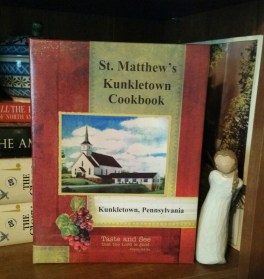
Wherever American communities sprang up, invariably early Americans set up churches. The first white settlers to the Kunkletown area (where my ancestors settled) were Moravian missionaries, who were trying to spread Christianity to local Delaware Indians.  Massacres and disease doomed the missionaries.  My direct ancestor, Abraham Schmidt, moved into the “West-End” of Northampton territory in 1762, after 7 years of watching the abandoned Moravian mission area.  He donated the land in 1774 to set up one of the first churches in that area of northeast Pennsylvania, where I grew up.  Most of these early German-American settlers were Lutheran or Reformed, but due to the only other German-speaking immigrants setting up “Union” churches, almost all of the churches became “Union” churches.  The first log cabin church,  which later became St. Matthew’s UCC in Kunkletown was a “Union church”.
wp-1477426769107.jpg

Photo: Front of recent church cookbook shows St. Matthew’s UCC church, my childhood church, in Kunkletown, PA.  The annex extending off the right side was added in recent years.

Abraham Schmidt was also the first constable and he was tasked with setting up a militia, as early as 1774, with a quota set at 82, which he easily filled. He was the captain of the militia too. The militia joined General George Washington and as the page from “The Story of Kunkletown” (records acquired through Northampton County records) shows, his militia was still active in 1780.

wp-1477425506765.jpg

From The Story of Kunkletown, a Bicentennial Pennsylvania history compiled by local historically minded citizens, like my wonderful pastor’s wife, Beatrice Goldman Boehner. mentioned in many of my posts.   Reverend Adan Boehner was the pastor of St. Matthews UCC Church from 1926-1969.

The 1976 book, “The Story of Kunkletown”, historical research and writing was done primarily by Rev. Perry L. Smith, who was born in Kunkletown in 1897, received a B.D from Franklin and Marshall College and graduated from the Marshall Theological Seminary.  Although Rev. Smith left Kunkletown behind, he spent years researching, gathering information and historical material, long before the American Bicentennial.  He even had already researched the Abraham Schmidt family tree, back to Philadelphia, when the Schmidts arrived.  Mrs. Boehner gave me a typed family tree in 1976 and told me, “Susie, your ancestor was very important to this community.”

Buddy mentioned the sacrifices of the founding fathers and  most Americans can relate to the Mel Gibson movie, The Patriot, yet never really grasp that while this story is fictional and  as Wikipedia explains, Gibson’s character:  “Benjamin Martin is a composite figure the scriptwriter claims is based on four factual figures from the American Revolutionary War: Andrew Pickens, Francis Marion, Daniel Morgan and Thomas Sumter.”

Buddy mentioned the sacrifices without grim details, so here’s a little more detail to give you a taste of how much many of the signers of the Declaration of Independence sacrificed:

“The British had a particular zeal for destroying the homes and property of the signers. Those suffering this fate included Benjamin Harrison, George Clymer, Dr. John Witherspoon, Philip Livingston, William Hooper and William Floyd. The sacrifices of John Hart and Francis Lewis are particularly noteworthy. “While his wife lay gravely ill, Redcoats destroyed Hart’s growing crops and ripped his many grist mills to pieces. Bent on taking him, they chased him for several days. They almost nabbed him in a wooded area, but he hid in a cave. When he returned home with his health broken, he found his wife dead and their 13 children scattered.”

The story of Francis Lewis was equally tragic. “When the British plundered and burned his home at Whitestone on Long Island, they took his wife prisoner. She was thrown into a foul barracks and treated cruelly. For several months she had to sleep on the floor and was given no change of clothing. George Washington was able eventually to arrange for her exchange for two wives of British officers the Continental Army was holding prisoner. Her health was so undermined that she died two years later.””

The price paid for your liberty, by Dr. Harold Pease

Once again, they pledged:

“For the support of this declaration,
with firm reliance on the protection
of the divine providence, we mutually pledge
to each other, our lives,
our fortunes, and our sacred honor.”

And they lived up to their word.

2 Comments

Filed under American Character, American History, Culture Wars, General Interest

Looking for a Savior in all the wrong places

The above MSNBC interview features J.D. Vance, author of Hillbilly Elegy: A Memoir of a Family and Culture in Crisis, a book that is part, starkly honest portrayal of his life as a poor “white trash” hillbilly growing up in the Rust Belt today, and part social policy analysis. In the book, Vance mentions “learned helplessness” as a looming problem in the economically depressed town in the Rust Belt, where he grew up.  He chronicles, in a very personal way, the current plight of the families of those who were part of the Appalachian migration out of the Appalachian Mountain communities to northern industrial cities in the first half of the last century, often referred to as the Hillbilly Highway.

His story is meant to open discussions about government social policy, local community actions, but most of all, he is hoping that the American families in crisis, at the heart of the cultural crisis in America, take a hard look at themselves and begin the painful, difficult process of changing how their own families treat each other.

That change requires unlearning “helplessness”, but also learning to quit blaming big government, big business, big bankers, nefarious Mexicans and Chinese, Obama  and Muslims, and other mythical scapegoats.  Quit looking for a new big government program or an American strong man promising to make your life or your community better!   You are responsible for the choices you make, but if you have managed to get your life on track, the responsibility doesn’t end there.  You have to try to help guide your own families and communities, especially children at risk, to learning to be productive and American success stories too.

Vance writes honestly about his mother’s drug addiction and the impact it had on him and his sister, but it also affected his grandparents and extended family too.  One addict or alcoholic in a family can create endless chaos and upheaval, both emotional and financial.  These people are like ticking time bombs, ready to tear apart their family and themselves, over and over.   The news clip above offers a shocking glimpse into the opioid  epidemic in America today.

Change begins first in our own hearts and then within our families and communities.

In many posts I’ve highlighted Trump’s populist appeal, his skillfully latching onto patriotic themes, spanning the globe from Mexico to China for foreign scapegoats abroad, evil domestic “establishment” politicians at home and of course, The Left, as the cause of all the failures in American communities.  Many Americans see Trump as hearing their pain and expressing their anger, but I want to move away from Trump and this election, to delve into the state of way too many American families, like the one Vance grew-up in.

wp-1477107842006.jpg

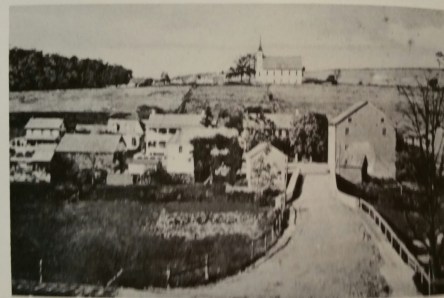
Above is an early photo of Kunkletown, PA, the village where I grew-up.  We lived on the outskirts of the village further off to the left side of where that photo ends.  Behind where the photographer was positioned, is part of the Blue Mountain range, which is the eastern edge of the Appalachian Mountain range.  The village had a few more buildings off to the left and right, when I was growing up, but not much more.  My family was a typical blue-collar, rural family in the Pocono Mountains in northeastern PA.  In the late 90s, my husband, kids and I had gone to visit my family and as my husband drove around winding roads in the mountains, one of my sons, who was around 11 or 12 at the time, said, “Mom, your family is kind of like northern rednecks.”  My first reaction was angry pride in my family, but when I thought about his words, I knew they were true.

I love my family, I am proud of my PA German heritage, and I am especially proud of my parents, who were very hard-workers, dedicated to family, drank alcohol only at social occasions and then sparingly, ran an organized home, lived frugally and within their means, did not tolerate drama in our home, instilled values in us, but most of all they lived their values through constant example.  Sure, my family had conflicts, problems, and many flaws, because no one has a “perfect” family, but I never doubted that my parents would care for us and do their very best to provide for us.  I never once doubted that they put caring for their family over their own wants and desires – they made sacrifices constantly to provide for us.

The things that bind strong families together go much deeper than blood, they are love and respect for each other, and building trust within the family.

My parents told all six of us, my three sisters and two brothers, that in America all things are possible if you work hard.  Coupled with that complete faith in the American Dream was faith in God, but also the constant reminders that we needed to help other people and that America isn’t just about “rights”.  My parents believed being an American imposed on all of us a “duty”  to be good citizens and good neighbors. This combined message of “civic duty” and the Christian message of being “good neighbors” is what built American communities.  That isn’t to say America can’t be inclusive and respectful of other religions, it’s a historical statement of how most rural communities and small town America were built.

The anger stewing among America’s poor is very real, but the scapegoating other groups, the latching onto federal government panaceas and the complete abdication of taking personal responsibility for ourselves, our families and our own communities, is destroying not only the American spirit, but also real American lives.

Vance survived a home in crisis, having a mother who had a drug addiction problem, run-ins with the criminal justice and social services systems, and whose lifestyle led to a revolving door of “father” figures moving in and out of his life.  He credits his loving, albeit dysfunctional in many ways, grandparents with saving him from ending up a high-school drop out.  He also credits the Marine Corps for instilling strong values that helped him become a stronger, more resilient person.  His story offers many insights as to what is really ailing America and it’s not just closing factories, corrupt Washington, or bad trade practices.

My husband survived a troubled childhood, eerily similar to, but, perhaps more stark than the one Vance recounts.  Interestingly enough, my husband’s alcoholic mother, grew up in West Virginia.  As Vance talked about his crazy grandmother’s rants and profanity-laced language, I kept thinking, “She talks just like my late mother-in-law.”

My goody-two shoes upbringing didn’t prepare me for my mother-in-law’s flowery language, where two of her favorite phrases were, ” Shit in your hat and pull it down over your ears.” and her version of “go to hell” was, “Up your giggy hole, bitch!”  I sat there dismayed and confused with many of her phrases, and after the first time she said that, when I was alone with my husband,  I asked him, “What on earth is a giggy hole?”  My mother considered “fart” a cuss word and we weren’t allowed to say that.  I tried to teach my children to say, “pass gas” and they told me even their teachers say “fart” and refused to believe me that “fart” is a vulgar word.

Besides all the “crazy” things and rough talking, Vance’s grandmother, instilled a belief in him that he could do anything and she also talked about her dream of becoming a lawyer when she was young.    My mother-in-law, besides the obvious problems that hit you in the face quickly, was a very smart woman and at some point in her life, she read a lot.  It always amazed me that she would rattle off the answers to Jeopardy questions on TV, before even the best contestants could open their mouths.  She would have choice words for the contestants who missed questions.  She also did the crossword puzzle in the newspaper every day, in very little time.  Occasionally, she would ponder out loud about a word she was struggling over, but invariably within a few minutes she’d have the answer.

I once asked my mother-in-law how she knew all this stuff and she gave me this confused look and said, “Everyone knows this!”  I didn’t know many of these things and I read constantly.  I’ve often wondered what my mother-in-law’s dreams were when she was young, before having 7 children, with only 2 having the same father, I believe.  My husband related that one sibling died young, so I am not sure about the paternity of that one.  My husband’s father left when he was 5 years old and he never saw him again.

Like the Marines helping Vance escape his troubled childhood, the Army provided my husband a way to escape his life, growing up poor in downtown Baltimore.  I suspect that my neck of the woods in PA was an anomaly in the 60s and 70s when I was growing up. It was the backward, west end of the county, where a small enclave of  PA Dutch people, most related to each other, were clinging to their rapidly evaporating community.  Drugs were prevalent when I was in high school in the 70s and the area has a lot of resorts and also an invasion of people from New York and New Jersey, who decided to move to the Poconos and commute to work in the city.

This urban invasion completely changed the culture in the area.  In high school, we were disparagingly called “farmers” by our rival high school team, from a more populated area of the county.  However, the dwindling family farm culture had been eroding for a large part of the last century.  Most of the people, to include my parents, commuted to other areas in PA to work, with few actually working on farms in my childhood.

wp-1477106414390.jpg

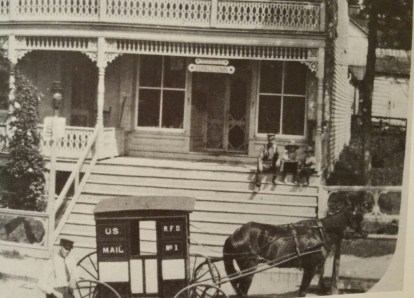
My paternal great-grandmother lamented selling their farm and moving to “town”, which was Kunkletown (a village with a church, a general store, a gas station, a post office,  and a few local businesses) and that was before my father was born in 1929.   The above photo is the post office in Kunkletown, PA, with my great-grandfather behind his horse and mail cart,  He  was one of two rural route mail carriers, when the rural routes were started in 1912.  See, not only John Kasich has a family member with claims to being a postman…   While compiling a history of Kunkletown during the American bicentennial in 1976, local historical sleuths found this record of my great-grandfather’s, January 1912 route stating he delivered 4 registered letters, 757 letters, 369 postal cards, 1802 newspapers, 538 circulars, and 442 packages.  He collected 4 registered letters, 640 letters, 206 postal cards, 2 newspapers, 10 packages and 36 money orders.  Guess reading newspapers was popular in the backwoods.  That post office was still the post office when I was growing up in the 60s and 70s.

The problems Vance relates experiencing growing up in the Rust Belt in Ohio, now are the same ones afflicting the poor white working class in the Poconos, in small towns, in rural America, but also in inner-city poor black communities too.

What is ailing America most is too many Americans started believing they are the downtrodden victims of a system stacked against them.   Much of the “learned helplessness” is the result of liberal government policies, academia and educational system indoctrination and Hollywood and media brainwashing.  Celebrities and flaky TV “experts”, televangelists and assorted “experts” exert more influence over many Americans’ lives than these Americans’ own families or local civic and religious leaders do.  Americans have bought into trusting the advice of total strangers over people in their own families or communities.  This “learned helplessness” belief rears itself in endless strings of lies, way too many people tell themselves and their families, about why their lives are an endless, downward trajectory of personal and financial train wrecks.

As one who has lived through some personal train wrecks and even spent years making excuses for some of my bad decisions, I’m not trying to judge other people who are struggling or acting like I have all the answers. All I can say is that in my life, at 56, one thing I’ve learned to do is to try to quit making excuses when I make mistakes, admit to them quickly, then try to fix them and avoid making the same ones in the future. Sometimes I succeed, sometimes I fail, but in the end, I blame myself for the outcome – not the “system is rigged or against me”.  Even when I have been treated “unfairly”, I keep working at forgiveness and not letting anger rule my life.  That forgiveness part is the hardest, but by focusing on looking for positive things, it helps me move past anger.

Vance penned an opinion piece in the New York Times, “The Bad Faith of the White Working Class,” June 25, 2016, where he writes about “paranoia replacing piety” in some Christian groups in America. He states, “A Christianity constantly looking for political answers to moral and spiritual problems gives believers an excuse to blame other people when they should be looking in the mirror.” Expanding on that thought, Vance writes:

“This paranoia harms the most vulnerable Christians the most of all. A few months ago I visited with a few teachers from my old high school and asked them how we might give kids in our community a better shot — at a good job, perhaps, or at least a peaceful family life. The mood grew somber. One told me that after a student, a bright young man from a “rough home,” stopped showing up to class, she drove to his house on a school day to check on him. She found him and his seven siblings home alone, her promising student too preoccupied with tending to his brothers and sisters to care much about school. A younger teacher, listening intently, sighed: “They want us to be shepherds to these kids, but so many of them are raised by wolves.”

In the white working class, there are far too many wolves: heroin, broken families, joblessness and, more often than we’d like to believe, abusive and neglectful parents. Confronted with those forces, we need, most of all, a faith that provides the things my faith gave to me: introspection, moral guidance and social support. Yet the most important institution in our lives, if it exists at all, encourages us to point a finger at faceless elites in Washington. It encourages us to further withdraw from our communities and country, even as we need to do the opposite.” (my highlight)

This post has run much longer than I intended, sorry about that.  In my next few posts I want to delve into the history of faith in America, where Gladius has so generously given me permission to pull whatever I want from a sermon he gave to his Baptist church this past 4th of July, to highlight the faith of our Founding Fathers.  Then I want to write a post about the things I learned about American culture working in Wal-Mart many years (leaving in 2015).

5 Comments

Filed under American Character, American History, Culture Wars, Food for Thought, General Interest, Politics

#ConstitutionDay

Today is #ConstitutionDay

Easy interactive on:

“What is the Constitution?

and

Why does it matter to me?”

Some of us, of a certain age, grew up with Schoolhouse Rock:

Here’s one more link: Constitution Day

Leave a comment

Filed under American Character, American History, General Interest, The Constitution

March Under One Flag (blog repost from 2013)

vintage-patriotic-american-flag-god-bless-america

The following is a blog post, I originally posted October 16, 2013.  I’ve done some slight editing to break up my mile long paragraphs (a bad habit of mine).  Considering the worsening state of America’s partisan divides, we definitely need to learn how to “march under one flag” again, in fact, the divides have deepened and the wounds to our national soul fester, to the point our national character is on life support.  The remedy isn’t a more liberal America or a more conservative America, it’s building a belief in one AMERICA, where every American citizen believes in The Constiution and that we are all equal under the law.


March Under One Flag

Legends on the rise and fall of great societies permeate history with certain threads, like the demise of the common culture leading the list as one of the prime harbingers of “doom”.  Yes, that word “doom” comes to mind quite frequently,  presaging our presumed ineluctable fated demise.  Warning signs, both large and small, abound, blaring out endless streams of our culture and Judeo-Christian value system in full retreat to the relentless moral relativist message.

Some retreat for public relations reasons, like Wal-mart this past weekend (story here).  The EBT system  failed last Saturday in 17 states, leading to EBT recipients debit cards showing no limits.  News reports indicate that in several states Wal-mart stores were crammed with customers filling slews of shopping carts with groceries and “checking out”, swiping their EBT card, which they knew did not have the funds to cover the amount of groceries “purchased” (stolen).  The corollary would be long ago when people used personal checks more often and supposing you wrote a check for your purchases knowing you did not have money to cover the purchase.

There’s no difference besides the fact that media handlers will guide Wal-mart and the image of Wal-mart tracking down “poor people” for criminal prosecution over this blatant thievery might look like the giant retailer is picking on the little people.  Wal-mart will likely end up eating this loss and due to American social conditioning, way too many people will use moral relativism to guide their moral reasoning in the matter – saying things like “Wal-mart can afford it” or “Wal-mart screws over the little guy all the time so turn around is fair play”.  Sure, in this case some Wal-mart management in the affected states made the call to let the sales go through rather than stop the theft and they failed to follow the proper procedure in place to call Xerox when EBT cards aren’t working properly.

In this same above-mentioned scenario the more disturbing behavior is that of the crowds of people who flooded Wal-mart stores to steal food in broad daylight, with no moral hesitation.  The problem with government hand-outs is the people start beginning to believe these programs really are “entitlements” and thus they never spend a moment’s notice wondering about taking other people’s money as their own, nor do they worry about stealing food from Wal-mart.

Taking stuff that is not yours is stealing, no matter the twisted semantics used to rationalize it.  To delve further into this moral relativist hellish enslavement of the mind I urge you to read the article Justin linked in a comment here yesterday, “Contemporary Liberal Doublethink: Welfare = Self-Reliance”.  The thieves in this scenario won’t bother to “think or reason” about their thievery, no, these are pack animals – used to being led, with no will to think for themselves nor will they ponder things like civic duty, aspiring to become better human beings or much beyond their instant gratification.

PJ Media offered this truly excellent piece written by a writer who pens under the pseudonym, Bookworm, titled “The Surprising Reason Americans Are Vulnerable to Moral Relativism”, which although lengthy, definitely rates the time.  This writer posits that our American embrace of Anne Frank’s idealistic belief: “I still believe, in spite of everything, that people are truly good at heart.”, creates a syllogism as described in this passage:

“Thanks to those words, Americans accept that “people are truly good at heart.” This belief creates a syllogism, one that sees Americans claiming that it must be a lie when someone dares to claim that another group doesn’t meet certain moral absolutes. How can there be moral absolutes when all “people are truly good at heart”?”

The author goes on to explain why Anne Frank’s simple idealistic belief was not only wrong in her own personal life, where she perished in the Holocaust, but it is simply wrong for mankind, in general.   People aren’t truly good at heart – that part takes a great deal of civilizing effort, both in the home and in society in general, hence we used to call it “civil society”.

Aristotle offered his definition, “a shared set of norms and ethos, in which free citizens on an equal footing lived under the rule of law”, which puts us on firmer footing than most of the opining from American academics in recent decades.  We need that shared set of norms and ethos as the glue to hold our splintering, divided country together.  Cutting through the leftist doublethink presents a daunting challenge, but unless we commit to “winning the hearts and minds” of Americans on the importance of being “good citizens”, where “rights” rest right next to “civic duty”, we’ll continue to drift, creating an ever-widening no man’s land, rather than to use a military metaphor and which I use as my gravatar, “march under one flag”.

We must become a country under one flag again – we must become American citizens first, political partisans second.

Leave a comment

Filed under American Character, American History, Culture Wars, General Interest, Hillary's Email Scandal, Politics, Public Corruption, ThatWitch2016, The Constitution

U.S. Airborne Day, 16 August

“Airborne All the Way” Author unknown These men with silver wings Troopers from the sky above In whom devotion springs What spirit so unites them? In brotherhood they say Their answer l…

Source: U.S. Airborne Day, 16 August

2 Comments

Filed under American History, Military, Uncategorized

#PurpleHeartDay

The Badge of Military Merit / The Purple Heart

Purple Heart Medal

Newburgh, 
	1783
Newburgh, 1783

At his headquarters in Newburgh, New York, on August 7, 1782, General George Washington devised two new badges of distinction for enlisted men and noncommissioned officers. To signify loyal military service, he ordered a chevron to be worn on the left sleeve of the uniform coat for the rank and file who had completed three years of duty “with bravery, fidelity, and good conduct”; two chevrons signified six years of service. The second badge, for “any singularly meritorious Action,” was the “Figure of a Heart in Purple Cloth or Silk edged with narrow Lace or Binding.” This device, the Badge of Military Merit, was affixed to the uniform coat above the left breast and permitted its wearer to pass guards and sentinels without challenge and to have his name and regiment inscribed in a Book of Merit. The Badge specifically honored the lower ranks, where decorations were unknown in contemporary European Armies. As Washington intended, the road to glory in a patriot army is thus open to all.”

Three badges were awarded in the waning days of the Revolutionary War, all to volunteers from Connecticut. On May 3, 1783, Sergeant Elijah Churchill and William Brown received badges and certificates from Washington’s hand at the Newburgh headquarters. Sergeant Daniel Bissell, Jr., received the award on June 10, 1783.

Churchill was a 32-year old carpenter from Enfield who entered the 8th Connecticut as a private on July 7, 1775. On May 7, 1777, he re-enlisted for the duration of the war as a corporal in the 2d Continental Light Dragoon Regiment, later the 2d Legionary Corps, and was promoted to sergeant on October 2, 1780. He was cited for gallantry in action at Fort St. George near Brookhaven on Long Island, at Coram, New York, in November 1780, and at Tarrytown, New York, in July 1781.

A native of Stamford, Brown enlisted in the 5th Connecticut Regiment as a corporal on May 23, 1775, and re-enlisted as a private on April 9, 1777, for the duration in the 8th Connecticut. He was promoted to corporal on May 8, 1779, and to sergeant on August 1, 1780, transferring with the consolidation of units to the 5th Connecticut on January 1, 1781, and to the 2d Connecticut on January 1, 1783. No record of his citation has been uncovered, but it is believed that he participated in the assault on Redoubt No. 10 during the siege of Yorktown.

Bissell, from East Windsor, enlisted on July 7, 1775, as a fifer in the 8th Connecticut Regiment, and on April 1, 1775, signed on for the duration as a corporal in the 5th Connecticut. He became a sergeant on September 1, 1777, and ended the war with the 2d Connecticut. Under Washington’s direct orders he posed as a deserter in the city of New York from August 14, 1781, to September 29, 1782, relaying valuable information to the Continental command.

The award fell into disuse following the Revolution and was not proposed again officially until after World War I. On October 10, 1927, Army Chief of Staff General Charles P. Summerall directed that a draft bill be sent to Congress “to revive the Badge of Military Merit.”

For reasons unclear, the bill was withdrawn and action on the case ceased on January 3, 1928, but the Office of The Adjutant General was instructed to file all materials collected for possible future use.

The rough sketch accompanying this proposal showed a circular disc medal with a concave center in which a relief heart appeared. The reverse carried the legend: For Military Merit.

A number of private interests sought to have the medal reinstituted in the Army. One of these was the board of directors of the For Ticonderoga Museum in New York.

On January 7, 1931, Summerall’s successor, General Douglas MacArthur, confidentially reopened work on a new design, involved the Washington Commission of Fine Arts. His object was medal issued on the bicentennial of George Washington’s birth.

Miss Elizabeth Will, an Army heraldic specialist in the Office of the Quartermaster General, was named to redesign the newly revive medal, which became known as the Purple Heart. Using general specifications provided to her, Ms. Will created the design sketch for the present medal of the Purple Heart. Her obituary , in the February 8, 1975 edition of The Washington Post newspaper, reflects her many contributions to military heraldry.

The Commission of Fine Arts solicited plaster models from three leading sculptors for the medal, selecting that of John R. Sinnock of the Philadelphia Mint in May 1931.

As described in Army Regulations 600-35 of November 10, 1941, the design consisted of a purple enameled heart within a bronze quarter-inch border showing a relief profile of George Washington in Continental uniform. Surmounting the enameled shield is Washington’s family coat of arms, the same used by the heart shape and the coat of arms of the obverse is repeated without enamel; within the heart lies the inscription, For Military Merit, with space beneath for the engraved name of the recipient. The device is 1-11/16 inches in length and 1-3/8 inches in width, and is suspended by a rounded rectangular length displaying a vertical purple band with quarter-inch white borders.

The War Department announced the new award in General Order No. 3, February 22, 1932:

By order of the President of the United States, the Purple Heart established by General George Washington at Newburgh, August 7, 1782, during the War of the Revolution, is hereby revived out of respect to his memory and military achievements.

By Order of the Secretary War:

Douglas MacArthur,
General
Chief of Staff

The association of the Purple Heart with wounds or fatality suffered in the line of meritorious service also stems from this time. Eligibility for the new award was defined to include:

•Those in possession of a Meritorious Service Citation Certificate issued by the Commander-in Chief of the American Expeditionary Forces in World War I. The Certificates had to be exchanged for the Purple Heat or the award and Oak Leaf Clusters as appropriate. This preserved the ideal of presenting the award for military merit and loyal service.

•Those authorized by Army Regulations 600-95 to wear wound chevrons. These men also had to apply for the new award.

•Those not authorized wound chevrons prior to February 22, 1931, but who would otherwise be authorized them under stipulations of Army Regulations 600-95.

Revisions to AR 600-45 at the time, defining conditions of the award, elaborated upon the “singularly meritorious act of extraordinary fidelity service” required. “A wound which necessitates treatment by a medical officer and which is received in action with an enemy may, in the judgment of the commander authorized to make the award, be construed as resulting from a singularly meritorious act of essential service.” War Department Circular No 6 dated February 22, 1931, carried the same instructions.

The Navy Department at this time saw no reason to authorize the Purple Heart for its officers and men. The Department maintained that the award was “purely an army decoration.”

No record survives today of the identity of the first individual to revive the revived and redesigned Purple Heart. Local posts of the American Legion held ceremonies to honor recipients, and it was also common to invite the Adjutant General of state National Guards to preside over the ceremonies and present awards, but the practice was nowhere standard.

Developments concerning the Purple Heart after 1931 served to define further eligibility requirements for the award and to identify it even more closely with bloodshed or loss of life in the nation’s service.

In Executive Order 9277 of December 3, 1942, President Franklin D. Roosevelt extended the use of the award to the Navy, the Marine Corps, and the Coast Guard after December 6, 1941, and established a uniform application of standards for the award in the Army and the Navy.

President Harry S. Truman, in Executive Order 10409 of November 12, 1952, retroactively extended Navy, Marine Corps, and Coast Guard eligibility for the Purple Heart back to April 5, 1917, to cover World War I.

President John F. Kennedy issued Executive Order 11016 on April 25, 1962, extending eligibility as well to “any civilian national o the United States, who while serving under competent authority in any capacity with an armed force, has been, or may hereafter be, wounded.”

Current eligibility and conditions for the award are defined in Army Regulations 600-8-22. Paragraph 2-8e, added June 20, 1969, carries the notice that “any member of the Army who was awarded the Purple Heart for meritorious achievement or service, as opposed to wounds received in action, between 7 December 1941 and 22 September 1943, may apply for award of an appropriate decoration instead of the Purple Heart.”

The Purple Heart is ranked immediately behind the bronze star in order of precedence among the personal awards; however, it is generally acknowledged to be among the most aesthetically pleasing of American awards and decorations.

The above article in from the U.S. Army Center Of Military History

http://www.history.army.mil/html/reference/purhrt.html

Leave a comment

Filed under American Character, American History, General Interest, Military

“He never means anything serious till he talks about justice and right” ( a repost from August 2015)

Here’s another old post, I wanted to repost from August 29, 2015:

“He never means anything serious till he talks about justice and right”

“My son,” said the Norman Baron, “I am dying, and you will be heir
To all the broad acres in England that William gave me for my share
When we conquered the Saxon at Hastings, and a nice little handful it is.
But before you go over to rule it I want you to understand this:
“The Saxon is not like us Normans. His manners are not so polite.
But he never means anything serious till he talks about justice and right.
When he stands like an ox in the furrow with his sullen set eyes on your own,
And grumbles, ‘This isn’t fair dealing,’ my son, leave the Saxon alone.”

—RUDYARD KIPLING, 1911

Hannan, Daniel (2013-11-19). Inventing Freedom: How the English-Speaking Peoples Made the Modern World (p. 91). HarperCollins. Kindle Edition.

Coming from a blue-collar background, I do understand the rise of populist icons, like Sarah Palin and Donald Trump, among working class Americans, who aren’t going to assiduously study issues, read history or pay any attention to renowned pundits like George Will, with his use of words most of these people have never even heard, let alone know their meaning.  These are the people I grew up around and as one of my sons, as a precocious 12 year-old informed me, many years ago while on a visit to the backwoods of PA, “Mom, your family is kind of like Northern rednecks.”  There you have your explanation for the rise of Donald Trump and Sarah Palin before him.

In my many years online, I have been banned two times from posting comments on two blogs, The American Thinker and The Last Refuge Blog, one years ago and one just recently.  After my experiences posting on the Excite message boards way back during the Clinton impeachment, these days I don’t venture to other sites very often to post comments, preferring to stay here at my own backwoods blog, to ramble to my heart’s content.  The past few days, I spent some time at National Review posting under my long-time user name, mhere (my little inside joke on the Russian word for peace) and at The American Thinker under the name, susanholly.  I was observing the comments from the devoted Trump supporters and thinking about the Trump supporters’ views.

This Trump phenomenon hearkened back to the Sarah Palin flirtation with a 2012 run for President and that is where I got banned from The American Thinker, for commenting on Sarah Palin wallowing (and making big money) in the reality TV trash culture, while bashing the decline in American culture.  I hadn’t written any cuss words or called any other posters names, just expressed my opinion, that she is a populist, self-promoter more than she is a staunch conservative standard-bearer.

Often Palin lands on the right side of conservative issues, but she can’t offer more than trite slogans and appeals to emotion to support her views.  Her supporters adore her and any venue where she ends up looking stupid, gets turned on the reporter asking the question, like Katie Couric asking Palin what  newspapers and periodicals she reads to stay informed, in that famous interview before the 2008 election.  Palin couldn’t even list any and to this day she insists that was a gotcha question, when in fact it’s a fair and very pertinent question.  Instead of learning from that failure, Palin doubled down on her attacks against the “lamestream” media and her supporters do the same.  Charles Krauthammer fell prey to vicious attacks from Palin supporters for his comments in a Dec 2010 appearance on Bill O’Reilly (at minute 2:50), for suggesting that Palin should have spent the past two years acquiring policy expertise.  Krauthammer committed the ultimate sacrilege for insisting the Couric interview questions during the 2008 election were not gotcha questions :

Daniel Hannan, in his book, Inventing Freedom: How the English-Speaking Peoples Made the Modern World explains this gap between the elites and ordinary people perfectly:

On July 3, 1940, Admiral Sir James Somerville issued the saddest order of his career. France had been occupied by the Nazis and was required under the armistice terms to transfer its Mediterranean fleet to German command. The British couldn’t allow such a development: Italy had entered the war on Hitler’s side, and control of the Mediterranean was at stake.

Winston Churchill ordered a larger British force to confront the French fleet off the Algerian naval base of Oran. The French admiral, Marcel-Bruno Gensoul, was given three options: to take his ships to British waters and carry on the struggle; to remove them from the theater of operations and keep them in the West Indies for the duration of the war; or to scuttle them.

All three options were turned down and, as the sultry day wore on, a final ultimatum was issued and rejected. At last, Admiral Somerville ordered his ships to shell the French fleet, the only occasion the British and French navies have exchanged hostile fire since Trafalgar. For ten minutes, great geysers of water shot into the sky, soon joined by black smoke from the battleship Bretagne, which was badly hit. No fewer than 1,297 Frenchmen were killed and 351 injured, by far the worst naval losses suffered by France during the war. There were no British casualties.

Somerville was sickened by what he later called “the most unnatural and painful decision” of his life. He passed a grim and silent evening in the mess, where many of his officers had tears in their eyes. But he couldn’t help noticing that, on the lower decks, a very different attitude prevailed, most sailors cheerfully declaring that they “never ’ad no use for them French bastards.”

It was an extreme illustration of an age-old social divide. The English (and later British) upper classes tended to be Francophone and Francophile. Yet theirs was a minority tendency, one that opened them down the centuries to accusations of being effete and unpatriotic.

That class division can be traced right back to the Norman Conquest, which placed England under a French-speaking aristocracy. It was to be more than three centuries before English again became the language of Parliament, the law courts, the monarchy, and the episcopacy. Certain parliamentary procedures are still, a millennium after the Conquest, conducted in Norman-French. The Queen’s approval of legislative bills, for example, is announced with the phrase “La Reine le veult.”

The native English, disinherited and resentful, projected their resentment onto French-speakers in general. The popular stereotype of the Frenchman closely resembled the radicals’ stereotype of the aristocrat: mincing, epicene, sly.

Even today, most Britons suspect (with good reason) that their elites are more Europhile in general, and more Francophile in particular, than the country at large. By “Europhile,” they don’t simply mean readier to accept EU jurisdiction, though that belief is demonstrably accurate. “Europhile” has wider connotations: of snobbery, of contempt for majority opinion, of the smugness of a remote political caste.

The extraordinary thing is that we can find no period in the past nine hundred years when such a sense was absent. The linkage between French manners and upper-class decadence has been made in England (then Britain, then the Anglosphere as a whole) by every generation.

Hannan, Daniel (2013-11-19). Inventing Freedom: How the English-Speaking Peoples Made the Modern World (pp. 92-93). HarperCollins. Kindle Edition.

Yesterday, at The American Thinker, I commented a good bit on an article, “The New Jacksonian Rebellion (and Trump, too)”, by J. Robert Smith. He writes:

In the day, weren’t Old Hickory and the Jacksonians “mad as hell?” Jacksonian Democracy was fueled by a righteous indignation — as is today’s liberty rebellion.

When we consider the struggle for freedom (and it’s been ongoing since the Revolution), we need to consider how past movements are amalgamated, synthesized. Today’s liberty rebellion resembles the Jacksonian but has many fathers. Expressions for liberty change, somewhat, to fit the times, but the core principles remain. Liberty is still man’s natural state. Humanity’s direction (as epitomized in the American experience) struggles toward achieving this birthright. It’s nearly instinct.

Though the focus is on Trump, some conservatives — and more Republicans — are unsettled by the liberty rebellion. It’s too Jacksonian in profile for whiggish conservatives — it’s raw, coarse, and full of the frontier; it discounts government more than they’d care. They are the George Wills of the world.

History.com explains Jacksonian Democracy in terms that do show this same sort of the elites vs the ordinary man class struggle:

By the 1820s, these tensions fed into a many-sided crisis of political faith. To the frustration of both self-made men and plebeians, certain eighteenth-century elitist republican assumptions remained strong, especially in the seaboard states, mandating that government be left to a natural aristocracy of virtuous, propertied gentlemen. Simultaneously, some of the looming shapes of nineteenth-century capitalism—chartered corporations, commercial banks, and other private institutions—presaged the consolidation of a new kind of moneyed aristocracy. And increasingly after the War of 1812, government policy seemed to combine the worst of both old and new, favoring the kinds of centralized, broad constructionist, top-down forms of economic development that many thought would aid men of established means while deepening inequalities among whites. Numerous events during and after the misnamed Era of Good Feelings—among them the neo-Federalist rulings of John Marshall’s Supreme Court, the devastating effects of the panic of 1819, the launching of John Quincy Adams’s and Henry Clay’s American System—confirmed a growing impression that power was steadily flowing into the hands of a small, self-confident minority.

Daniel Hannan and J. Robert Smith clearly lay out this common man vs the moneyed elite sentiment, which transcends centuries in American society as surely as in British society. At the turn of the 20th century novelist  Owen Wister, dedicated his popular novel, “The Virginian”, to his close friend, President Theodore Roosevelt.  “The Virginian” introduced America to the iconic cowboy, bold, brave, unfettered by Eastern elite snobbery.  This is one of my favorite American novels and I often cite a quote from it too: “When a man ain’t got no ideas of his own, he’d ought to be kind of o’ careful who he borrows ’em from.” Wister perfectly describes the class gap between the self-made Western cowboy as he prepares to go East to meet the family of his new bride, a New England schoolmarm from a blue-blood family:

“Why, I have been noticing. I used to despise an Eastern man because his clothes were not Western. I was very young then, or maybe not so very young, as very–as what you saw I was when you first came to Bear Creek. A Western man is a good thing. And he generally knows that. But he has a heap to learn. And he generally don’t know that. So I took to watching the Judge’s Eastern visitors. There was that Mr. Ogden especially, from New Yawk–the gentleman that was there the time when I had to sit up all night with the missionary, yu’ know. His clothes pleased me best of all. Fit him so well, and nothing flash. I got my ideas, and when I knew I was going to marry you, I sent my measure East–and I and the tailor are old enemies now.”

Bennington probably was disappointed. To see get out of the train merely a tall man with a usual straw hat, and Scotch homespun suit of a rather better cut than most in Bennington–this was dull. And his conversation–when he indulged in any–seemed fit to come inside the house.

Mrs. Flynt took her revenge by sowing broadcast her thankfulness that poor Sam Bannett had been Molly’s rejected suitor. He had done so much better for himself. Sam had married a rich Miss Van Scootzer, of the second families of Troy; and with their combined riches this happy couple still inhabit the most expensive residence in Hoosic Falls.

But most of Bennington soon began to say that Molly s cow-boy could be invited anywhere and hold his own. The time came when they ceased to speak of him as a cow-boy, and declared that she had shown remarkable sense. But this was not quite yet.

Donald Trump, part and parcel, a creature of that wealthy, elite class that his supporters loathe, has managed to transcend his personal history and take on an outsider personna, carefully crafted to tap into this populist sentiment of his supporters, many who like Palin, rail against the Washington elites, big-money interests, mainstream media and most especially those they deem RINOs.  I was called a pinkie wagger a couple times yesterday while commenting, for holding a different view of Trump.  Most of these people will not be swayed by smart punditry, as Kevin D. Williamson and Jonah Goldberg are finding out, nor will they bother with George Will or Charles Krauthammer, because what is happening is they are closing ranks and it is very much a class struggle.  The more information you provide to show Trump flip-flopped or discredit his vague policy ideas, the more they will hunker down, fuming about “pinkie-waggers” and elitists.  In fact, here’s Sarah Palin’s interview, commiserating still over those unfair media gotcha questions, with Trump.  He, being asked what his favorite Bible verse is, fits her definition of a gotcha question… Truly, he said his favorite book after the Bible was his own book, “The Art of the Deal”, so asking him what his favorite Bible verse was an attempt at a gotcha question???.  You can watch the entire Palin interview of Trump, replete with their mutual adoration society, but very slim on policy or insights on anything more than how they understandhow ordinary people feel: Video here.

Partisan political ideology aside, America remains torn apart by factions and this Trump phenomenon must be forcefully exposed as just that – a populist movement centered on a personality more than firm American founding principles.  They may rally under “freedom and liberty” slogans, but there is no firm principled core to the Trump campaign, because his campaign centers on emotion and ginning up a mob tactics.  In every other breath he spouts his polls numbers as vindication that he is right.  Poll numbers don’t make you right. He should hone his arguments in well-thought out, clear sentences.

America needs to hold all of its presidential candidates’ feet to the fire.  Expecting intelligent, well-reasoned arguments and explanations for their policies and ideas, should be the standard we demand. We need leaders who read extensively, who will study issues carefully and at the heart, being President is the highest political office in the land, so demanding a president who has mastered government policy issues is a must.  Expecting that all of our elected officials, both in Congress and the President possess an in-depth understanding of The Constitution, a breadth of knowledge on US history and a strong foundation on foreign policy issues should be our minimum expectation.

Education is free in America!  Accept no excuses!  I possess no college degree, but I devoted my life to reading as much as I can in my spare time.  I have signed out books from Army post libraries, public libraries, purchased many books and even borrowed books from friends.  The ability to access information and learn is limitless in our internet age.   Assuredly, there are gaps in my education, as my blog will surely affirm, but if someone points out something they think I need to read or points out an issue where what I have written is totally misguided or ill-informed, I don’t get angry.  I get reading and try to learn more.  We must all start demanding excellence, not only from our leaders, but from ourselves as well.  America should be admired for it’s educated citizens, not  considered as the home of ignorant, loudmouth, vulgar slobs!

Trump is a smart man, who has been fabulously successful.  He can afford the best speech coaches, writers and political advisers.  Showing up for a debate unprepared is not to be cheered, it’s a show of arrogance and self-conceit.  Ronald Reagan wrote his speeches out on index cards.  A poster yesterday told me I was supposed to infer what Trump was saying in his ramblings .  Absolutely, dead wrong!!!  The President represents all of us to the entire world and he/she must be a person with clear ideas, excellent public-speaking ability and our American message must reverberate, clear, concise and leave no doubts!  Perhaps, Trump will devote the energy to study policy and perfect presenting his vision for America, and prove that he is the best candidate to represent all of us.  And that’s the key, the President of the United States is not just the President of his partisan followers; he is the President of ALL Americans.

To put America on the right track, every American should read President George Washington’s Farewell Address and understand that railing about partisan political views is fine, but to “make America great again” we need to unite as one nation, bond by common values, and that remains the challenge none of the Presidential candidates has spoken to. Factions will destroy our Republic andPresident Washington warned that it is the “duty of a wise people to discourage and restrain it.”

Leave a comment

Filed under American History, Culture Wars, Foreign Policy, General Interest, History, Politics, The Constitution, The Media

The Little Woman in White

My love of American history began in elementary school and all through grade school I loved to sign out, not only fictional stories from the school library, but also biographies of great Americans.  In 1975, I was a teenager when the American bicentennial craze took hold in America, leading up to July 4, 1976.

Along with patriotic fervor and a renewed interest in American history, the American feminist movement had revved into high gear too, leading to the push for “herstory”.

Merriam-Webster defines “herstory” as “history considered or presented from a feminist viewpoint or with special attention to the experience of women” and lists the first known use as 1970.

I remember reading about women of the American Revolution, where their deeds were greatly exaggerated and possibly complete fabrications,  in my opinion, and the feminist movement seemed determined to conjure up unknown Amazon-warrior females, throughout history, whom somehow the evil male patriarchy had deliberately erased from history.

Having been a soldier a short time in my youth and having seen and experienced just a few of the grueling physical requirements for combat troops, the truth is, by human nature, women do NOT possess the upper-body strength to compete with men in ground combat skills.   That’s one of those hard facts that feminists prefer to pretend is just discrimination against women, while at the same time they accept that in sports competitions men and women differ in peak performance outcomes.  Getting women into every traditional position of power held by men continues to be the feminist quest.

Last night served as one of those pivotal feminist moments, which Hillary Clinton, with her nomination for president, touts as breaking through one of the last remaining “glass ceilings”.

Hillary represents the victory of HERstory over fact-based history.

So, here she is, the smartest woman in the world, a feminist icon, ostensibly the most talented woman in American politics ever and her handlers tried to sell her as June Cleaver….

The great irony last night was that while she envisions being the “first” female President as her destiny, to try and sell her to the American people, her handlers sent her daughter out there with a hokey speech about what a doting mother she was, devoting time to family dinners, trips to the library, writing personal notes to her daughter every day (yeah right).  Heck, she sounded like a stay-at-home Mom…   Even Bill Clinton resorted to a hokey story about Hillary on her knees putting liner in the drawers for Chelsea’s clothes, while getting Chelsea settled at college.

As a cynic when it comes to the Clintons, I suspect these “family stories” are about as real as Hillary being under sniper fire in Bosnia.

Does anyone believe any of that from this power-driven woman, who has devoted every waking moment to her own quest for political power for 40 years???

This was as bad as her 1992 pretty in pink interview: https://www.c-span.org/video/?56307-1/whitewater-investigation

Turning her into a traditional stay-at-home-mom personality was their desperate gambit to try to “humanize”  and soften her image from the money-grubbing, coattail-clinging, power-grasping harpy that she really is and that America knows too well.

Next thing you know, they’ll be whispering to the press that power-hungry Hillary is so misunderstood and really, she’s a wonderfully doting grandmother, who secretly loves to bake cookies for Charlotte…


4 Comments

Filed under American History, General Interest, Politics