Today is #ConstitutionDay
Easy interactive on:
“What is the Constitution?
and
Why does it matter to me?”
Some of us, of a certain age, grew up with Schoolhouse Rock:
Here’s one more link: Constitution Day
Today is #ConstitutionDay
Easy interactive on:
“What is the Constitution?
and
Why does it matter to me?”
Some of us, of a certain age, grew up with Schoolhouse Rock:
Here’s one more link: Constitution Day

The following is a blog post, I originally posted October 16, 2013. I’ve done some slight editing to break up my mile long paragraphs (a bad habit of mine). Considering the worsening state of America’s partisan divides, we definitely need to learn how to “march under one flag” again, in fact, the divides have deepened and the wounds to our national soul fester, to the point our national character is on life support. The remedy isn’t a more liberal America or a more conservative America, it’s building a belief in one AMERICA, where every American citizen believes in The Constiution and that we are all equal under the law.
Legends on the rise and fall of great societies permeate history with certain threads, like the demise of the common culture leading the list as one of the prime harbingers of “doom”. Yes, that word “doom” comes to mind quite frequently, presaging our presumed ineluctable fated demise. Warning signs, both large and small, abound, blaring out endless streams of our culture and Judeo-Christian value system in full retreat to the relentless moral relativist message.
Some retreat for public relations reasons, like Wal-mart this past weekend (story here). The EBT system failed last Saturday in 17 states, leading to EBT recipients debit cards showing no limits. News reports indicate that in several states Wal-mart stores were crammed with customers filling slews of shopping carts with groceries and “checking out”, swiping their EBT card, which they knew did not have the funds to cover the amount of groceries “purchased” (stolen). The corollary would be long ago when people used personal checks more often and supposing you wrote a check for your purchases knowing you did not have money to cover the purchase.
There’s no difference besides the fact that media handlers will guide Wal-mart and the image of Wal-mart tracking down “poor people” for criminal prosecution over this blatant thievery might look like the giant retailer is picking on the little people. Wal-mart will likely end up eating this loss and due to American social conditioning, way too many people will use moral relativism to guide their moral reasoning in the matter – saying things like “Wal-mart can afford it” or “Wal-mart screws over the little guy all the time so turn around is fair play”. Sure, in this case some Wal-mart management in the affected states made the call to let the sales go through rather than stop the theft and they failed to follow the proper procedure in place to call Xerox when EBT cards aren’t working properly.
In this same above-mentioned scenario the more disturbing behavior is that of the crowds of people who flooded Wal-mart stores to steal food in broad daylight, with no moral hesitation. The problem with government hand-outs is the people start beginning to believe these programs really are “entitlements” and thus they never spend a moment’s notice wondering about taking other people’s money as their own, nor do they worry about stealing food from Wal-mart.
Taking stuff that is not yours is stealing, no matter the twisted semantics used to rationalize it. To delve further into this moral relativist hellish enslavement of the mind I urge you to read the article Justin linked in a comment here yesterday, “Contemporary Liberal Doublethink: Welfare = Self-Reliance”. The thieves in this scenario won’t bother to “think or reason” about their thievery, no, these are pack animals – used to being led, with no will to think for themselves nor will they ponder things like civic duty, aspiring to become better human beings or much beyond their instant gratification.
PJ Media offered this truly excellent piece written by a writer who pens under the pseudonym, Bookworm, titled “The Surprising Reason Americans Are Vulnerable to Moral Relativism”, which although lengthy, definitely rates the time. This writer posits that our American embrace of Anne Frank’s idealistic belief: “I still believe, in spite of everything, that people are truly good at heart.”, creates a syllogism as described in this passage:
“Thanks to those words, Americans accept that “people are truly good at heart.” This belief creates a syllogism, one that sees Americans claiming that it must be a lie when someone dares to claim that another group doesn’t meet certain moral absolutes. How can there be moral absolutes when all “people are truly good at heart”?”
The author goes on to explain why Anne Frank’s simple idealistic belief was not only wrong in her own personal life, where she perished in the Holocaust, but it is simply wrong for mankind, in general. People aren’t truly good at heart – that part takes a great deal of civilizing effort, both in the home and in society in general, hence we used to call it “civil society”.
Aristotle offered his definition, “a shared set of norms and ethos, in which free citizens on an equal footing lived under the rule of law”, which puts us on firmer footing than most of the opining from American academics in recent decades. We need that shared set of norms and ethos as the glue to hold our splintering, divided country together. Cutting through the leftist doublethink presents a daunting challenge, but unless we commit to “winning the hearts and minds” of Americans on the importance of being “good citizens”, where “rights” rest right next to “civic duty”, we’ll continue to drift, creating an ever-widening no man’s land, rather than to use a military metaphor and which I use as my gravatar, “march under one flag”.
We must become a country under one flag again – we must become American citizens first, political partisans second.
“Airborne All the Way” Author unknown These men with silver wings Troopers from the sky above In whom devotion springs What spirit so unites them? In brotherhood they say Their answer l…
Source: U.S. Airborne Day, 16 August
Filed under American History, Military, Uncategorized
At his headquarters in Newburgh, New York, on August 7, 1782, General George Washington devised two new badges of distinction for enlisted men and noncommissioned officers. To signify loyal military service, he ordered a chevron to be worn on the left sleeve of the uniform coat for the rank and file who had completed three years of duty “with bravery, fidelity, and good conduct”; two chevrons signified six years of service. The second badge, for “any singularly meritorious Action,” was the “Figure of a Heart in Purple Cloth or Silk edged with narrow Lace or Binding.” This device, the Badge of Military Merit, was affixed to the uniform coat above the left breast and permitted its wearer to pass guards and sentinels without challenge and to have his name and regiment inscribed in a Book of Merit. The Badge specifically honored the lower ranks, where decorations were unknown in contemporary European Armies. As Washington intended, the road to glory in a patriot army is thus open to all.”
Three badges were awarded in the waning days of the Revolutionary War, all to volunteers from Connecticut. On May 3, 1783, Sergeant Elijah Churchill and William Brown received badges and certificates from Washington’s hand at the Newburgh headquarters. Sergeant Daniel Bissell, Jr., received the award on June 10, 1783.
Churchill was a 32-year old carpenter from Enfield who entered the 8th Connecticut as a private on July 7, 1775. On May 7, 1777, he re-enlisted for the duration of the war as a corporal in the 2d Continental Light Dragoon Regiment, later the 2d Legionary Corps, and was promoted to sergeant on October 2, 1780. He was cited for gallantry in action at Fort St. George near Brookhaven on Long Island, at Coram, New York, in November 1780, and at Tarrytown, New York, in July 1781.
A native of Stamford, Brown enlisted in the 5th Connecticut Regiment as a corporal on May 23, 1775, and re-enlisted as a private on April 9, 1777, for the duration in the 8th Connecticut. He was promoted to corporal on May 8, 1779, and to sergeant on August 1, 1780, transferring with the consolidation of units to the 5th Connecticut on January 1, 1781, and to the 2d Connecticut on January 1, 1783. No record of his citation has been uncovered, but it is believed that he participated in the assault on Redoubt No. 10 during the siege of Yorktown.
Bissell, from East Windsor, enlisted on July 7, 1775, as a fifer in the 8th Connecticut Regiment, and on April 1, 1775, signed on for the duration as a corporal in the 5th Connecticut. He became a sergeant on September 1, 1777, and ended the war with the 2d Connecticut. Under Washington’s direct orders he posed as a deserter in the city of New York from August 14, 1781, to September 29, 1782, relaying valuable information to the Continental command.
The award fell into disuse following the Revolution and was not proposed again officially until after World War I. On October 10, 1927, Army Chief of Staff General Charles P. Summerall directed that a draft bill be sent to Congress “to revive the Badge of Military Merit.”
For reasons unclear, the bill was withdrawn and action on the case ceased on January 3, 1928, but the Office of The Adjutant General was instructed to file all materials collected for possible future use.
The rough sketch accompanying this proposal showed a circular disc medal with a concave center in which a relief heart appeared. The reverse carried the legend: For Military Merit.
A number of private interests sought to have the medal reinstituted in the Army. One of these was the board of directors of the For Ticonderoga Museum in New York.
On January 7, 1931, Summerall’s successor, General Douglas MacArthur, confidentially reopened work on a new design, involved the Washington Commission of Fine Arts. His object was medal issued on the bicentennial of George Washington’s birth.
Miss Elizabeth Will, an Army heraldic specialist in the Office of the Quartermaster General, was named to redesign the newly revive medal, which became known as the Purple Heart. Using general specifications provided to her, Ms. Will created the design sketch for the present medal of the Purple Heart. Her obituary , in the February 8, 1975 edition of The Washington Post newspaper, reflects her many contributions to military heraldry.
The Commission of Fine Arts solicited plaster models from three leading sculptors for the medal, selecting that of John R. Sinnock of the Philadelphia Mint in May 1931.
As described in Army Regulations 600-35 of November 10, 1941, the design consisted of a purple enameled heart within a bronze quarter-inch border showing a relief profile of George Washington in Continental uniform. Surmounting the enameled shield is Washington’s family coat of arms, the same used by the heart shape and the coat of arms of the obverse is repeated without enamel; within the heart lies the inscription, For Military Merit, with space beneath for the engraved name of the recipient. The device is 1-11/16 inches in length and 1-3/8 inches in width, and is suspended by a rounded rectangular length displaying a vertical purple band with quarter-inch white borders.
The War Department announced the new award in General Order No. 3, February 22, 1932:
By order of the President of the United States, the Purple Heart established by General George Washington at Newburgh, August 7, 1782, during the War of the Revolution, is hereby revived out of respect to his memory and military achievements.
By Order of the Secretary War:
Douglas MacArthur,
General
Chief of Staff
The association of the Purple Heart with wounds or fatality suffered in the line of meritorious service also stems from this time. Eligibility for the new award was defined to include:
•Those in possession of a Meritorious Service Citation Certificate issued by the Commander-in Chief of the American Expeditionary Forces in World War I. The Certificates had to be exchanged for the Purple Heat or the award and Oak Leaf Clusters as appropriate. This preserved the ideal of presenting the award for military merit and loyal service.
•Those authorized by Army Regulations 600-95 to wear wound chevrons. These men also had to apply for the new award.
•Those not authorized wound chevrons prior to February 22, 1931, but who would otherwise be authorized them under stipulations of Army Regulations 600-95.
Revisions to AR 600-45 at the time, defining conditions of the award, elaborated upon the “singularly meritorious act of extraordinary fidelity service” required. “A wound which necessitates treatment by a medical officer and which is received in action with an enemy may, in the judgment of the commander authorized to make the award, be construed as resulting from a singularly meritorious act of essential service.” War Department Circular No 6 dated February 22, 1931, carried the same instructions.
The Navy Department at this time saw no reason to authorize the Purple Heart for its officers and men. The Department maintained that the award was “purely an army decoration.”
No record survives today of the identity of the first individual to revive the revived and redesigned Purple Heart. Local posts of the American Legion held ceremonies to honor recipients, and it was also common to invite the Adjutant General of state National Guards to preside over the ceremonies and present awards, but the practice was nowhere standard.
Developments concerning the Purple Heart after 1931 served to define further eligibility requirements for the award and to identify it even more closely with bloodshed or loss of life in the nation’s service.
In Executive Order 9277 of December 3, 1942, President Franklin D. Roosevelt extended the use of the award to the Navy, the Marine Corps, and the Coast Guard after December 6, 1941, and established a uniform application of standards for the award in the Army and the Navy.
President Harry S. Truman, in Executive Order 10409 of November 12, 1952, retroactively extended Navy, Marine Corps, and Coast Guard eligibility for the Purple Heart back to April 5, 1917, to cover World War I.
President John F. Kennedy issued Executive Order 11016 on April 25, 1962, extending eligibility as well to “any civilian national o the United States, who while serving under competent authority in any capacity with an armed force, has been, or may hereafter be, wounded.”
Current eligibility and conditions for the award are defined in Army Regulations 600-8-22. Paragraph 2-8e, added June 20, 1969, carries the notice that “any member of the Army who was awarded the Purple Heart for meritorious achievement or service, as opposed to wounds received in action, between 7 December 1941 and 22 September 1943, may apply for award of an appropriate decoration instead of the Purple Heart.”
The Purple Heart is ranked immediately behind the bronze star in order of precedence among the personal awards; however, it is generally acknowledged to be among the most aesthetically pleasing of American awards and decorations.
The above article in from the U.S. Army Center Of Military History
Filed under American Character, American History, General Interest, Military
Here’s another old post, I wanted to repost from August 29, 2015:
“My son,” said the Norman Baron, “I am dying, and you will be heir
To all the broad acres in England that William gave me for my share
When we conquered the Saxon at Hastings, and a nice little handful it is.
But before you go over to rule it I want you to understand this:
“The Saxon is not like us Normans. His manners are not so polite.
But he never means anything serious till he talks about justice and right.
When he stands like an ox in the furrow with his sullen set eyes on your own,
And grumbles, ‘This isn’t fair dealing,’ my son, leave the Saxon alone.”
—RUDYARD KIPLING, 1911
Hannan, Daniel (2013-11-19). Inventing Freedom: How the English-Speaking Peoples Made the Modern World (p. 91). HarperCollins. Kindle Edition.
Coming from a blue-collar background, I do understand the rise of populist icons, like Sarah Palin and Donald Trump, among working class Americans, who aren’t going to assiduously study issues, read history or pay any attention to renowned pundits like George Will, with his use of words most of these people have never even heard, let alone know their meaning. These are the people I grew up around and as one of my sons, as a precocious 12 year-old informed me, many years ago while on a visit to the backwoods of PA, “Mom, your family is kind of like Northern rednecks.” There you have your explanation for the rise of Donald Trump and Sarah Palin before him.
In my many years online, I have been banned two times from posting comments on two blogs, The American Thinker and The Last Refuge Blog, one years ago and one just recently. After my experiences posting on the Excite message boards way back during the Clinton impeachment, these days I don’t venture to other sites very often to post comments, preferring to stay here at my own backwoods blog, to ramble to my heart’s content. The past few days, I spent some time at National Review posting under my long-time user name, mhere (my little inside joke on the Russian word for peace) and at The American Thinker under the name, susanholly. I was observing the comments from the devoted Trump supporters and thinking about the Trump supporters’ views.
This Trump phenomenon hearkened back to the Sarah Palin flirtation with a 2012 run for President and that is where I got banned from The American Thinker, for commenting on Sarah Palin wallowing (and making big money) in the reality TV trash culture, while bashing the decline in American culture. I hadn’t written any cuss words or called any other posters names, just expressed my opinion, that she is a populist, self-promoter more than she is a staunch conservative standard-bearer.
Often Palin lands on the right side of conservative issues, but she can’t offer more than trite slogans and appeals to emotion to support her views. Her supporters adore her and any venue where she ends up looking stupid, gets turned on the reporter asking the question, like Katie Couric asking Palin what newspapers and periodicals she reads to stay informed, in that famous interview before the 2008 election. Palin couldn’t even list any and to this day she insists that was a gotcha question, when in fact it’s a fair and very pertinent question. Instead of learning from that failure, Palin doubled down on her attacks against the “lamestream” media and her supporters do the same. Charles Krauthammer fell prey to vicious attacks from Palin supporters for his comments in a Dec 2010 appearance on Bill O’Reilly (at minute 2:50), for suggesting that Palin should have spent the past two years acquiring policy expertise. Krauthammer committed the ultimate sacrilege for insisting the Couric interview questions during the 2008 election were not gotcha questions :
Daniel Hannan, in his book, Inventing Freedom: How the English-Speaking Peoples Made the Modern World explains this gap between the elites and ordinary people perfectly:
On July 3, 1940, Admiral Sir James Somerville issued the saddest order of his career. France had been occupied by the Nazis and was required under the armistice terms to transfer its Mediterranean fleet to German command. The British couldn’t allow such a development: Italy had entered the war on Hitler’s side, and control of the Mediterranean was at stake.
Winston Churchill ordered a larger British force to confront the French fleet off the Algerian naval base of Oran. The French admiral, Marcel-Bruno Gensoul, was given three options: to take his ships to British waters and carry on the struggle; to remove them from the theater of operations and keep them in the West Indies for the duration of the war; or to scuttle them.
All three options were turned down and, as the sultry day wore on, a final ultimatum was issued and rejected. At last, Admiral Somerville ordered his ships to shell the French fleet, the only occasion the British and French navies have exchanged hostile fire since Trafalgar. For ten minutes, great geysers of water shot into the sky, soon joined by black smoke from the battleship Bretagne, which was badly hit. No fewer than 1,297 Frenchmen were killed and 351 injured, by far the worst naval losses suffered by France during the war. There were no British casualties.
Somerville was sickened by what he later called “the most unnatural and painful decision” of his life. He passed a grim and silent evening in the mess, where many of his officers had tears in their eyes. But he couldn’t help noticing that, on the lower decks, a very different attitude prevailed, most sailors cheerfully declaring that they “never ’ad no use for them French bastards.”
It was an extreme illustration of an age-old social divide. The English (and later British) upper classes tended to be Francophone and Francophile. Yet theirs was a minority tendency, one that opened them down the centuries to accusations of being effete and unpatriotic.
That class division can be traced right back to the Norman Conquest, which placed England under a French-speaking aristocracy. It was to be more than three centuries before English again became the language of Parliament, the law courts, the monarchy, and the episcopacy. Certain parliamentary procedures are still, a millennium after the Conquest, conducted in Norman-French. The Queen’s approval of legislative bills, for example, is announced with the phrase “La Reine le veult.”
The native English, disinherited and resentful, projected their resentment onto French-speakers in general. The popular stereotype of the Frenchman closely resembled the radicals’ stereotype of the aristocrat: mincing, epicene, sly.
Even today, most Britons suspect (with good reason) that their elites are more Europhile in general, and more Francophile in particular, than the country at large. By “Europhile,” they don’t simply mean readier to accept EU jurisdiction, though that belief is demonstrably accurate. “Europhile” has wider connotations: of snobbery, of contempt for majority opinion, of the smugness of a remote political caste.
The extraordinary thing is that we can find no period in the past nine hundred years when such a sense was absent. The linkage between French manners and upper-class decadence has been made in England (then Britain, then the Anglosphere as a whole) by every generation.
Hannan, Daniel (2013-11-19). Inventing Freedom: How the English-Speaking Peoples Made the Modern World (pp. 92-93). HarperCollins. Kindle Edition.
Yesterday, at The American Thinker, I commented a good bit on an article, “The New Jacksonian Rebellion (and Trump, too)”, by J. Robert Smith. He writes:
In the day, weren’t Old Hickory and the Jacksonians “mad as hell?” Jacksonian Democracy was fueled by a righteous indignation — as is today’s liberty rebellion.
When we consider the struggle for freedom (and it’s been ongoing since the Revolution), we need to consider how past movements are amalgamated, synthesized. Today’s liberty rebellion resembles the Jacksonian but has many fathers. Expressions for liberty change, somewhat, to fit the times, but the core principles remain. Liberty is still man’s natural state. Humanity’s direction (as epitomized in the American experience) struggles toward achieving this birthright. It’s nearly instinct.
Though the focus is on Trump, some conservatives — and more Republicans — are unsettled by the liberty rebellion. It’s too Jacksonian in profile for whiggish conservatives — it’s raw, coarse, and full of the frontier; it discounts government more than they’d care. They are the George Wills of the world.
History.com explains Jacksonian Democracy in terms that do show this same sort of the elites vs the ordinary man class struggle:
By the 1820s, these tensions fed into a many-sided crisis of political faith. To the frustration of both self-made men and plebeians, certain eighteenth-century elitist republican assumptions remained strong, especially in the seaboard states, mandating that government be left to a natural aristocracy of virtuous, propertied gentlemen. Simultaneously, some of the looming shapes of nineteenth-century capitalism—chartered corporations, commercial banks, and other private institutions—presaged the consolidation of a new kind of moneyed aristocracy. And increasingly after the War of 1812, government policy seemed to combine the worst of both old and new, favoring the kinds of centralized, broad constructionist, top-down forms of economic development that many thought would aid men of established means while deepening inequalities among whites. Numerous events during and after the misnamed Era of Good Feelings—among them the neo-Federalist rulings of John Marshall’s Supreme Court, the devastating effects of the panic of 1819, the launching of John Quincy Adams’s and Henry Clay’s American System—confirmed a growing impression that power was steadily flowing into the hands of a small, self-confident minority.
Daniel Hannan and J. Robert Smith clearly lay out this common man vs the moneyed elite sentiment, which transcends centuries in American society as surely as in British society. At the turn of the 20th century novelist Owen Wister, dedicated his popular novel, “The Virginian”, to his close friend, President Theodore Roosevelt. “The Virginian” introduced America to the iconic cowboy, bold, brave, unfettered by Eastern elite snobbery. This is one of my favorite American novels and I often cite a quote from it too: “When a man ain’t got no ideas of his own, he’d ought to be kind of o’ careful who he borrows ’em from.” Wister perfectly describes the class gap between the self-made Western cowboy as he prepares to go East to meet the family of his new bride, a New England schoolmarm from a blue-blood family:
“Why, I have been noticing. I used to despise an Eastern man because his clothes were not Western. I was very young then, or maybe not so very young, as very–as what you saw I was when you first came to Bear Creek. A Western man is a good thing. And he generally knows that. But he has a heap to learn. And he generally don’t know that. So I took to watching the Judge’s Eastern visitors. There was that Mr. Ogden especially, from New Yawk–the gentleman that was there the time when I had to sit up all night with the missionary, yu’ know. His clothes pleased me best of all. Fit him so well, and nothing flash. I got my ideas, and when I knew I was going to marry you, I sent my measure East–and I and the tailor are old enemies now.”
Bennington probably was disappointed. To see get out of the train merely a tall man with a usual straw hat, and Scotch homespun suit of a rather better cut than most in Bennington–this was dull. And his conversation–when he indulged in any–seemed fit to come inside the house.
Mrs. Flynt took her revenge by sowing broadcast her thankfulness that poor Sam Bannett had been Molly’s rejected suitor. He had done so much better for himself. Sam had married a rich Miss Van Scootzer, of the second families of Troy; and with their combined riches this happy couple still inhabit the most expensive residence in Hoosic Falls.
But most of Bennington soon began to say that Molly s cow-boy could be invited anywhere and hold his own. The time came when they ceased to speak of him as a cow-boy, and declared that she had shown remarkable sense. But this was not quite yet.
Donald Trump, part and parcel, a creature of that wealthy, elite class that his supporters loathe, has managed to transcend his personal history and take on an outsider personna, carefully crafted to tap into this populist sentiment of his supporters, many who like Palin, rail against the Washington elites, big-money interests, mainstream media and most especially those they deem RINOs. I was called a pinkie wagger a couple times yesterday while commenting, for holding a different view of Trump. Most of these people will not be swayed by smart punditry, as Kevin D. Williamson and Jonah Goldberg are finding out, nor will they bother with George Will or Charles Krauthammer, because what is happening is they are closing ranks and it is very much a class struggle. The more information you provide to show Trump flip-flopped or discredit his vague policy ideas, the more they will hunker down, fuming about “pinkie-waggers” and elitists. In fact, here’s Sarah Palin’s interview, commiserating still over those unfair media gotcha questions, with Trump. He, being asked what his favorite Bible verse is, fits her definition of a gotcha question… Truly, he said his favorite book after the Bible was his own book, “The Art of the Deal”, so asking him what his favorite Bible verse was an attempt at a gotcha question???. You can watch the entire Palin interview of Trump, replete with their mutual adoration society, but very slim on policy or insights on anything more than how they understandhow ordinary people feel: Video here.
Partisan political ideology aside, America remains torn apart by factions and this Trump phenomenon must be forcefully exposed as just that – a populist movement centered on a personality more than firm American founding principles. They may rally under “freedom and liberty” slogans, but there is no firm principled core to the Trump campaign, because his campaign centers on emotion and ginning up a mob tactics. In every other breath he spouts his polls numbers as vindication that he is right. Poll numbers don’t make you right. He should hone his arguments in well-thought out, clear sentences.
America needs to hold all of its presidential candidates’ feet to the fire. Expecting intelligent, well-reasoned arguments and explanations for their policies and ideas, should be the standard we demand. We need leaders who read extensively, who will study issues carefully and at the heart, being President is the highest political office in the land, so demanding a president who has mastered government policy issues is a must. Expecting that all of our elected officials, both in Congress and the President possess an in-depth understanding of The Constitution, a breadth of knowledge on US history and a strong foundation on foreign policy issues should be our minimum expectation.
Education is free in America! Accept no excuses! I possess no college degree, but I devoted my life to reading as much as I can in my spare time. I have signed out books from Army post libraries, public libraries, purchased many books and even borrowed books from friends. The ability to access information and learn is limitless in our internet age. Assuredly, there are gaps in my education, as my blog will surely affirm, but if someone points out something they think I need to read or points out an issue where what I have written is totally misguided or ill-informed, I don’t get angry. I get reading and try to learn more. We must all start demanding excellence, not only from our leaders, but from ourselves as well. America should be admired for it’s educated citizens, not considered as the home of ignorant, loudmouth, vulgar slobs!
Trump is a smart man, who has been fabulously successful. He can afford the best speech coaches, writers and political advisers. Showing up for a debate unprepared is not to be cheered, it’s a show of arrogance and self-conceit. Ronald Reagan wrote his speeches out on index cards. A poster yesterday told me I was supposed to infer what Trump was saying in his ramblings . Absolutely, dead wrong!!! The President represents all of us to the entire world and he/she must be a person with clear ideas, excellent public-speaking ability and our American message must reverberate, clear, concise and leave no doubts! Perhaps, Trump will devote the energy to study policy and perfect presenting his vision for America, and prove that he is the best candidate to represent all of us. And that’s the key, the President of the United States is not just the President of his partisan followers; he is the President of ALL Americans.
To put America on the right track, every American should read President George Washington’s Farewell Address and understand that railing about partisan political views is fine, but to “make America great again” we need to unite as one nation, bond by common values, and that remains the challenge none of the Presidential candidates has spoken to. Factions will destroy our Republic andPresident Washington warned that it is the “duty of a wise people to discourage and restrain it.”
My love of American history began in elementary school and all through grade school I loved to sign out, not only fictional stories from the school library, but also biographies of great Americans. In 1975, I was a teenager when the American bicentennial craze took hold in America, leading up to July 4, 1976.
Along with patriotic fervor and a renewed interest in American history, the American feminist movement had revved into high gear too, leading to the push for “herstory”.
Merriam-Webster defines “herstory” as “history considered or presented from a feminist viewpoint or with special attention to the experience of women” and lists the first known use as 1970.
I remember reading about women of the American Revolution, where their deeds were greatly exaggerated and possibly complete fabrications, in my opinion, and the feminist movement seemed determined to conjure up unknown Amazon-warrior females, throughout history, whom somehow the evil male patriarchy had deliberately erased from history.
Having been a soldier a short time in my youth and having seen and experienced just a few of the grueling physical requirements for combat troops, the truth is, by human nature, women do NOT possess the upper-body strength to compete with men in ground combat skills. That’s one of those hard facts that feminists prefer to pretend is just discrimination against women, while at the same time they accept that in sports competitions men and women differ in peak performance outcomes. Getting women into every traditional position of power held by men continues to be the feminist quest.
Last night served as one of those pivotal feminist moments, which Hillary Clinton, with her nomination for president, touts as breaking through one of the last remaining “glass ceilings”.
Hillary represents the victory of HERstory over fact-based history.
So, here she is, the smartest woman in the world, a feminist icon, ostensibly the most talented woman in American politics ever and her handlers tried to sell her as June Cleaver….
The great irony last night was that while she envisions being the “first” female President as her destiny, to try and sell her to the American people, her handlers sent her daughter out there with a hokey speech about what a doting mother she was, devoting time to family dinners, trips to the library, writing personal notes to her daughter every day (yeah right). Heck, she sounded like a stay-at-home Mom… Even Bill Clinton resorted to a hokey story about Hillary on her knees putting liner in the drawers for Chelsea’s clothes, while getting Chelsea settled at college.
As a cynic when it comes to the Clintons, I suspect these “family stories” are about as real as Hillary being under sniper fire in Bosnia.
Does anyone believe any of that from this power-driven woman, who has devoted every waking moment to her own quest for political power for 40 years???
This was as bad as her 1992 pretty in pink interview: https://www.c-span.org/video/?56307-1/whitewater-investigation
Turning her into a traditional stay-at-home-mom personality was their desperate gambit to try to “humanize” and soften her image from the money-grubbing, coattail-clinging, power-grasping harpy that she really is and that America knows too well.
Next thing you know, they’ll be whispering to the press that power-hungry Hillary is so misunderstood and really, she’s a wonderfully doting grandmother, who secretly loves to bake cookies for Charlotte…
Filed under American History, General Interest, Politics

Note: The floral background is my coffee table runner, which I sewed from Wal-mart clearance fabric.
The information age makes so many tasks easier and accessible to ordinary people. My husband went and bought our first personal computer in 1997 after months of me arguing, “Who needs a computer in their home?” He kept telling me it would be great for the kids and that brought forth my argument about how much money we already wasted on our two sons and their endless need for a newer gaming system. Our two daughters never took much of an interest in computer gaming.
After we had a PC, the kids began to complain to my husband that I was hogging the computer and my husband would smirk and remind me of all my arguments against purchasing a PC. I was completely wrong and this same argument goes to the cellphone craze. I rarely used my cellphone, and had my husband take internet off our phones years ago. We still have a landline at home and I don’t travel much. I didn’t need a cellphone at my job. Assuredly, I didn’t need a smart phone. Last year, my husband told me he wanted to get an Android phone and he said I should get one too. Here again, I didn’t see the point, so my son, who is a software engineer, told me I was thinking about a cellphone in the wrong way. He told me I needed to stop thinking of it as a “phone” and start thinking of it as a portable computer.
Being technologically challenged, my forays into the computer world always start with baby steps, then I’ll have some epiphany leading me towards my son’s much clearer vision of technology, both the marvelous good and the ominous, potential bad.
Robotics are being used to improve the lives of many people with physical disabilities, in industry and many other positive ways. Yet, after the Dallas police shooting, I hadn’t given a second thought to the robot armed with C-4 the Dallas police used to take down the shooter, but my son pointed out some nightmarish scenarios combining militarized police and robotics, that gave me pause to reflect. My thought was that I was just glad the police had neutralized the shooter without any more police officers being injured. Such is technology, it can be put to good or evil and as I’ve mentioned before about what a “threat” is:
“Here’s another one of those home truths that I am so fond of using to make my point. Let’s state what should be obvious, but apparently needs to be driven home once more – any weapon, be it a slingshot or a nuclear weapon, is an inanimate object. Inanimate objects aren’t the problem. Yep, it’s always the people that pose the problem and let’s be more precise here, it’s what’s in the hearts of man that can turn that slingshot or nuclear weapon into a “threat”. We’ve always got to contend with people first and the rest of the inanimate objects truly rank as a secondary issue.”
https://libertybellediaries.com/2013/06/18/global-zero-another-nothing-burger-plan/
While my son brought up nightmare scenarios, in my life, I’ve been trying to incorporate computer technology into my life in positive, helpful ways, with my crafting, cooking, writing and definitely with my love of books. A couple posts back I mentioned printing out a vintage print for a craft project, which I found at a free site. There’re plenty of free sites for many things, from coupons to full novels no longer under copyright. I keep trying to find more ways to incorporate computer technology into my daily tasks, from finding recipes to paying bills to historical research, to my blogging.
Around the Army, it’s like a true melting pot of America and I learned so much from all the people we met along our travels as an Army family. Many years ago, my husband, kids and I had gone to Augusta to visit a Desert Storm friend of my husband and his wife, whom had also been our neighbors in Germany during Desert Storm.
Often, enlisted soldiers come from poor backgrounds, like my husband and I did. However, around the Army I noticed that among enlisted leaders, who move up the ranks, there are a lot of very smart, hard-working people, who read a lot. This friend and his wife loved to read as much as my husband and I do.
During this visit, my husband’s friend, who has rural GA roots, and I began talking about several things as I was looking at some of the books in his home. I love browsing through people’s home libraries or even their periodicals, as it tells me a lot about them. In fact, when my kids were young, I told them if they go in a friend’s house and there are no books, find other friends.

Above: My grandmother’s two books on herbal medicine
This friend had several books on old folk medicine and home remedies in the South and also on oral histories. Both topics have been of interest to me since my early teens. When my maternal grandmother died when I was 11, my mother, inherited some of my grandmother’s books and a unique revolving wooden bookcase, that was about 40 inches high. I became fascinated by two books on herbal remedies, while my mother, a registered nurse and dedicated believer in modern medicine, refused to consider herbal remedies.
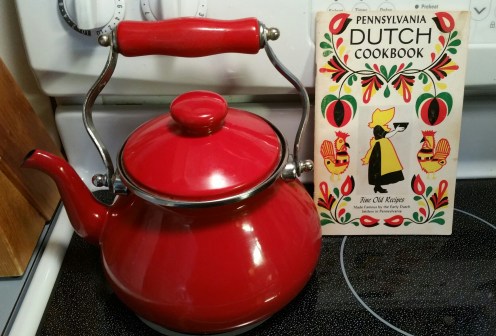
My maternal grandmother preferred natural remedies over chemical ones. The early PA Dutch used a faith healing called Pow wow medicine combined with herbal remedies. My grandmother embraced Pow wow medicine and both herbal and modern medicine, so I guess she wanted to cover all the bases. My mother didn’t want to hear about Pow wow medicine or herbal remedies. My paternal great-grandmother, like my maternal grandmother, embraced all three. As a child, my great-grandmother sent me off to wander the fields and woods to gather items for her. Among her home remedies, she made a salve from the knots on pine trees, so I would go cut off knots on pine trees for her and she made a tea from some weed, the name escapes me at the moment, that was good for whatever ails you. My mother constantly warned me not to drink any of her teas, as I had bad allergies. I sipped my great-grandmother’s teas and survived… That salve she made was actually a good drawing salve for cuts.
On the history channel, when it still was a “history” channel, I watched a show on ancient Egypt and there was a segment on ancient medicine, where the narrator mentioned honey being good to aid in fighting infection and healing cuts. I’ve tried it many times and it works. The ancient Chinese also used honey. I met a young Army wife from south Texas, who babysat my kids when we lived in Germany, who told me to wet a wad of tobacco and stick it on a bee sting to draw out the venom. It worked, so I use it. My late mother would be appalled, but there you have it. She lamented my pack rat tendencies constantly and despaired, when she would ask me why I was keeping all this “junk” and I would respond, “I might need it one day.” And in exasperation she would say, “You are just like your grandmother!” So, I am like my grandmother in many ways….

My grandmothers were just ordinary, poor women in the backwoods of PA, but they worked hard, they were great cooks and bakers, did lovely needlework and quilts, and although “uneducated” they both valued learning. My great-grandmother had a third grade education, married when she was 13 or 14 years old, raised 9 children, ran a farm, she was an expert gardener with shelves midway up her kitchen windows filled with African violets. She taught me how to propagate African violets from leaf cuttings and other plants from cuttings. She taught me how to spot plant insects, diseases and signs of over or under watering. She told me it’s always better to under water than to over water and from my experience that is the truth. She spent her life being productive until she was almost 90 years old. She was in her 70s when I was born and she taught me needlework and I helped her with selecting the fabrics, from boxes of fabric scraps she had acquired from a local blouse factory, and then cutting out her quilt pieces for her. She also patiently helped me learn how to write my letters, while we sat at her kitchen table. She taught me how to read crochet patterns, but despite her best efforts I never caught on to crocheting. She read the newspaper every day.

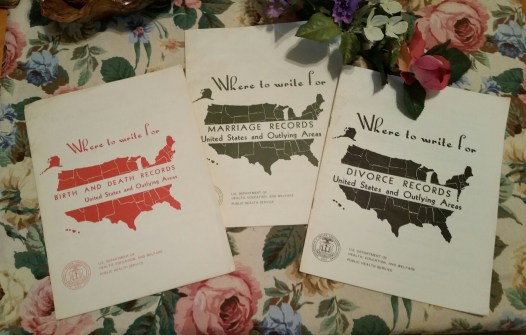
Above: Government leaflets on where to write for records
One summer, I had been up in her attic looking through boxes and came across post cards and old photos, so I carted them downstairs. My great-grandmother, with the third grade education, had somewhere picked up the habit of having tea with cookies or pastry in the afternoon, so we sat at her kitchen table many afternoons, as I would show her old photos and write the names on the back, as she struggled to remember who the relatives in the photos were. This led to my interest in genealogy. So, I did some research and found addresses to write for information on birth and death records, marriage records, and divorce records.
Herein comes this conversation with my husband’s friend about oral histories, where the information age can greatly aid in not only genealogical research, but in compiling and saving oral histories. Several years ago, an elderly customer in the store where I worked asked me for assistance and we had an amazing conversation, after I commented on the WWII baseball cap he was wearing. He was a local farmer wearing overalls, from out in the boonies in rural GA. As he started to tell me of his WWII experiences, it struck me that his was a tale of a soldier from my favorite WWII movie, The Big Red One, which I wrote about in a long ago blog post:
“Being sort of squeamish and abhorring violence, I’m not a fan of war movies, but one of my favorite movies, oddly enough, is The Big Red One, the 1980 Sam Fuller WWII epic. Being a lowly private in the Army, stationed in southern Germany in 1980, our movie theater was located across a parking lot, behind my barracks. My kaserne, perched atop a picturesque southern mountaintop, was a vintage German army post and the Germans built their posts in a consistent, orderly fashion, with the companies neatly arranged around a parade field in the center and all the lesser support facilities beyond that tight circle.
There wasn’t much to do on small kasernes, like the one I was at, but being a little country girl, I found everything new and interesting. I could imagine I was Heidi in the Alps (well, okay, the Swabian Alps), following the footpath down the mountain to the town proper or let my imagination run wild, gazing out the large window at the end of the female hallway, where a view to rival the famous Neuschwanstein Castle, greeted me each morning. My view, a lovely old monastery perched upon another mountaintop in the distance, fueled my ever-fluttering flights of fancy. Of course, I took several trips to that old monastery to explore it close-up.
Now, having a movie theater within walking distance seemed a luxury to me, because the nearest movie theater, where I grew-up in the mountains of PA, was 10 miles away. I would always ask a few of the guys to go to the movies with me and first we’d go to the snack bar, next to the movie theater, for ice cream, because I loved eating my vanilla ice cream first. These uncomplaining young men, in gentlemanly fashion, usually insisted on buying my ice cream too.
I met many wonderful young men in that unit and as an aside to this tale, gentlemen were still in plentiful supply in the US Army in those days. Back to my story, the only drawback to our movie theater was the same movie played for weeks on end, until something new arrived from the States. I watched The Big Red One over and over and each time I came away remembering some new details I had missed before.”
https://libertybellediaries.com/2014/03/24/who-will-defend-our-castle/
This old farmer is one of America’s heroes, who will likely never be remembered for his sacrifices to our great country. If you’ve got old war veterans in your family or neighborhood, just taking a few minutes to record their stories and preserving them in an online journal or creating a blog to share with other family members could preserve more of the real history of our American heroes.
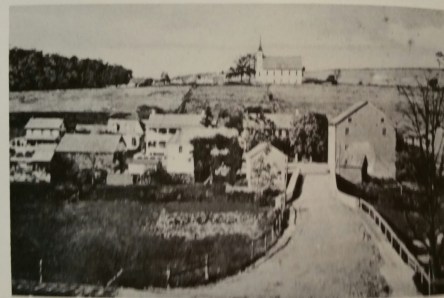
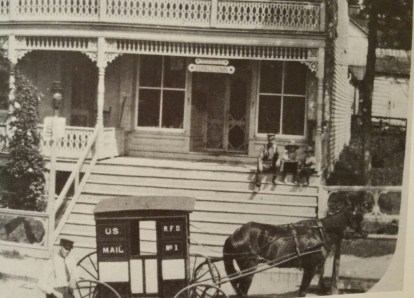
My interest in these old family photos gave me a deeper appreciation of my uneducated, backwoods ancestors. A few times while having tea in my great-grandmother’s kitchen, one of her sons, my Great-Uncle Clark, stopped by and he took an interest in what I was doing. He served in the South Pacific as a Marine in WWII and was seriously injured.
Years later, when my husband and I were visiting my parents in rural PA, my mother told me, “You should go visit Uncle Clark while you’re home. He asks about you all the time.” So, I drove over to his modest home. His wife is a typical PA Dutch homemaker. The house was charmingly decorated and very clean. My Uncle Clark had pursued the genealogy search with a vengeance and he wanted to discuss his findings with me. He had several boxes in the basement he wanted to retrieve, so I trailed along to the basement, where everything was arranged in an orderly fashion and there were shelves lined with home-canned vegetables and fruits.
We carted the boxes up to his kitchen and chatted for several hours. My Uncle Clark passed away several years ago and his genealogy collection, I believe, is with one of his daughters. Someday I’d like to visit her and see if I can take photos of some of his collection and create an online journal, but the one thing I never talked about, nor did my Uncle Clark ever talk about, was his wartime experiences in WWII. I wish I had gotten his war story and not just “old” family history.
Filed under American Character, American History, General Interest
Above is a half-hour lecture on Civic virtue in Early America, by Dr. Saul Cornell, the Paul and Diane Guenther Chair, American History, Fordham University. Dr. Cornell explains the vital role of Civic virtue in the thinking of our Founding Fathers and also in Early American society.
At minute 26:56 Dr. Cornell discusses how after the American Revolution women in America started including elements of American civic values into their needlework samplers, which strikes a chord with me. As an avid needlewoman, I’ve done a great deal of reading about needlework and samplers are my favorite needlework design, actually. A sampler was a personal stitch guide that young girls sewed, as they mastered new stitches. They would use it later as a guide to help them remember the various stitches, which was extremely useful in an era before printed references and literacy were widespread.
Even among educated women, a sampler provided a very useful reference, where you could look at the actual stitch on fabric and see how a stitch was worked. Although samplers served a utilitarian purpose, as with needlewomen for millennia, women add their own personal flourishes and artistic elements to turn the prosaic into something pretty. It is most definitely a “female thing”.
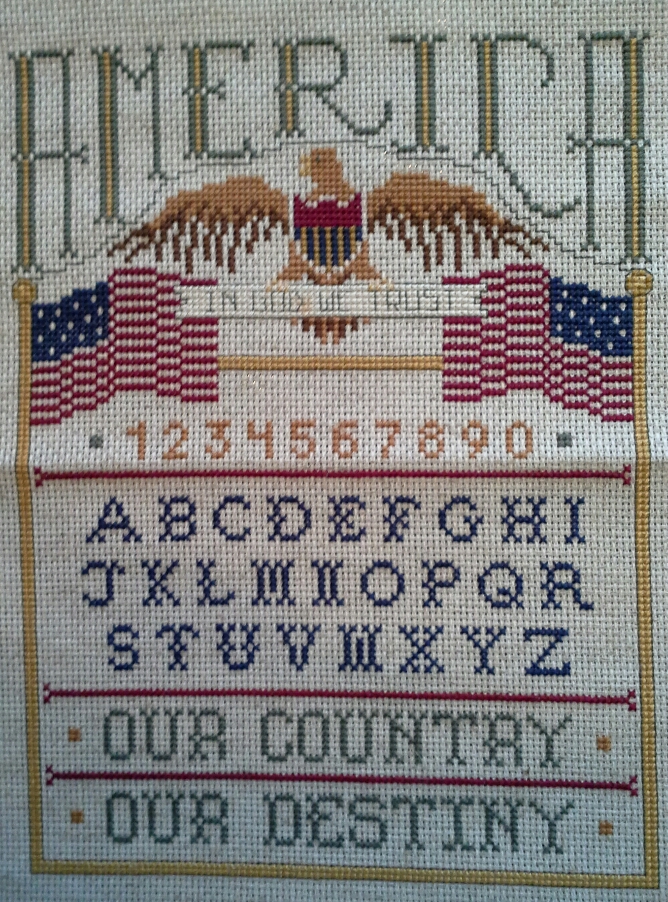
I posted this photo of one of my samplers a while back. Sorry the lighting was bad, but here is one of my samplers with American motifs awaiting pressing and framing. This one was a pattern designed by a modern-day needlework designer:
In previous posts I’ve mentioned Rose Wilder Lane, who besides being a famous early 20th century journalist, novelist and political theorist, was an accomplished needlewoman.
In 1961, Woman’s Day magazine invited Rose Wilder Lane to write the story and history of the development of the needlework arts in America. Just as the spirit of individual liberty invigorated American political and commercial life, it invigorated American women and their needlework. Lane writes:
“The first thing that American needlework tells you is that Americans live in the only classless society. This republic is the only country that has no peasant needlework. Everywhere else, peasant women work their crude, naive, gay patterns, suited to their humble class and frugal lives, while ladies work their rich and formal designs proper to higher birth and breeding.
American needlework is not peasant’s work or aristocrat’s. It is not crude and it is not formal. It is needlework expressing a new and unique spirit, more American than American sculpture, painting, literature or classical music.”
p.10, Woman’s Day Book of American Needlework, , by Rose Wilder Lane, Copyright 1963
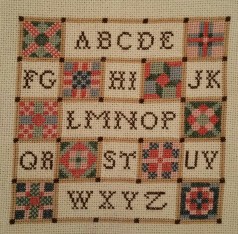
Here are a few more of my other samplers needing some pressing to block the designs (make sure there’s no stretching out) and then framing. Part of the distortion is my poor photography;-)

Although modern day feminists scoff at needlework, personally I think needlework teaches many lessons way more useful than droning about the evil male patriarchy. It teaches patience, self-discipline and perseverance;-)
Filed under American Character, American History, General Interest
“Civilization is built on the practice of keeping promises. It may not sound a high attainment, but if trust in its observance be shaken the whole structure cracks and sinks. Any constructive effort and all human relations – personal, political, and commercial – depend on being able to depend on promises.”
– B.H. Liddell Hart, “Why We Don’t Learn From History”
The massacre of police officers in Dallas late Thursday night, that left 11 police officers shot, 5 fatally, continues to fuel politicians, pundits, political activists and assorted “experts” filling the airwaves and internet with analysis, insights, context, and plenty of SPIN (LIES). All these public mouthpieces yammer on about how to fix “this problem”. Politicians make a living talking about “the problems”, but hardly ever fix any of them. “This problem”, is not just black and white.
There are politicians fueling BLM, starting with President Obama and his minions at the White House. There are black grievance industry activists, many whom have become rich off the backs of “civil rights” activism in America. There are politicians on the right drawing a red line on the 2nd Amendment. There are two presidential campaigns trying to capitalize on looking “presidential” in this crisis. There are police officers across America outraged, saddened and worrying about how to protect their fellow citizens, while feeling under attack and more and more like walking targets wearing their uniforms. There are many angry black people being encouraged to take to the streets and demand “justice”. There are many angry white people too…… some racists, some who feel their right to own guns is under attack, some who are outraged about the police being attacked, etc., etc., etc. Again, “this problem” isn’t just black and white.
There is the Black Lives Matter movement, which at this point should be investigated by federal law enforcement, as to who is funding the movement, who is leading this movement, and determining if this group should be designated a terrorist group. BLM sure looks like an anarchist organization, working to fuel racial discord, encourage attacks on civil law enforcement and to fuel a breakdown of American society.
Fueling racial tensions in America has been a staple tactic of communist, far-left factions, and it is part of the political playbook of people very close to the Obama administration. Sorry, that’s the truth. Van Jones was part of an anarchist movement, an avowed Marxist and an advocate of inciting race wars to advance political change in America. President Obama follows the Cloward-Piven political strategy.
The mainstream press mentions President Obama’s background as a “community organizer” in Chicago often, but they never really explain the history of “community organizing”. Saul Alinksy, an American radical, dedicated to fueling racial tensions for political purposes, founded community organizing and whether you are a leftist who believes, you should never let a crisis go to waste, as Rahm Emmanuel once stated, or a right-winger, like Rush Limbaugh, who has filled talk radio with warnings about Alinsky, Cloward-Piven and political race hustlers, the fact is community organizing is all about sensationalizing racially charged issues for political purposes. That’s it in a nutshell.
Now, here’s a small snapshot of race interactions I saw last week.
Yesterday afternoon I was sitting in my primary care doctor’s waiting room. I had a bad week with my blood sugar and despite several medication changes in the past year to get my Type 2 diabetes back under control, it’s still not. Being put on insulin may be in my near future. Bad week is waking up Monday morning feeling nauseated, with a really bad headache, and feeling like my head was in a fog. Checked my blood sugar, 350. It’s down now, but not down where it needs to be. So, if some of my blog posts this past week were really bad, I’ll use the excuse that my head was in a fog from my diabetes, lol.
So, I was sitting there waiting to see my wonderful, Syrian-born doctor, whom I really think the world of, because beyond being a very good doctor, he always takes the time to talk to me like a person, not just a number. Some doctors treat you like you’re just a list of symptoms on a page to examine, diagnose and prescribe a remedy. My doctor looks me in the eye and listens to me.
While in his waiting room, CNN was playing on the TV, with more news on the Dallas massacre.
There were several other patients waiting, some white, some black. The receptionists were two black ladies. The receptionists know me as an established patient and they’re always smiling, helpful and wonderful. The other patients all behaved courteously and as I waited this elderly white lady showed up, walking with a cane.
I don’t know this lady’s name and the next time I see her, I need to get her name, but we know each other from my doctor’s waiting room and my work in a local store, where she shops often. She sat down next to me and we picked up talking about what’s been going on in our lives since the last time we chatted, without even a moment’s hesitation.
I wrote about this elderly white lady in a 2013 blog post, “An afternoon in the doctor’s waiting room”, and I’m going to repost the first and last paragraph of that post:
“We’re approaching that American holiday that’s come to symbolize two diverse cultures, American settlers and American Indians, oops Native Americans or whatever is the PC-approved term, sitting together to share a meal and offer thanks to God for a successful harvest. Agrarian societies through the ages have held similar celebrations at the end of the harvest season. The unique component of our Thanksgiving rests heavily on our national self-image of a melting pot of cultures living in harmony, where Martin Luther King, Jr.’s dream of a place where we will “sit down at a table of brotherhood” evokes a national yearning for the America we hope we can someday be.”
And it ended:
“It’s not about making race the central theme at the dinner table, but to learn to make a seat at the table and feed as many people as possible that will lead us to the fulfillment of Martin Luther King’s dream. Only by taking the time to get to know people, can you ever find out who they are. People will surprise you, if you let them. She told me that she won a motorcycle in a raffle recently, but she traded it in for a new Harley-Davidson trike. She ended our conversation by telling me, her husband doesn’t have to ask her twice if she wants to ride, because she has always loved to ride motorcycles.”
This lady’s son is a pastor working to build up a congregation for a non-denominational Protestant church and back in 2013 she invited me to her son’s church and yesterday she invited me again. She wasn’t pushy, but sincere, just as a black lady, who came to my door this week, inviting me to her Jehovah’s Witness church was sincere and seemed to be a very nice lady. Unlike many people, who get angry at Jehovah’s Witnesses coming to the door, I try always to be polite, because when I was young and newly married, a pair of them showed up at my door and I talked to them. I wasn’t so much curious about their religion, but why they go door-to-door, despite getting doors slammed in their face often. So, I asked them.
These two ladies pointed me to a Bible verse, Mark 6:7:
“And he called unto him the twelve, and began to send them forth by two and two; and gave them power over unclean spirits”
They explained that they go by twos to spread the Gospel. Now, I am not going to dissect their entire church doctrine, because I am not qualified, but just having a general understanding about why they do go door-to-door helped me to be more tolerant and respectful when they come to my door.
Last week, my friend, Gladius, a Southern Baptist, emailed me an audio link of a sermon, “The Faith of Our Founding Fathers”, which he gave at his local church last Sunday. He discussed the Christian faith of the men who signed the Declaration of Independence. He laid out how much they put on the line by signing that declaration:
“And for the support of this Declaration, with a firm reliance on the protection of divine Providence, we mutually pledge to each other our Lives, our Fortunes and our sacred Honor.”
Gladius gave the statistics on how much many of the signers sacrificed, with many giving their very lives, during the Revolutionary War, to secure the freedoms most Americans take for granted today. A goodly number of them died fighting in the Revolutionary War, and while Gladius didn’t go into the grim details, here are a couple examples of what the men and women of the American Revolution sacrificed, from an article by Dr. Harold Pease, “The price paid for your liberty”:
“Unable to capture Abraham Clark, another signatory, the British took their wrath out on his two sons, who were imprisoned on the notorious prison ship Jersey. “Word was sent to Clark that his boys would be freed if he would disown the revolutionary cause and praise the British Crown. At his refusal, his sons were singled out for cruel treatment. One was placed in a tiny cell and given no food. Fellow prisoners kept him alive by laboriously pushing tiny bits of food through a keyhole. Both sons somehow survived their ordeal.””
Here’s another patriot’s sacrifice:
” The British had a particular zeal for destroying the homes and property of the signers. Those suffering this fate included Benjamin Harrison, George Clymer, Dr. John Witherspoon, Philip Livingston, William Hooper and William Floyd. The sacrifices of John Hart and Francis Lewis are particularly noteworthy. “While his wife lay gravely ill, Redcoats destroyed Hart’s growing crops and ripped his many grist mills to pieces. Bent on taking him, they chased him for several days. They almost nabbed him in a wooded area, but he hid in a cave. When he returned home with his health broken, he found his wife dead and their 13 children scattered.””
Dr. Pease states:
“Probably John Quincy Adams, a son of one of the 55 patriots making the above pledge and later a president of the United States, said it best. “Posterity — You will never know how much it has cost my generation to preserve your freedom. I hope you will make good use of it.” Let us never forget that liberty is not free. It was purchased and maintained by the blood of those before us.”
Gladius brought this same question to the forefront, “How much would you sacrifice for liberty?” It is something all Americans need to think about.
America does need people willing to fight with all their might to preserve our liberty, but truthfully, as one who abhors violence and loves America, perhaps the best way to fight for The Constitution is to quit with the warring political factions, quit with the endless partisan hot-headed rhetoric, quit with all the pointing fingers, but most of all:
“QUIT TREATING FELLOW AMERICANS AS YOUR ENEMY!”“
– Libertybelle, July 9, 2016
It’s time we all work as hard as we can to be Good Citizens.
It’s time for us to fight as hard as we can to unite as one nation dedicated to a common purpose – “Protecting and defending The Constitution”.
Perhaps, if we pledge “our Lives, our Fortunes and our sacred Honor” to preserving our great nation, America can truly fulfill the dream expressed so eloquently by Martin Luther King, Jr. and at long last, “sit down at a table of brotherhood”