Category Archives: American History

Talking to ordinary people

“My country is the world and my religion is to do good.”  – Thomas Paine

Here’s another quote I had typed on a piece of my “cute” stationery in the 70s, which was in my beat-up quote notebook.  The type is fading on these saved quote loose pages, but then again that old typewriter I used in the 70s was a second-hand, manual one my Pop found somewhere.

I had mentioned that I wanted a typewriter and Pop came home with a used one shortly thereafter.   My Pop always encouraged my interests.  When I came home with stray pets, he let me keep them, when I told him I really wanted a large desk, he found an old wood schoolteacher’s desk.  The top was badly damaged, so he covered the top with a woodtone formica, which I absolutely loved.  I didn’t have to worry about damaging the top when I set a glass of iced tea or cup of hot tea (my two favorite drinks – always) on it.  In 7th or 8th grade, I needed to do a science project and science is not my strong suit.  I decided I wanted to order some liquid that I saw in a science catalog a boy in my class had.  It could preserve snowflakes on glass slides.  My mother helped me order the liquid and sure enough, my Pop came home with a microscope and slides, he found somewhere, probably a flea market.  It worked and I got an A on that “saving snowflakes” project…

After looking through my old quote notebook, I decided to tape the falling apart cover back together the other day, using some dollar store, red duct tape I had in my sewing/craft room.  It might be good for another 40 years:

The quote at the top of this post is from Thomas Paine, one of America’s foremost political theorists, activists, and revolutionaries.  He fought with words. The American Pamphlet Debate, probably set the stage for how big issues in America are fought in the public square, as intellectuals, politicians, and often, unheard of American citizens rise from the rabble, with a voice or message that will not be silenced.  America has always had a very egalitarian view when it comes to the voices that gain prominence and effect enormous influence and change.

I like The Smithsonian magazine, because in every issue there are so many articles that spark my interest.  From the July edition I mentioned the article on the history of maps a few days ago.  There’s a very interesting article on Earl Shaffer, who was the first person to hike the entire Appalachian Trail in 1948, that’s definitely worth a read.   Another article in that edition, What Happened to America’s Public Intellectuals?, written by Elizabeth Mitchell, got me thinking, again, about America’s long history with our very open, often loud public debates.

Mitchell lays out the current angst with America’s seeming dismissal of experts, in favor of populist fervor:

“This painful conclusion weighs heavily on public intellectuals, who created the country during the 116 steamy days of the 1787 Constitutional Convention, when Alexander Hamilton, James Madison and crew crafted a new nation entirely out of words. Then they bolstered it with 85 newspaper columns under the pen name Publius, now known as the Federalist Papers, to explain and defend their work.”

Read more: http://www.smithsonianmag.com/history/what-happened-americas-public-intellectuals-180963668/#yVyIdqRP8zD3WrGS.99
Give the gift of Smithsonian magazine for only $12! http://bit.ly/1cGUiGv
Follow us: @SmithsonianMag on Twitter

Understanding America’s long tradition of public debate leading to great political and cultural changes leads me to believe that public intellectual battles, to win American hearts and minds, are ingrained in the American psyche and I don’t believe the soul of America is lost.

Millions of Americans may have fallen for a fast-talking, NYC real estate hustler/con man turned reality TV star, but even with the power of the bully pulpit of the Office of the President of the United States and his just “great” tweet storms, brimming with 140-character rants, he still seems to have a public image problem, if his flagging approval poll numbers are to be believed.  While some of the self-professed “experts” on politics and national security fuss and fume daily, via their own tweet storms, about how people aren’t listening to them, perhaps many of them have the same problem as Trump – overblown egos and constant braggadocio repel many people.

America’s Pamphlet Debate began more than a decade before the Revolutionary War.  I mentioned the 2-volume Library of America set, The American Revolution: Writings from the Pamphlet Debate 1764-1776, in a previous blog post.  The set was edited by Gordon S, Wood and it includes many of the most influential pamphlets in the Pamphlet Debate, which really defined both American political beliefs and principles and later, the very framework of The Constitution. Volume 2, which covers 1773-1776, includes this explanation on Thomas Paine’s writing approach:

“Paine was determined to reach a wide readership, especially among the middling sorts in the tavern and artisan centered worlds of the cities, and to do more than explain and persuade; he wanted to express feelings — even revulsions and visions — that the traditional conventions of writing tended to disparage.  He refused to decorate his work with Latin quotations and scholarly references; instead , he relied on his readers knowing only the Bible and the Book of Common Prayer.  He used simple, direct — some critics said coarse, even barnyard– imagery that could be understood by the unlearned.  He wrote for ordinary people and forever changed the rules of rhetoric.”

p.647,  The American Revolution: Writings from the Pamphlet Debate 1773-1776, edited by Gordon S. Wood, published by The Library of America, copyright 2015

President Trump may have lowered the bar with his effort to reach the common man, resorting to ruthless, modern mass media information warfare tactics (GOP insurgency, indeed), but Americans, even “the worst deplorables”, are not beyond having their hearts won over to American principles, defending The Constitution and above all treating other people respectfully.   Even with FOX news serving as a powerful Trump propaganda platform, America is not becoming Trumpistan.

The real crisis for America’s current intellectual class, is not Trump, but that many Americans are sick of puffed up pontificating pundits, parading a pile of degrees from posh pillars of academia, posing and primping before the cameras  — talking down to them.  Trump, while certainly no Thomas Paine (or Mussolini, for that matter), has learned the fine art of the con man, he identifies his mark and speaks directly to him.  That is why Trump relates to ordinary people – he knows he’s got to get them and keep them buying into him.  He talks to them.

The media faces the same problem as many of the pundits, especially given how many times, in recent months, the media spun themselves into a tizzy with a new, devastating revelation about Trump, which within 24-48 hours fell apart, as the facts in these stories turned out not to be facts at all.  The constant media and punditry Trump hysteria is destroying their credibility way more than anything Trump can do.

I agree with Mitchell’s view on America’s present crisis of spirit.  She writes:

“If we look back at our history, public intellectuals always emerged when the country was sharply divided: during the Civil War, the Vietnam War, the fights for civil rights and women’s rights. This moment of deep ideological division will likely see the return, right when we need them, of the thinkers and talkers who can bridge the emotional divide. But this time they will likely be holding online forums and stirring up podcasts.”
Read more: http://www.smithsonianmag.com/history/what-happened-americas-public-intellectuals-180963668/#yVyIdqRP8zD3WrGS.99

One of the things I love about YouTube videos is that I can find so many crafting and sewing tutorials.   I can watch several videos on how to make something and get different approaches about how to make it.  I don’t have to buy an entire book or magazine for directions for one project.   Often, I end up using bits and pieces of instructions and advice from several videos.  Many of these videos are made by ordinary people and completely amateur.  Yet, some of these amateur videos are carefully edited and produced with the dedication of professional videographers.  Some have tens of thousands of subscribers.

Most of America’s intellectuals and experts on politics and public policy talk to each other, not to ordinary Americans.  And while castigating Trump’s use of Twitter, many of America’s intellectuals lazily lecture and throw temper tantrums about Trump, daily, on Twitter, and of course, boringly brag about all their “expertise”.

Love him or hate him, Trump talks to ordinary people.

Note: Here is a podcast that is a Library of Law and Liberty conversation with Gordon S. Wood, discussing the American .Pamphlet Debate

2 Comments

Filed under American Character, American History, Culture Wars, General Interest, Politics, The Media, Worthwhile Quotations

Soldiers and books

Today, being D-Day, I keep coming across interesting Army history links.  Among the many things I loved about living in an Army community, Army post libraries rank high on my list.  Books have always been near and dear to my heart.  Growing up in a rural PA village, with no public library, my first experience with an actual library was my elementary school library.

The interesting thing about growing up in a rural area, without a public library, is despite the lack of an actual library, books circulated informally among family and friends.  Along with these informal book exchanges, my childhood pastor and his wife, who lived across the road from my family, had acquired a nice-sized home library, which they freely shared with me.

One of the things I quickly noticed around the Army was books circulated in the same informal way as they did in my rural PA village, which was a part of the sense of  “community”, that made me feel at home around the Army.  An added bonus was Army posts, even small ones had post libraries.

Here’s a bit of Army library history:

“During World War I and World War II, camp libraries popped up everywhere at military bases in the United States and all over Europe, stretching as far east as Siberia. These camp libraries were originally established by the American Library Association (ALA), and at the end of World War I, ALA transferred control of them to the war department, which maintains them to this day. ALA worked with the YMCA, the Knights of Columbus, and the American Red Cross to provide library services to other organizations, such as hospitals and rehabilitation centers.

These libraries were nothing glamorous—usually a shed, shack, or a hut built of wood and other available materials. They were run by librarians who volunteered to travel overseas to care for the libraries. Responsibilities included circulating the collections, maintaining them, weeding out books, and acquiring new ones. More than 1,000 librarians volunteered during World War I, and that number only increased with World War II.”

How libraries served soldiers and civilians during WWI and WWII

Leave a comment

Filed under American History, General Interest, Military

D-Day Remembered

1 Comment

Filed under American Character, American History, General Interest, Military

Senator Ben Sasse explains Inauguration Day

Leave a comment

Filed under American Character, American History, General Interest, The Constitution

Hand-me-downs

wp-1483053909409.jpg

A hand-me-down book from my childhood

Fair warning, this is going to be another backwoods PA story from my childhood.  Escape while you can:-)

I was born in 1960 and grew-up in a small village in the Pocono Mountains.  Our end of the county was and still is called the West End (which is synonymous with hicks).  Most of our neighbors were of PA German ancestry, although even in the 1960s, the urban exodus to the Poconos had begun.   The Poconos had been a vacation spot for city dwellers since the Civil War era, but during my childhood many of these urban visitors began building homes in the Poconos and staying year-round.  Many of the locals hold the urban dwellers moving into their peaceful country neighborhood as loud, boorish, pushy, stupid and very rude.

Back in the 90s, a phone conversation with my mother railing about some “stupid New Yorker” about sums up the sentiment and the disconnect.  My mother was complaining about some woman from New York who wanted the township to pay for street lights in her little residential area in the Poconos.  The woman also apparently had thought sidewalks would be a good idea.  My mother, like most locals, ended her complaints with a statement that went pretty much like, “I wish these damned city people would go back to the city and leave us alone!”

However, that unknown woman from New York got a very different reaction than my mother dealing with our pastor’s wife, who was not only New York City born and bred, but also Jewish.  The parsonage was right across the road from our home, so our pastor’s wife was also our neighbor.  My mother adored our pastor’s wife, my mother adored her elderly mother too, who would come and visit for several weeks at a time when I was a child.

It’s often interesting how many people will prejudge an entire group of people, but when they are in a situation where they are dealing with an individual from that group and getting to know him or her, all of sudden common ground can be found and friendships blossom.

Spending my adult life around Army communities, I’ve always been very grateful for the experience of being able to meet so many people from so many different countries, backgrounds, and experiences.  The thing that binds Army communities is soldiers with a common mission.  Their wives, no matter if they are foreign-born or American invariably become friends, share recipes, share in the worries when their spouses deploy, and share in a sense of community.

Finding that common ground in America is an existential crisis, not media hysteria about “fake news” or “Russian influence”.

The partisan political divides, listening to political pundits, reading news from various political stripes and observing comments on Twitter, facebook, etc., make me feel like these groups live on different planets, not in the same country.

So, back to my childhood, in a family with six kids, with widely different opinions.  For instance, conservative me, has a far-left brother, who was really into zero population growth as a cause.  When he lectured me when I was pregnant with my third child, asking if my husband and I thought our genes were so good that we had to spread them around with so many children, well, I didn’t get angry.  I smiled at him and replied, “Well, now that you mention it, yes, we do.”  I also told him I wanted 5 or 7 kids, because I like odd numbers (although we stopped “spreading our genes around”, overpopulating the world, at 4 kids).

No matter how angry we were at each other or how vehemently we disagreed, when it was dinner time, we all had to sit at the table and behave civilly.  My parents didn’t want to hear how mad we were or how much we disagreed or whether we had been fighting all day about something – we had to sit at the table and eat our dinner.  There was no taking your plate to another room or screaming at each other at the table allowed.

Especially with the advent of the internet, the splintering of America has escalated, where there’s really very little discussion in online political discussion forums, only hyper-charged partisan attacks.  Each side generates talking points, which the political combatants hurl back and forth non-stop.  Poll numbers get tossed in to validate positions, although really polls are meaningless – they’re the opinions of a few people extrapolated to represent the opinions of very large groups of people.

I’ve met many wonderful people from New York City and other urban areas.  I’ve also met some total assholes right where I grew up, who were locals.  And it shouldn’t even have to be said in America, but we’ve got to start talking to each other and move beyond our own little cocoon of people who think just like we do or hold the same political views.

We need to start embracing getting to know people as individuals.

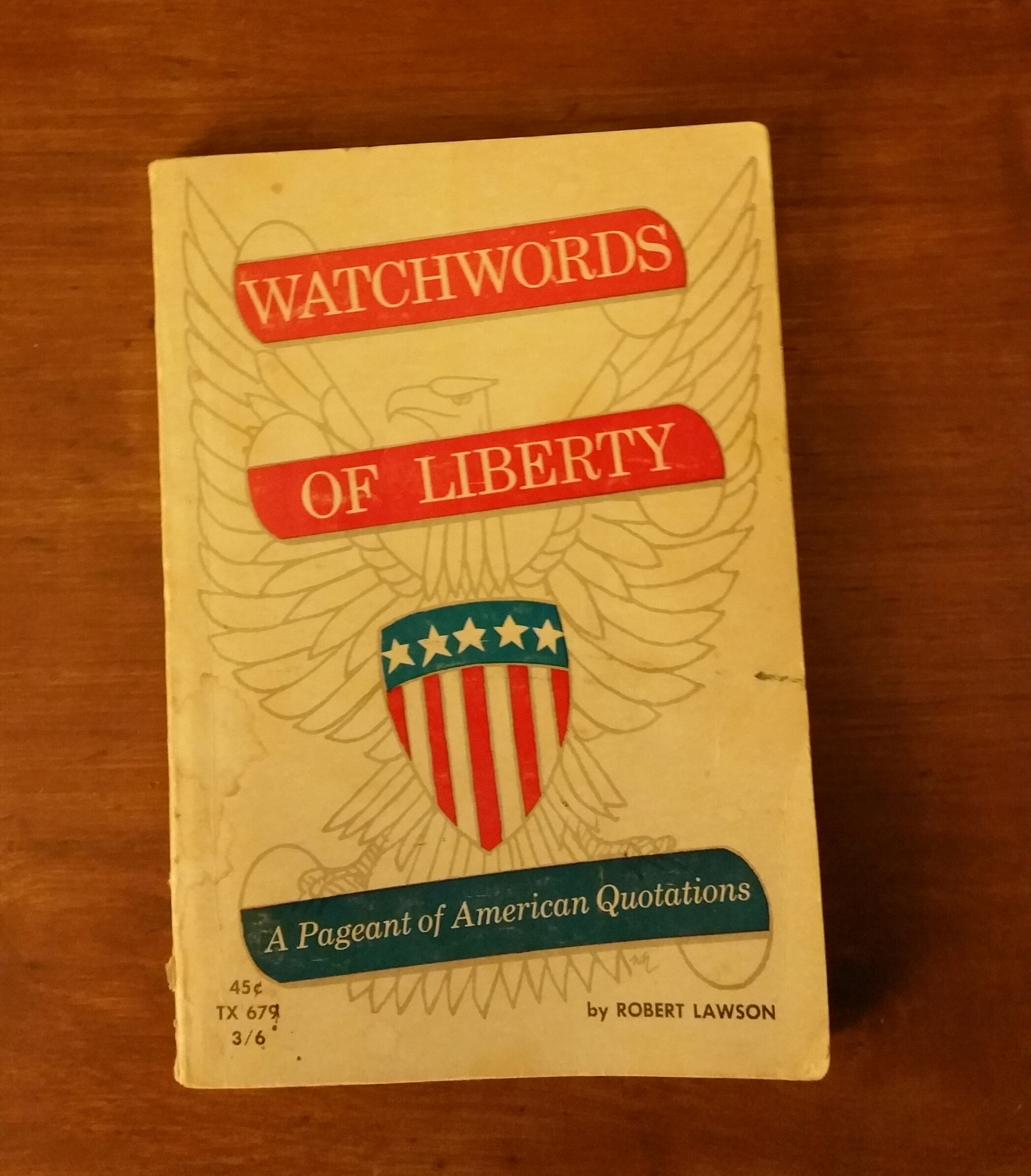
The same goes for considering political viewpoints and here again, my mother taught me that you can’t make anyone believe anything.  My oldest sister is 8 years older than me and she had friends in high school, who like her, read a lot.  Along with wearing hand-me-down clothes, I became a proud collector of hand-me-down books.  Anything my sister or her friends were ready to discard, I was ready to add it to my “collection” of books.  I read the entire Warren Commission Report in paperback, I got a copy of To Kill A Mockingbird.  I still have the Watchwords of Liberty, filled with great American quotes.  I also ended up with paperback histories like:

wp-1483053958016.jpg

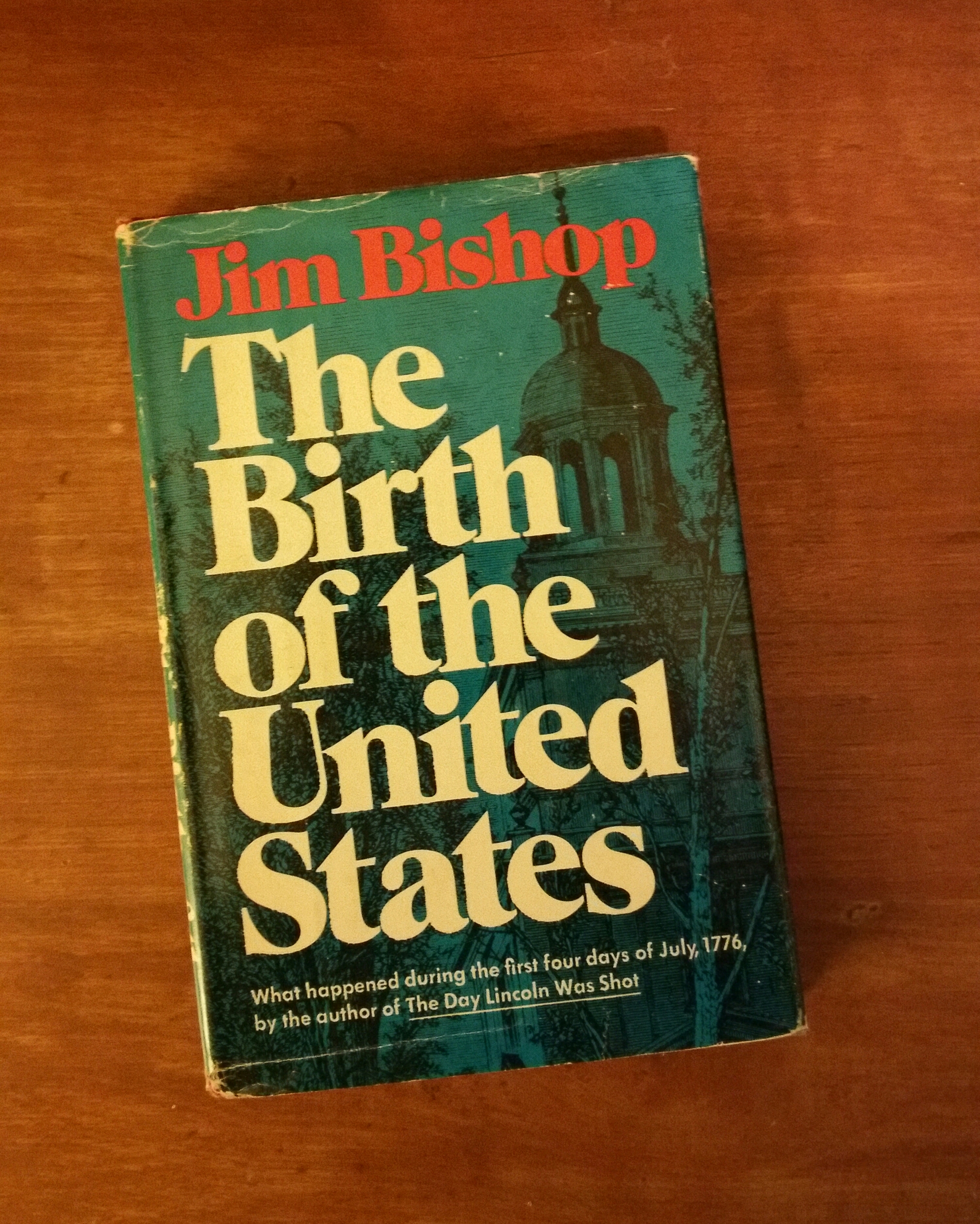
Then somehow I ended up with:

wp-1483054003464.jpg

So, while you might expect my conservative, staunch Republican mother to want this book out of her house, you’d be wrong.  She told me she didn’t believe in Marxism, but to decide for myself.  She gave me a copy of a little booklet (which I gave to someone), called, Good Citizen and she told me this booklet had a lot of interesting information on America.  So, I read Marx’s Concept of Man and then I read her Good Citizen booklet and many other books too.

In 1976, the American Bicentennial fueled a bunch of books on the American Revolution and my American love affair with The Constitution and our republic bloomed like cherry blossoms in Washington springtime.  I was hooked on American ideals.  I had started adding to my hand-me-down book “collection” with books I bought with babysitting money – books like:

wp-1483057678139.jpg

I also got enthralled by The Kent Family Chronicles, that John Jakes series commemorating the 200 year anniversary of America.  By that point, I was sold on The Constitution, sold on American ideals and Marx sounded like depressing whining about “unfairness”, where there’s never any hope for individuals to aspire to anything… just endless reliance on imposition of command economy enforcers to decide on what’s fair and relentless fueling class warfare. The American Bicentennial fueled a life-long love of reading American history.  My short time in the Army expanded that to loving to read military history too.

In life, we all have some really dumb ideas and beliefs.   That’s the truth!  No one gets through life being perfect and all-knowing.  For instance, I abhor violence and had this idea that all behavior is learned, so when I had kids, I didn’t want my kids to be violent.  I didn’t want my sons to have any toy guns, because I believed that would encourage violence.  I believed this despite the fact that I got into plenty of fistfights as a kid fighting bullies.

My mother and sisters laughed at me and told me I was stupid.  My husband just rolled his eyes.  My toddler sons, well, they turned everything into a weapon, to include their older sister’s Barbie dolls.  They were very destructive and liked to clobber each other, while there I was telling them in this prissy voice, “you’ve got to be nice!”  My daughter didn’t take to them wrecking her stuff and she smacked them when they touched her stuff.  So much for my toy guns make boys violent belief.

When I told my mother about my sons throwing everything and turning everything into a weapon, which my daughter had never done, my mother said, “welcome to the world of boys.”

Here’s another story on “boys” from a few years later.  We were living in Germany and I was throwing a birthday party for one of my sons.  My next-door neighbor had a lot of very colorful finches in a cage and she decided to let them fly loose that day.  They were getting ready to PCS back to the states.  My daughter came running in the house to tell me that all these little boys had sticks and were trying to kill these little finches that were sitting in the bushes around the house.  So, I walked outside and there was this group of little boys, bloodlust in their eyes, gleefully trying to kill these tiny birds with big sticks.   They were barbarians!  In that moment I realized that there is something about males and violence that is probably hard-wired.  And I realized that my “be nice” idea had been idiotic all along.

What people believe can’t be forced, so it’s best to try to find that common ground, I keep blabbing on about.  Here again, I think my mother had the right idea there too – get people to sit at the same table and share a meal, insisting that everyone be polite.

Simple as it may be, perhaps just getting people to share a meal and talk might work miracles, where all the social programs have failed.  Here’s an old LB blog post from 2014:

“I’m always amazed at how when people sit down to share a meal, the petty squabbles subside, conversations almost invariably turn to family and home.  A friendly dinner table is the world’s most under-tapped peacemaking tool.  The simple act of breaking bread together at a table of brotherhood doesn’t seem all that hard and once people can come together and peacefully share a meal and conversation, then all the other politicized barriers fall to the wayside.  Community potlucks could rebuild communities and not cost taxpayers a dime.  Believe it, because it’s true and with so much animosity and hatred in America, at the very least neighbors might make new friends, so there’s no downside to the endeavor.”

https://libertybellediaries.com/2014/11/29/another-home-truth/

I also quoted my mother’s least favorite poet, Maya Angelou in that post.  I’m not a fan of Angelou’s poetry either, but she sure nailed a home truth with this quote:

“Hate, it has caused a lot of problems in the world, but has not solved one yet.”
http://www.goodreads.com/quotes/26244-hate-it-has-caused-a-lot-of-problems-in-the

Again, finding ways to heal the divides in America is an existential necessity.

1 Comment

Filed under American Character, American History, Culture Wars, General Interest, Politics, The Constitution

Pamphlet Debates in 140 characters…

wp-1482377030052.jpg
Started another plastic canvas tissue box cover – 2 sides done and working on the 3rd side.  This one is for my friend, Marrietta, in AZ, who is an expert quilter, talented maker of beadwork jewelry, all around creative needle-worker, and the maker of fantastic potholders:wp-1475350243889.jpg

I used bolder colors than the picture with the pattern, because, unlike me, she’s not a “pink person.  I love pink, it’s one of my favorite colors.  True story – decades ago we were discussing repainting the living room walls and since my husband defers to me on decorating and because he’s color-blind, I sold him on painting the living room walls a lovely rose color.  It wasn’t bubblegum pink, but a more dignified pink color.  I told him “rose” is not “pink”.  As he painted, he kept saying, “Are you sure this isn’t pink?”  I kept a straight face and said, “NO, it’s “rose”!”  All the pictures and decorations on the walls popped with that rose color in the background and it sure beat that standard off-white color the walls were originally.  The next time we painted the walls, he insisted it was his turn to pick the color and it was back to boring – English eggshell was the name of that blah off-white color.

On to politics – the Left’s push to discredit the electoral college continues.  A big component of their talking points is that the electoral college is racist and a remnant of slavery.  Well, since The Constitution was written when slavery was legal, not only in the South, but also in the North too, abolishing slavery was not a central issue to the debates on The Constitution. Sure, there was a budding abolitionist movement in the late 1700s, but the overarching goal of the framers of The Constitution was to unite the States and create a federal framework.

I grew up in PA and as my husband always says, “They’re a bunch of Quakers!” (although my family was Lutheran/Reformed).  PA was where the first abolitionist society in America,  Society for the Relief of Free Negroes Unlawfully Held in Bondage, formed in 1775.  It was founded by Quakers, in fact, Thomas Paine, one of America’s greatest “Domestic Propagandists” (to borrow President Obama’s terminology), was a founding member of the group.

William Penn, the founder of Pennsylvania, was a Quaker and to get a feel for Quaker moral conscience, you can read his work, Some Fruits of Solitude.

The British colonial experience in early America was an amazing lab of real-life experiments in various governmental forms and societal orders.  Supreme Court Justice, John Marshall, who largely defined America’s Supreme Court, took on the task of writing a biography of George Washington, which resulted in a 5-volume set, titled, The Life of George Washington.  The first volume goes into finely detailed history of the explorations in government in early America.  To understand how at the end of the 1700s, Americans were forging ahead with a revolutionary new government, the history of the colonial governmental experiments will give you a broader view.  Here is a free online copy of Volume 1.

Now, on to the electoral college debate.  Since most states had legal slavery, not just Southern states, although some abolitionist sentiments were percolating in colonial America, when the founders, who had forged together The Articles of Confederation as a government framework during the American Revolution, met in 1787 to draft The Constitution of the United States, their intent was to draft an entirely new governmental framework – a constitutional federal republic.

The Articles of Confederation were felt to be in need of improvement.  One of the key failings in the articles, was the same failing of many previous mutual defense agreements between states throughout the 1700s, it did nothing to provide for a unified defense.  In many agreements between states, in previous decades, requests by one state for militias from another state to assist in military defense needs, were ignored, tardy or insufficient to repel attacks. States often didn’t live up to their pledged defense agreements.  The early American frontier was a battle front, with attacks from French and Indians in the north and Spanish and more Indians in the south.  The founders had just fought the Revolutionary War, so the intent of drafting The Constitution was to create a stronger union and a national defense structure.

How the framers of The Constitution sold their revolutionary new governmental framework was through Pamphlet Debates, which were a common form of political debate in colonial times.  The most famous pamphlet debates on The Constitution are called The Federalist Papers, where three writers, John Jay, Alexander Hamilton, and James Madison, using pen names, energetically set forth to sell America on The Constitution they were writing.  Other Americans argued mightily against their radical new form of government, some in its entirety, and some only argued against certain aspects of it.

In today’s factionalized America, President Obama referred to people supporting the electoral college online as “Domestic Propagandists”, using a tone you’d expect to be reserved for calling people “domestic terrorists”. Online, anytime anyone posts an opposing viewpoint or makes mincemeat of an opposing viewpoint, the person is labeled a “troll”.  It’s time for more people to make their case, in a vigorous national debate, if they want to amend The Constitution.  Some flim-flam, spin-cycle media blitz in a hyped “crisis” mode won’t work for the Dems, who are pushing this only to delegitimize Trump’s winning the presidency.

The electoral college was designed to promote states sovereignty and afford proportional representation among states, so that less populated states would not be marginalized by more populous states.  This idea that the founders were all enthused about “popular votes” is nonsense, since some states only allowed land-owners to vote.  Slaves were used only to pad the census numbers to give southern states more power and women were not allowed to vote at all. The idea to promote states soverignty, the concept of federalism,  is encapsulated in the 10th Amendment to The Constitution:

Amendment X

The powers not delegated to the United States by the Constitution, nor prohibited by it to the states, are reserved to the states respectively, or to the people.

https://www.law.cornell.edu/constitution/tenth_amendment

Conservative Review put out a Twitter video called, “You Do You”, which in an entertaining manner explains federalism:

https://twitter.com/CR/status/810868496544493568

The thing about America, that should hearten all Americans, is we live in a country where we are free to have opposing views.  We are free to criticize our government and elected officials, without fear of reprisals too.

So, if the Left wants to abolish the electoral college, let the free, open, spirited debate begin.


Decided to update this post with a link to an October LB post: America: Our Ordered Liberty Roots, in which I mentioned British charters:

To understand America’s founding, it’s important to look at who the first settlers in America were and how the American colonies were set-up and developed. Originally the British colonies, who later broke off from England and the British crown, operated under proprietary colonies, royal charters, or charters:

“A charter is a document that gave colonies the legal rights to exist. A charter is a document, bestowing certain rights on a town, city, university or an institution. Colonial Charters were empowered when the king gave a grant of exclusive powers for the governance of land to proprietors or a settlement company. The charters defined the relationship of the colony to the mother country, free from involvement from the Crown. For the trading companies, charters vested the powers of government in the company in England. The officers would determine the administration, laws, and ordinances for the colony, but only as conforming to the laws of England. Proprietary charters gave governing authority to the proprietor, who determined the form of government, chose the officers, and made laws, subject to the advice and consent of the freemen. All colonial charters guaranteed to the colonists the vague rights and privileges of Englishmen, which would later cause trouble during the revolutionary era. In the second half of the seventeenth century, the Crown looked upon charters as obstacles to colonial control, substituting the royal province for corporations and proprietary governments.”

https://en.wikipedia.org/wiki/Colonial_charters_in_the_Thirteen_Colonies

The American colonies, in essence,  were business ventures, set-up to operate under a British legal structure, but the charter-holder had control of appointing whom would administer the law within the colony.  In some colonies, the crown directly appointed an administrator for the colony.  The colonial administrators varied widely in leadership ability, legal knowledge, experience and also administrative talent. However, the actual American settlers who embarked on setting up the colonies (business ventures) were almost exclusively Christians of various denominations and their Christian faith defined every aspect of their communities.

4 Comments

Filed under American History, Culture Wars, General Interest, The Constitution, The Media

“Domestic Propagandists”


wp-1482153142675.jpg

Decided to make another one of these quilt design plastic canvas tissue box covers for my friend.  This design is called Arrowhead… a perfectly named American pattern.

wp-1482154530964.jpg

This pattern leaflet has 8 different quilt designs.

wp-1481647930697.jpg

This pattern is called Log Cabin, another perfectly named American quilt pattern.

Quilting had been done all around the world, but industrious and frugal early American women turned quilting into a distinctive American needle art form. These early Americans carefully saved small fabric scraps from old clothing and blankets, which they pieced together into blocks.  They arranged the blocks into a quilt and often used solid color strips, called “sashing,” between the blocks,  “to frame” them.  Slave women quilted too and studying the history of African-American quilting is a neglected area of quilt history, that has gained attention in recent years.

wp-1482154602308.jpg

On the left, in the background of my tissue box cover photo, in my row of books, next to my book about Samuel Adams, there’s a gap.  Sorry the previous sentence sounds like a “in the library, next to the desk” clue leading you to the murder weapon, in a “Whodunit” mystery, but I assure you, it led to a book about an important American patriot in our nation’s fight for Independence: Thomas Paine.

After President Obama mentioned “Domestic Propagandists”, in tones that sounded like he was referring to “Domestic Terrorists” over the weekend, well, I pulled out my book, “46 Pages: Thomas Paine, Common Sense, and the Turning Point to Independence” by Scott Liell.  I had purchased this book a few years ago and hadn’t read it yet, but I started reading it last night… in between stitching this tissue box cover and tweeting.  I’m quite the multi-tasker these days, lol.

“Domestic Propagandists” indeed, LOL.  All I can say to that is, “Yankee Doodle Dandy!”

Have a nice day and maybe after today the Queen Hillary coup attempt to overthrow The Constitution will be over.

Leave a comment

Filed under American History, General Interest

Mixed potpourri

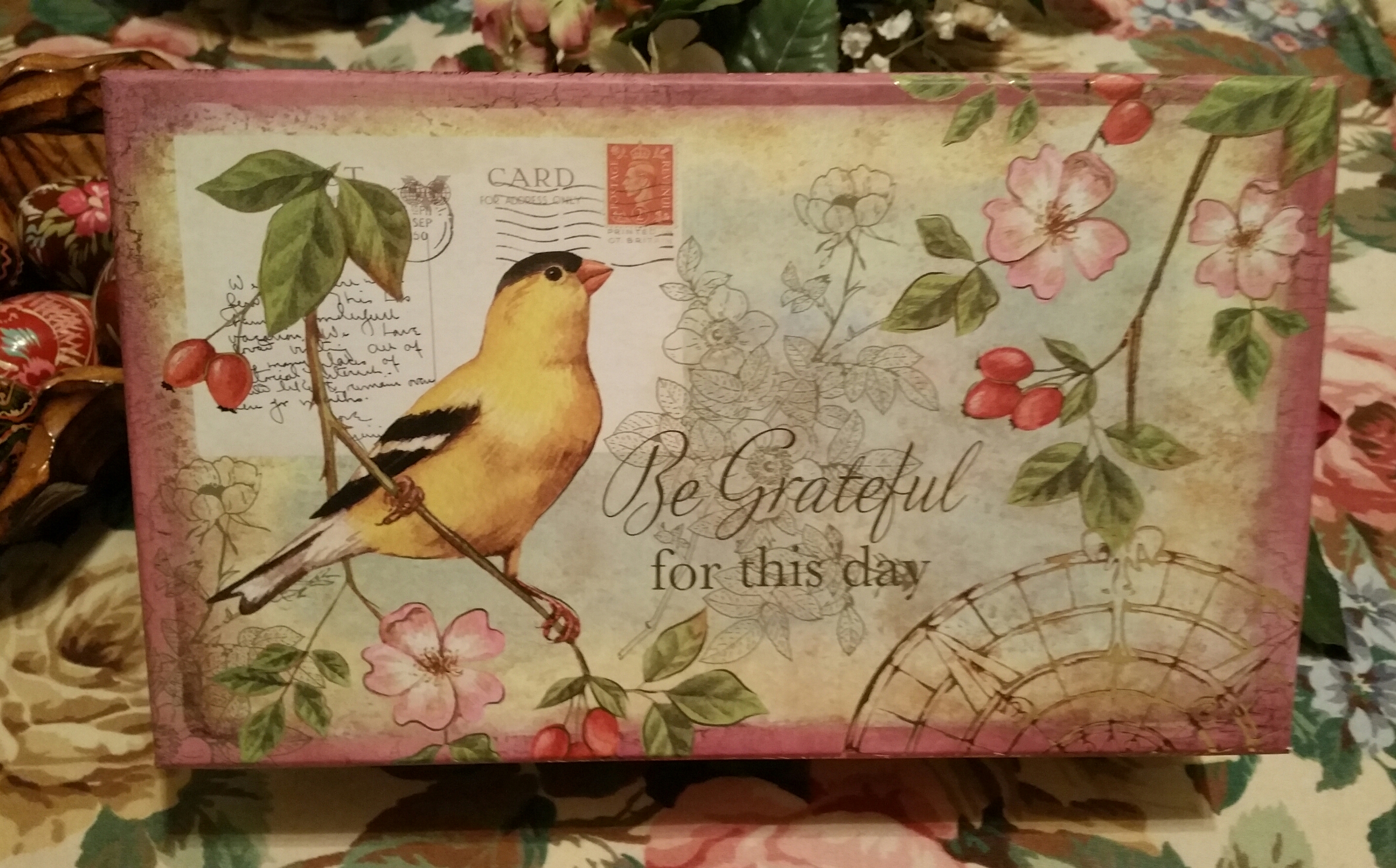
wp-1477628355558.jpg
A dollar of cheer – yep, a decorative box from the Dollar Store to hold junk on my desk.

There’s still more of Buddy’s 4th of July sermon I want to incorporate into another blog post, but first I need to do some more research, reading and pondering.  I spend a lot of time “pondering”.   While I ponder that, here are some thoughts from this election.  This post is a mixed potpourri of thoughts – no cohesive theme.

The media, popular blogs and news sites are even more tiresome than the candidates, for instance, Drudge is running the same agitprop game for Trump against Hillary, that he ran against the GOP candidates in the primary.  It’s amazing to behold.  In a change from Drudge’s onslaught of posting photos of Hillary looking demented or decrepit, today he had a collage of Hillary the guzzler/alcoholic-themed photos.

The mainstream media keeps running non-stop “news” stories about “Trump the Sexual Predator” and then you have conservative news sites hyping “Bill Clinton the Sexual Predator”.  The Free Washington Beacon has a story interviewing Dolly Kyle, a woman who claims to have had an affair with Bill Clinton many years ago.  The irrelevancy and sheer cattiness of Kyle’s attack is stunning and one wonders what the point is to print this sort of garbage:

“Kyle’s most memorable run in with Bill and Hillary Clinton revolved around Hillary’s poor hygiene.

“I picked Billy up at the airport and he had this dowdy-looking middle-aged woman with him … this woman was Hillary,” Kyle said. “Hillary, I thought was a Hillary impersonator. Because she looked so bad and she smelled so bad I just didn’t believe this was Hillary.”

Hillary’s bad odor and unkempt appearance were what Kyle claimed she remembered most, thinking Bill Clinton was playing some sort of “sick joke” on her.

“I couldn’t imagine why Billy would haul such a person in the plane with him in public. She was wearing a misshapen, brown, dress-like thing that must have been intended to hide her lumpy body. The garment was long, but stopped too soon to hide her fat ankles and her thick calves covered with black hair,” Kyle said.

“I noticed that the woman emitted an overpowering odor of perspiration and greasy hair. I hoped that I wouldn’t gag when she got in my car. The sandal-shod woman with lank, smelly hair stood off to the side and glared at everyone.””

http://freebeacon.com/politics/hillary-the-warden-clinton-smells-bad/

This extremely, full-bitch mode, catty attack is from the 1970s, just as Trump’s bimbo eruption is bimbos from years ago.  This Kyle woman was having an affair with a married man,  and that decades later she’s tossing this dirt out into the public square, speaks volumes about her character.  That news sites run this, as if it’s newsworthy, speaks to their lack of integrity too.  On the other side, days ago, Gloria Allred was wheeling out another woman who claims that Donald Trump treated her disrespectfully and like a sex object… that woman is a porn star…  Here we are, subjected to the geriatric Viagra generation’s sex stories.   Along with trying to go the low road of all-out scorched earth, for the media and online sites, all of this garbage is meant to garner clicks and attention.
Sex sells.

The scorched earth campaigns being waged by both Hillary Clinton and Donald Trump truly  disrespect the American people and are a national embarrassment.

I am reading some of the Pamphlet Debate from 1764-1775, which I have in a 2-volume set, because so many of the stirrings among the American people today and their discontent with Washington echo popular sentiment that brewed for the years leading up to the American Revolution.

I see some historical parallels in the rise of individual bloggers online, often writing anonymously, as being very similar to the pamphlet writers leading up to the American Revolution. This pamphlet debate preceded the Debate on The Constitution, which took place years later where the people, both for and against The Constitution, once again waged a war for the hearts and minds of the American people via pamphlets and newspapers.

These early American writers also often used pseudonyms.  So, political blogging using pseudonyms follows a long American tradition.  I actually went with my pen name as a combination of my affection for The Federalist Papers and my affection for historical romance novels.  There’s a Julia Quinn series, set in Regency England, where an anonymous writer, Lady Whistledown,  is publishing “titillating and intriguing society gossip”, which plays into the plots.  None of Lady Whistledown’s gossip comes anywhere near to this gutter politics election.

Gordon S. Wood, Brown University’s professor of history, emeritus, edited this 2-volume set and he states that the revolution was created in the minds of American rebels long before 1775.  The discontent rippling in both the outer edges of the left and right, which led to Sanders and Trump being able to gain traction, has been brewing for years too.

Military adventures, from ancient times to the present, while offering new territory and riches or securing some vital geopolitical advantage, are always expensive and almost always lead to a country incurring large war debts. In 1765, the British enacted The Stamp Act, which was very unpopular in the American colonies, but was intended to pay off war debt from The Seven Years War and fund security needs in the British North American colonies.

In the present, we have gone through more than a decade of endless war, with no real gain for America in any way – certainly no gain in national security. We have endured 8 years of increasing government programs with the exorbitantly expensive Affordable Healthcare Act, but that was preceded by an economic downturn, trillions in debt through the bail-outs and prior to that GWB doing his prescription drug program, in the midst of very expensive military operations in Iraq and Afghanistan.

The looming debt crisis coupled with a stagnant economy and the fractured polity in Washington is fomenting widespread discontent, but even worse, distrust in our government’s ability to govern.

For the past year, the common refrain to justify the anger that feeds the Trump movement, BLM, Sanders supporters, and other Americans feeling mistreated disgusts me.   Each person railing should be asked what they have actually done to make their own life, their families’ lives and their community a better place.  People throughout the ages always look to some mystical leader to create, to borrow President Obama’s, parting the waters promise, “Change you can believe in.”

No one person or leader can “make America great again” or  turn an angry person, who feels his/her life  a train wreck into a success.  Only you can change your own life and establish order in it and only people in their own communities can establish the social structure and actions to restore broken communities.

Russelk Kirk explains social order in terms everyone can understand:

“Like many other concepts, perhaps the word “order” is best apprehended by looking at its opposite, “disorder.” A disordered existence is a confused and miserable existence. If a society falls into general disorder, many of its members will cease to exist at all. And if the members of a society are disordered in spirit, the outward order of the commonwealth cannot endure.

We couple the words “law and order”; and indeed they are related, yet they are not identical. Laws arise out of a social order; they are the general rules which make possible the tolerable functioning of an order. Nevertheless an order is bigger than its laws, and many aspects of any social order are determined by beliefs and customs, rather than being governed by positive laws.

This word “order” means a systematic and harmonious arrangement—whether in one’s own character or in the commonwealth. Also “order” signifies the performance of certain duties and the enjoyment of certain rights in a community: thus we use the phrase “the civil social order.””

Kirk, Russell. The Roots of American Order (Kindle Locations 389-397). Intercollegiate Studies Institute. Kindle Edition.

November 8th won’t resolve anything.

Washington can’t fix what’s broken in America, only millions of Americans across America, committing to change their own lives, families, and communities can do that.  However, some honorable leaders assuredly could help inspire and guide Americans in this process.  Money and more “programs” can’t fix social problems – only people can do that.

It’s highly unlikely, that either Trump or Hillary will be able to move the country toward any sense of unity or common purpose – both are clueless, corrupt, lack any historical vision, and beyond that both have narcissistic personalities, that repel people from being able to trust in their integrity. Either one bodes poorly for America’s future. Hillary will be consumed by fall-out from her emails (especially foreign blackmail) and Republicans determined to expose her corruption. Trump will be easily manipulated by America’s adversaries, continues to prefer waging war against Republicans, meaning he will never be able to unify even his own party, let alone Democrats or the country. His hubris, coupled with his disdain for actually studying policy and penchant for rash, incendiary statements, dooms him as a leader.

Two toxic leaders, who are both neck deep into wholesale public corruption,  are the choices.  American discontent and virulent factions  assuredly will continue to percolate, but I hope they don’t boil over.  Trying to keep a positive attitude is a challenge where the media and these two vile candidates have turned watching the news so cringe-worthy, you feel like you need a shower afterwards.

I kind of like looking at my Dollar Store box, with the metallic gold lettering and cheerful yellow bird.  I keep it here on my desk to cheer me up every day… and remind me to: “Be grateful for every day!”

America needs voices of hope and inspiration… but absent that we can always laugh:

There’s a whole bunch of these “epic rap battle” videos on YouTube, like Joan of Arc vs. Miley Cyrus or Dr. Seuss vs. Shakespeare, etc., etc.

4 Comments

Filed under American Character, American History, Culture Wars, General Interest, Politics, Public Corruption

America: Our Ordered Liberty Roots

The Liberty Bell

The previous two posts dealt with cultural chaos and chaos in too many homes across America.  This post is going to be more a big picture of America’s founding, both political and cultural.   This will take two posts.  In this post I’d like to cover some basic American history and relate some examples of “selfless sacrifice”, an alien core civic value to probably most Americans today, but completely still understood by almost every member of the US Armed Forces.  Then in the next post, I’m going to attempt to explain some small steps, using more personal examples, that I believe, might help America become a united country again and help alleviate some of the cultural chaos.

The picture above is The Liberty Bell, located in Philadelphia, PA and considered an iconic symbol of American liberty.  In the 1830s, abolitionist societies in America adopted the Liberty Bell as a symbol for freedom too.  The inscription on the Liberty Bell speaks to the Christian faith of America’s founding fathers:

“The Pennsylvania Assembly ordered the Bell in 1751 to commemorate the 50-year anniversary of William Penn’s 1701 Charter of Privileges, Pennsylvania’s original Constitution. It speaks of the rights and freedoms valued by people the world over. Particularly forward thinking were Penn’s ideas on religious freedom, his liberal stance on Native American rights, and his inclusion of citizens in enacting laws.

The Liberty Bell gained iconic importance when abolitionists in their efforts to put an end to slavery throughout America adopted it as a symbol.

As the Bell was created to commemorate the golden anniversary of Penn’s Charter, the quotation “Proclaim Liberty throughout all the land unto all the inhabitants thereof,” from Leviticus 25:10, was particularly apt. For the line in the Bible immediately preceding “proclaim liberty” is, “And ye shall hallow the fiftieth year.” What better way to pay homage to Penn and hallow the 50th year than with a bell proclaiming liberty?”

http://www.ushistory.org/libertybell/

Just as keeping order in your family and community is the way to assure everyone can live peacefully, the same applies to government too.  Sure, all sorts of governmental structures exist and most people survive, even under the most oppressive governmental systems, but America is unique in world history.   Our founding fathers sat down and devised a governmental system based on a careful study of history, weighing pros and cons, while determined to create a system of government that completely deviated from history, by establishing a government run as a bottom-up system, where the people control the government rather than the government controlling the people.  We have a republic, where checks and balances were carefully incorporated into The Constitution, and where the rule of law was established to protect individual liberty, while establishing laws necessary to maintain social order.  We have a system of:

Ordered Liberty: freedom limited by the need for order in society

Russell Kirk, in his 1974 book, The Roots of American Order, describes the influence of Hebraic Covenant and Law to the American social order and the thinking behind the American founding fathers when setting up The Constitution.  Kirk writes:

“Throughout western civilization, and indeed in some degree through the later world, the Hebraic understanding of Covenant and Law would spread, in forms both religious and secular. The idea of an enduring Covenant, or compact, whether between God and people or merely between man and man, took various styles in various lands and ages; it passed into medieval society through Christian teaching, and became essential to the social order of Britain, from which society most settlers in North America came. This concept and reality of Covenant was not confined to those American colonies—notably the New England settlements and Pennsylvania— which were fundamentally religious in their motive. Like the people of Israel and Judah, the Americans broke solemn covenants repeatedly; but like Israel, America nevertheless knew that without a covenant, the people would be lost.

And from Israel, even more than from the Roman jurisconsults, America inherited an understanding of the sanctity of law. Certain root principles of justice exist, arising from the nature which God has conferred upon man; law is a means for realizing those principles, so far as we can. That assumption was in the minds of the men who wrote the Declaration of Independence and the Constitution of the United States. A conviction of man’s sinfulness, and of the need for laws to restrain every man’s will and appetite, influenced the legislators of the colonies and of the Republic. Thomas Jefferson, rationalist though he was, declared that in matters of political power, one must not trust in the alleged goodness of man, but “bind him down with the chains of the Constitution.”

A principal difference between the American Revolution and the French Revolution was this: the American revolutionaries in general held a biblical view of man and his bent toward sin, while the French revolutionaries in general attempted to substitute for the biblical understanding an optimistic doctrine of human goodness advanced by the philosophes of the rationalistic Enlightenment. The American view led to the Constitution of 1787; the French view, to the Terror and to a new autocracy. The American Constitution is a practical secular covenant, drawn up by men who (with few exceptions) believed in a sacred Covenant, designed to restrain the human tendencies toward violence and fraud; the American Constitution is a fundamental law deliberately meant to place checks upon will and appetite. The French innovators would endure no such checks upon popular impulses; they ended under a far more arbitrary domination.

Israel’s knowledge of the Law merely commenced with the experience under God imaginatively described in the books of Genesis and Exodus. This knowledge was broadened and deepened by a succession of prophets. The power of the prophets diminished with the fall of Jerusalem to the armies of Babylon, and ended in the first century of the Christian era. Without venturing rashly here into the labyrinths of biblical scholarship, it is possible to describe the prophets’ enduring significance for modern men, and to suggest how deeply interwoven with the fabric of American order this prophetic teaching remains.”

Kirk, Russell. The Roots of American Order (Kindle Locations 777-799). Intercollegiate Studies Institute. Kindle Edition.

To understand America’s founding, it’s important to look at who the first settlers in America were and how the American colonies were set-up and developed. Originally the British colonies, who later broke off from England and the British crown, operated under proprietary colonies, royal charters, or charters:

“A charter is a document that gave colonies the legal rights to exist. A charter is a document, bestowing certain rights on a town, city, university or an institution. Colonial Charters were empowered when the king gave a grant of exclusive powers for the governance of land to proprietors or a settlement company. The charters defined the relationship of the colony to the mother country, free from involvement from the Crown. For the trading companies, charters vested the powers of government in the company in England. The officers would determine the administration, laws, and ordinances for the colony, but only as conforming to the laws of England. Proprietary charters gave governing authority to the proprietor, who determined the form of government, chose the officers, and made laws, subject to the advice and consent of the freemen. All colonial charters guaranteed to the colonists the vague rights and privileges of Englishmen, which would later cause trouble during the revolutionary era. In the second half of the seventeenth century, the Crown looked upon charters as obstacles to colonial control, substituting the royal province for corporations and proprietary governments.”

https://en.wikipedia.org/wiki/Colonial_charters_in_the_Thirteen_Colonies

The American colonies, in essence,  were business ventures, set-up to operate under a British legal structure, but the charter-holder had control of appointing whom would administer the law within the colony.  In some colonies, the crown directly appointed an administrator for the colony.  The colonial administrators varied widely in leadership ability, legal knowledge, experience and also administrative talent. However, the actual American settlers who embarked on setting up the colonies (business ventures) were almost exclusively Christians of various denominations and their Christian faith defined every aspect of their communities.

An excellent, although very detailed accounting of the American colonies, prior to American Revolution is in Volume 1 of the 5 volume set of The Life of George Washington, written by John Marshall, American revolutionary, friend of George Washington,  4th Chief Justice of the Supreme Court, and longest-serving  Justice, who shaped the Supreme Court into a co-equal branch of the American government.  So, along with his other achievements, John Marshall should have “historian” listed, because he spent 5 years writing 3,200 pages carefully chronicling George Washington’s life, but in Volume 1, he carefully chronicles the beginning of America’s life leading up to the American Revolution too.

During the last century many bizarre, yet deliberate, revisions, rewritings, or let me borrow a Obama administration term, creating new “narratives”  indoctrinated Americans into believing that America’s Founding Fathers were not Christians, but rather Deists, that Christian faith played little or no role in America’s founding and that Christianity is a threat to American secular government.  However,  many of the philosophical and political underpinnings to modern-day progressivism and modern liberalism go back to before the American Revolution, but were not popular beliefs among America’s founding fathers and were completely rejected.  America’s founding fathers borrowed ideas from ancient Greece and Rome, but the English common law and social order in the American colonies, which played an out-sized role in their political and philosophical beliefs were grounded firmly in their Christian faith.

Another often overlooked reality about the founding fathers is they had more than a century of actual, practical American experience at experiments in devising governmental systems within the colonies, from extreme religious communal control in some Puritan settlements to the scientific-type experiment, in the South Carolina colony, where  the esteemed political thinker, John Locke, helped devise their constitution (it was an unmitigated disaster).   Constitution writing was in vogue.  When Napoleon seized power after the failed French Revolution, he became the premiere constitution writer of history, as he plundered his way across Europe and North Africa.  Many of the American colonies had functioning constitutions before the American Revolution and throughout the colonial period, various colonies kept working out legal alliances, common mutual defense agreements, that often ended in disarray when one side would not provide the men requested to fight off Indians, the French or other threats.

Christian churches were a powerful social force and exerted a great deal of influence on politics in early America.  All but one of America’s Ivy League colleges had connections to religious groups, with most originally being intended as institutions to educate and train clergy. Education in early America was directly connected to Christian religious groups, because churches wanted educated clergy preaching to their flock.  These clergymen were instrumental in working within their communities to establish schools to educate American children.

 Texas State Judge, Albert M. McCaig, Jr. (Buddy), kindly gave me permission to use whatever portions of his 4th of July sermon he delivered at the Waller Baptist Church this year.  In June, Buddy was inducted into the Army ROTC National Hall of Fame. He is an Evangelical Christian, deacon in his church, author of “Praying with Passion” and a trusted friend of mine.  I’m a lukewarm Lutheran/Reformed, struggling with faith, homemaker, who gets invited to churches all the time.  In fact, last week a dear friend of mine, here in GA, invited me to her small Pentecostal church.

Despite my avoidance of joining organized churches, I firmly believe that the Christian faith was instrumental to America’s founding and to America’s Founding Fathers’ moral, social and political viewpoints and that Christian faith in America remains a potent force for good.  This is not intended to denigrate other religions or those who don’t believe,  nor is it to question the secular nature of our government.  It is, however, to make the case that America’s founding fathers and the American colonial social order were grounded in the Christian faith.

Before I discuss Buddy’s sermon, I want to relate a small true story of how sometimes you can utter a phrase, intending nothing ill, and later others point out how your words probably registered.  We were in a car heading to my daughter’s wedding.  She was marrying Buddy’s nephew.  So, I was in Texas, in the backseat of a car with my two sons and Buddy’s sister and brother-in-law were in the front seat.  Buddy’s brother-in-law was engaged in a conversation about guns, hunting and gun-related issues.  Without thinking, I made a comment referring to “gun nuts” and one of my sons bumped me with his shoulder and gave me this look that said, “Are you crazy?”.  My other son gave me this glare.  And without missing a beat, Buddy’s brother-in-law firmly said, “They’re not gun nuts; they’re gun enthusiasts.”

Once I was alone with my sons, the lectures started, “Are you crazy?  You’re in Texas and you call people gun nuts!”  My son, who is a gun nut, started his 2nd Amendment lectures and told me that at least in Texas they understand our rights.  My other son said, “Way to go to get along with your daughter’s in-laws!”  And so it went…  Perhaps, I need to cut some slack to President Obama and his, “And it’s not surprising then they get bitter, they cling to guns or religion or antipathy to people who aren’t like them or anti-immigrant sentiment or anti-trade sentiment as a way to explain their frustrations.”

Back to America’s Christian history from Buddy’s sermon, Faith of Our Founding Fathers:

“For the support of this declaration,
with firm reliance on the protection
of the divine providence, we mutually pledge
to each other, our lives,
our fortunes, and our sacred honor.”

Last line of Declaration of Independence

Those are some of the words of our founding fathers. There are many more such quotes, and our history is full of such sayings by such men. So,have you ever wondered what happened to the 56 men who signed the Declaration of Independence?

What happened to these men of faith who stood strong in the founding of this great nation? Five were captured by the British, jailed as traitors, and tortured before they died. Twelve had their homes ransacked and burned.

Two lost their sons serving in the Revolutionary Army; another had two sons captured. Nine of the 56 fought and died from wounds or hardships of the Revolutionary War.

Mostly, those men were financially well off and well-educated. They were comfortable in their own lives, but they signed the Declaration of Independence knowing they could lose it all, and knowing that the penalty would be death if they were captured because they had become traitors to the British Crown.

They had security in their own lives; but they valued liberty more. Standing together, they made this pledge:”For the support of this declaration, with firm reliance on the protection of the divine providence, we mutually pledge to each other, our lives, our fortunes, and our sacred honor.”

And, fully 25 percent of them died during the war. With all they had, including their lives, they gave you and me a free and independent United States of America.

There’s been a lot of chatter in the media and in politics, and even in Christian circles, about the faith of the Founding Fathers and the status of the United States as a “Christian nation.”

I mentioned earlier the 56 signers of the Declaration of Independence. That was largely written by Thomas Jefferson, in 1776. Interestingly, there were 55 delegates to the Constitutional Convention, which took place in 1787. And, only a few men served in both.

The denominational affiliations of the men who signed the Constitution are interesting:

28 Episcopalians
8 Presbyterians
7 Congregationalists,
2 Lutherans
2 Dutch Reformed
2 Methodists
2 Roman Catholics
1 unknown
3 Deists.

Leaders, such as George Washington, Samuel Adams, James Madison, Alexander Hamilton, John Adams, Patrick Henry, and Thomas Jefferson were the true political philosophers of their time.

Their lives and the history they leave us give us a very complete record that shows that these men were deeply influenced by Christianity
That means that the most influential group of men shaping the political foundations of our nation, were almost all Christians.

We get a very clear picture of the character of those men by what they created:

• Virtually all those involved were Christian; and most were Calvinistic Protestants.

• The Founders were deeply influenced by a biblical view of man and government. They devised a system of limited authority and checks and balances.

• A fear of God, moral leadership, and a righteous citizenry were necessary for the new government to succeed.

• They structured a political climate that was encouraging to Christianity, but at the same time accommodating to all religion. They sought to set up a just society, not a Christian theocracy.

• They specifically prohibited the establishment of Christianity
— or any other faith– as the religion of our nation.

As we look at the relationship between religion and government in the United States as it was viewed in the beginning by those men, we can draw two conclusions.

First, at the founding of our nation, Christianity influenced virtually every aspect of American life, from education to our work ethic to families and to politics.

Second, the Founders did not give Christianity any legal privilege over other faith. In their view, believers were to be salt and light of the world; not the rulers of the country.

In our Constitution, the First Amendment insured the liberty needed for Christianity to be a preserving influence— the salt— and a moral beacon— the light— but it also insured that Christianity would never be the law of the land.

It is very clear that our nation was founded on the principles of Christ; but not in such a way as to oppressively rule over others.

So, to answer the contemporary question of are we a Christian nation, the overwhelming evidence says, Yes, we were founded as a Christian nation.

So, the historical record, and it is an extensive one at that, since many of America’s founding fathers left vast amounts of writings, clearly shows their Christian beliefs, character and principles they lived by.  The “salt” and “light” belief can be found repeatedly in quotes from founding fathers, warning that our American republic was intended only for a morally upright people:

“Of all the dispositions and habits, which lead to political prosperity, Religion and Morality are indispensable supports. In vain would that man claim the tribute of Patriotism, who should labor to subvert these great pillars of human happiness, these firmest props of the duties of Men and Citizens. The mere Politician, equally with the pious man, ought to respect and to cherish them. A volume could not trace all their connexions with private and public felicity.”

~ George Washington, Farewell Address (1796)

Wherever American communities sprang up, invariably early Americans set up churches. The first white settlers to the Kunkletown area (where my ancestors settled) were Moravian missionaries, who were trying to spread Christianity to local Delaware Indians.  Massacres and disease doomed the missionaries.  My direct ancestor, Abraham Schmidt, moved into the “West-End” of Northampton territory in 1762, after 7 years of watching the abandoned Moravian mission area.  He donated the land in 1774 to set up one of the first churches in that area of northeast Pennsylvania, where I grew up.  Most of these early German-American settlers were Lutheran or Reformed, but due to the only other German-speaking immigrants setting up “Union” churches, almost all of the churches became “Union” churches.  The first log cabin church,  which later became St. Matthew’s UCC in Kunkletown was a “Union church”.
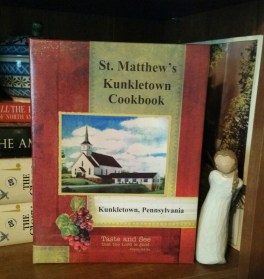
wp-1477426769107.jpg

Photo: Front of recent church cookbook shows St. Matthew’s UCC church, my childhood church, in Kunkletown, PA.  The annex extending off the right side was added in recent years.

Abraham Schmidt was also the first constable and he was tasked with setting up a militia, as early as 1774, with a quota set at 82, which he easily filled. He was the captain of the militia too. The militia joined General George Washington and as the page from “The Story of Kunkletown” (records acquired through Northampton County records) shows, his militia was still active in 1780.

wp-1477425506765.jpg

From The Story of Kunkletown, a Bicentennial Pennsylvania history compiled by local historically minded citizens, like my wonderful pastor’s wife, Beatrice Goldman Boehner. mentioned in many of my posts.   Reverend Adan Boehner was the pastor of St. Matthews UCC Church from 1926-1969.

The 1976 book, “The Story of Kunkletown”, historical research and writing was done primarily by Rev. Perry L. Smith, who was born in Kunkletown in 1897, received a B.D from Franklin and Marshall College and graduated from the Marshall Theological Seminary.  Although Rev. Smith left Kunkletown behind, he spent years researching, gathering information and historical material, long before the American Bicentennial.  He even had already researched the Abraham Schmidt family tree, back to Philadelphia, when the Schmidts arrived.  Mrs. Boehner gave me a typed family tree in 1976 and told me, “Susie, your ancestor was very important to this community.”

Buddy mentioned the sacrifices of the founding fathers and  most Americans can relate to the Mel Gibson movie, The Patriot, yet never really grasp that while this story is fictional and  as Wikipedia explains, Gibson’s character:  “Benjamin Martin is a composite figure the scriptwriter claims is based on four factual figures from the American Revolutionary War: Andrew Pickens, Francis Marion, Daniel Morgan and Thomas Sumter.”

Buddy mentioned the sacrifices without grim details, so here’s a little more detail to give you a taste of how much many of the signers of the Declaration of Independence sacrificed:

“The British had a particular zeal for destroying the homes and property of the signers. Those suffering this fate included Benjamin Harrison, George Clymer, Dr. John Witherspoon, Philip Livingston, William Hooper and William Floyd. The sacrifices of John Hart and Francis Lewis are particularly noteworthy. “While his wife lay gravely ill, Redcoats destroyed Hart’s growing crops and ripped his many grist mills to pieces. Bent on taking him, they chased him for several days. They almost nabbed him in a wooded area, but he hid in a cave. When he returned home with his health broken, he found his wife dead and their 13 children scattered.”

The story of Francis Lewis was equally tragic. “When the British plundered and burned his home at Whitestone on Long Island, they took his wife prisoner. She was thrown into a foul barracks and treated cruelly. For several months she had to sleep on the floor and was given no change of clothing. George Washington was able eventually to arrange for her exchange for two wives of British officers the Continental Army was holding prisoner. Her health was so undermined that she died two years later.””

The price paid for your liberty, by Dr. Harold Pease

Once again, they pledged:

“For the support of this declaration,
with firm reliance on the protection
of the divine providence, we mutually pledge
to each other, our lives,
our fortunes, and our sacred honor.”

And they lived up to their word.

2 Comments

Filed under American Character, American History, Culture Wars, General Interest

Looking for a Savior in all the wrong places

The above MSNBC interview features J.D. Vance, author of Hillbilly Elegy: A Memoir of a Family and Culture in Crisis, a book that is part, starkly honest portrayal of his life as a poor “white trash” hillbilly growing up in the Rust Belt today, and part social policy analysis. In the book, Vance mentions “learned helplessness” as a looming problem in the economically depressed town in the Rust Belt, where he grew up.  He chronicles, in a very personal way, the current plight of the families of those who were part of the Appalachian migration out of the Appalachian Mountain communities to northern industrial cities in the first half of the last century, often referred to as the Hillbilly Highway.

His story is meant to open discussions about government social policy, local community actions, but most of all, he is hoping that the American families in crisis, at the heart of the cultural crisis in America, take a hard look at themselves and begin the painful, difficult process of changing how their own families treat each other.

That change requires unlearning “helplessness”, but also learning to quit blaming big government, big business, big bankers, nefarious Mexicans and Chinese, Obama  and Muslims, and other mythical scapegoats.  Quit looking for a new big government program or an American strong man promising to make your life or your community better!   You are responsible for the choices you make, but if you have managed to get your life on track, the responsibility doesn’t end there.  You have to try to help guide your own families and communities, especially children at risk, to learning to be productive and American success stories too.

Vance writes honestly about his mother’s drug addiction and the impact it had on him and his sister, but it also affected his grandparents and extended family too.  One addict or alcoholic in a family can create endless chaos and upheaval, both emotional and financial.  These people are like ticking time bombs, ready to tear apart their family and themselves, over and over.   The news clip above offers a shocking glimpse into the opioid  epidemic in America today.

Change begins first in our own hearts and then within our families and communities.

In many posts I’ve highlighted Trump’s populist appeal, his skillfully latching onto patriotic themes, spanning the globe from Mexico to China for foreign scapegoats abroad, evil domestic “establishment” politicians at home and of course, The Left, as the cause of all the failures in American communities.  Many Americans see Trump as hearing their pain and expressing their anger, but I want to move away from Trump and this election, to delve into the state of way too many American families, like the one Vance grew-up in.

wp-1477107842006.jpg

Above is an early photo of Kunkletown, PA, the village where I grew-up.  We lived on the outskirts of the village further off to the left side of where that photo ends.  Behind where the photographer was positioned, is part of the Blue Mountain range, which is the eastern edge of the Appalachian Mountain range.  The village had a few more buildings off to the left and right, when I was growing up, but not much more.  My family was a typical blue-collar, rural family in the Pocono Mountains in northeastern PA.  In the late 90s, my husband, kids and I had gone to visit my family and as my husband drove around winding roads in the mountains, one of my sons, who was around 11 or 12 at the time, said, “Mom, your family is kind of like northern rednecks.”  My first reaction was angry pride in my family, but when I thought about his words, I knew they were true.

I love my family, I am proud of my PA German heritage, and I am especially proud of my parents, who were very hard-workers, dedicated to family, drank alcohol only at social occasions and then sparingly, ran an organized home, lived frugally and within their means, did not tolerate drama in our home, instilled values in us, but most of all they lived their values through constant example.  Sure, my family had conflicts, problems, and many flaws, because no one has a “perfect” family, but I never doubted that my parents would care for us and do their very best to provide for us.  I never once doubted that they put caring for their family over their own wants and desires – they made sacrifices constantly to provide for us.

The things that bind strong families together go much deeper than blood, they are love and respect for each other, and building trust within the family.

My parents told all six of us, my three sisters and two brothers, that in America all things are possible if you work hard.  Coupled with that complete faith in the American Dream was faith in God, but also the constant reminders that we needed to help other people and that America isn’t just about “rights”.  My parents believed being an American imposed on all of us a “duty”  to be good citizens and good neighbors. This combined message of “civic duty” and the Christian message of being “good neighbors” is what built American communities.  That isn’t to say America can’t be inclusive and respectful of other religions, it’s a historical statement of how most rural communities and small town America were built.

The anger stewing among America’s poor is very real, but the scapegoating other groups, the latching onto federal government panaceas and the complete abdication of taking personal responsibility for ourselves, our families and our own communities, is destroying not only the American spirit, but also real American lives.

Vance survived a home in crisis, having a mother who had a drug addiction problem, run-ins with the criminal justice and social services systems, and whose lifestyle led to a revolving door of “father” figures moving in and out of his life.  He credits his loving, albeit dysfunctional in many ways, grandparents with saving him from ending up a high-school drop out.  He also credits the Marine Corps for instilling strong values that helped him become a stronger, more resilient person.  His story offers many insights as to what is really ailing America and it’s not just closing factories, corrupt Washington, or bad trade practices.

My husband survived a troubled childhood, eerily similar to, but, perhaps more stark than the one Vance recounts.  Interestingly enough, my husband’s alcoholic mother, grew up in West Virginia.  As Vance talked about his crazy grandmother’s rants and profanity-laced language, I kept thinking, “She talks just like my late mother-in-law.”

My goody-two shoes upbringing didn’t prepare me for my mother-in-law’s flowery language, where two of her favorite phrases were, ” Shit in your hat and pull it down over your ears.” and her version of “go to hell” was, “Up your giggy hole, bitch!”  I sat there dismayed and confused with many of her phrases, and after the first time she said that, when I was alone with my husband,  I asked him, “What on earth is a giggy hole?”  My mother considered “fart” a cuss word and we weren’t allowed to say that.  I tried to teach my children to say, “pass gas” and they told me even their teachers say “fart” and refused to believe me that “fart” is a vulgar word.

Besides all the “crazy” things and rough talking, Vance’s grandmother, instilled a belief in him that he could do anything and she also talked about her dream of becoming a lawyer when she was young.    My mother-in-law, besides the obvious problems that hit you in the face quickly, was a very smart woman and at some point in her life, she read a lot.  It always amazed me that she would rattle off the answers to Jeopardy questions on TV, before even the best contestants could open their mouths.  She would have choice words for the contestants who missed questions.  She also did the crossword puzzle in the newspaper every day, in very little time.  Occasionally, she would ponder out loud about a word she was struggling over, but invariably within a few minutes she’d have the answer.

I once asked my mother-in-law how she knew all this stuff and she gave me this confused look and said, “Everyone knows this!”  I didn’t know many of these things and I read constantly.  I’ve often wondered what my mother-in-law’s dreams were when she was young, before having 7 children, with only 2 having the same father, I believe.  My husband related that one sibling died young, so I am not sure about the paternity of that one.  My husband’s father left when he was 5 years old and he never saw him again.

Like the Marines helping Vance escape his troubled childhood, the Army provided my husband a way to escape his life, growing up poor in downtown Baltimore.  I suspect that my neck of the woods in PA was an anomaly in the 60s and 70s when I was growing up. It was the backward, west end of the county, where a small enclave of  PA Dutch people, most related to each other, were clinging to their rapidly evaporating community.  Drugs were prevalent when I was in high school in the 70s and the area has a lot of resorts and also an invasion of people from New York and New Jersey, who decided to move to the Poconos and commute to work in the city.

This urban invasion completely changed the culture in the area.  In high school, we were disparagingly called “farmers” by our rival high school team, from a more populated area of the county.  However, the dwindling family farm culture had been eroding for a large part of the last century.  Most of the people, to include my parents, commuted to other areas in PA to work, with few actually working on farms in my childhood.

wp-1477106414390.jpg

My paternal great-grandmother lamented selling their farm and moving to “town”, which was Kunkletown (a village with a church, a general store, a gas station, a post office,  and a few local businesses) and that was before my father was born in 1929.   The above photo is the post office in Kunkletown, PA, with my great-grandfather behind his horse and mail cart,  He  was one of two rural route mail carriers, when the rural routes were started in 1912.  See, not only John Kasich has a family member with claims to being a postman…   While compiling a history of Kunkletown during the American bicentennial in 1976, local historical sleuths found this record of my great-grandfather’s, January 1912 route stating he delivered 4 registered letters, 757 letters, 369 postal cards, 1802 newspapers, 538 circulars, and 442 packages.  He collected 4 registered letters, 640 letters, 206 postal cards, 2 newspapers, 10 packages and 36 money orders.  Guess reading newspapers was popular in the backwoods.  That post office was still the post office when I was growing up in the 60s and 70s.

The problems Vance relates experiencing growing up in the Rust Belt in Ohio, now are the same ones afflicting the poor white working class in the Poconos, in small towns, in rural America, but also in inner-city poor black communities too.

What is ailing America most is too many Americans started believing they are the downtrodden victims of a system stacked against them.   Much of the “learned helplessness” is the result of liberal government policies, academia and educational system indoctrination and Hollywood and media brainwashing.  Celebrities and flaky TV “experts”, televangelists and assorted “experts” exert more influence over many Americans’ lives than these Americans’ own families or local civic and religious leaders do.  Americans have bought into trusting the advice of total strangers over people in their own families or communities.  This “learned helplessness” belief rears itself in endless strings of lies, way too many people tell themselves and their families, about why their lives are an endless, downward trajectory of personal and financial train wrecks.

As one who has lived through some personal train wrecks and even spent years making excuses for some of my bad decisions, I’m not trying to judge other people who are struggling or acting like I have all the answers. All I can say is that in my life, at 56, one thing I’ve learned to do is to try to quit making excuses when I make mistakes, admit to them quickly, then try to fix them and avoid making the same ones in the future. Sometimes I succeed, sometimes I fail, but in the end, I blame myself for the outcome – not the “system is rigged or against me”.  Even when I have been treated “unfairly”, I keep working at forgiveness and not letting anger rule my life.  That forgiveness part is the hardest, but by focusing on looking for positive things, it helps me move past anger.

Vance penned an opinion piece in the New York Times, “The Bad Faith of the White Working Class,” June 25, 2016, where he writes about “paranoia replacing piety” in some Christian groups in America. He states, “A Christianity constantly looking for political answers to moral and spiritual problems gives believers an excuse to blame other people when they should be looking in the mirror.” Expanding on that thought, Vance writes:

“This paranoia harms the most vulnerable Christians the most of all. A few months ago I visited with a few teachers from my old high school and asked them how we might give kids in our community a better shot — at a good job, perhaps, or at least a peaceful family life. The mood grew somber. One told me that after a student, a bright young man from a “rough home,” stopped showing up to class, she drove to his house on a school day to check on him. She found him and his seven siblings home alone, her promising student too preoccupied with tending to his brothers and sisters to care much about school. A younger teacher, listening intently, sighed: “They want us to be shepherds to these kids, but so many of them are raised by wolves.”

In the white working class, there are far too many wolves: heroin, broken families, joblessness and, more often than we’d like to believe, abusive and neglectful parents. Confronted with those forces, we need, most of all, a faith that provides the things my faith gave to me: introspection, moral guidance and social support. Yet the most important institution in our lives, if it exists at all, encourages us to point a finger at faceless elites in Washington. It encourages us to further withdraw from our communities and country, even as we need to do the opposite.” (my highlight)

This post has run much longer than I intended, sorry about that.  In my next few posts I want to delve into the history of faith in America, where Gladius has so generously given me permission to pull whatever I want from a sermon he gave to his Baptist church this past 4th of July, to highlight the faith of our Founding Fathers.  Then I want to write a post about the things I learned about American culture working in Wal-Mart many years (leaving in 2015).

5 Comments

Filed under American Character, American History, Culture Wars, Food for Thought, General Interest, Politics