Twitter doesn’t matter at all

The news media, pundit class and assorted social media influencers are going on and on… and on about Elon Musk buying Twitter, which is the main battlefield of the spin information war. Most of America isn’t on Twitter and certainly doesn’t follow politics Twitter, but Twitter is where the spin battles are fought out between the blue-checkmark politics elites – the journalists, politicians and influencers, who Twitter decided were blue checkmark-worthy.

Elon Musk is an eccentric billionaire and that right-wing Americans are looking to another rich guy, who isn’t even a conservative or Republican, in any sense of the word, as their savior, speaks volumes about how this spin war has fried brain cells. That so many powerful, left-wing Twitter elites are having meltdowns over Twitter no longer being under control of liberals, likewise, speaks volumes of how important the corrupt spin war is to them. They’re upset they are losing control of the main spin battlefield in America.

I don’t care about Elon Musk or Twitter. I care about America – both our republic and the millions of wonderful American people. A lot of prominent right-wing folks are running around thanking Elon Musk for “saving free speech,” while a lot of left-wing folks are hysterically portending the “end of our democracy.” Some liberals are talking about leaving Twitter and some are even going the Hollywood routine of dramatically announcing they’re leaving America… again.

Our country is facing massive challenges right now – especially economic ones, a total lack of leadership in Washington, Russia and China waging aggressive information and economic war against the West and the war in Ukraine. And this domestic spin war greases the skids for political corruption and it still fuels divides in our country every day. Hence, with the Twitter political crowd, one side grasps at Elon Musk as the savior of free speech in America and the other side is hyperventilating he’s the devil sent to destroy our democracy. That’s the level of stupid in our country.

Here goes with my broken record about the American spin information war… again, sorry, but it’s important. The American spin info war way of politics started with the Clinton crowd, then over the years spread to the entire Democratic Party and liberal activists. Trump borrowed the Dem spin war tactics in 2016 and beat the Dems and liberal media at their own corrupt spin war antics.

Back in the 90s, once the internet came along and forums like Excite became popular, the emerging Clinton spin war moved online. The objective of the Dem spin information war was, and still remains, to control public opinion via control of political news messaging in America.

Those Dem spin word games, from the very beginning, were repetitive messaging campaigns orchestrated by Dem operatives, who coordinated with liberal news media. The most important thing about this spin information war, is it’s just the visible part of a very ruthless, coordinated, win-by-any-means-necessary way of politics, where wholesale public corruption runs rampant.

Bill Clinton survived impeachment and Excite went away:

“The original Excite company was founded in 1994 and went public two years later. Excite was once a popular site on the Internet during the 1990s, with the main portal site Excite.com being the sixth most visited website in 1997. The company merged with broadband provider @Home Network but together went bankrupt in 2001. Excite’s portal and services were acquired by iWon and then by Ask Jeeves, but the website went into a steep decline in popularity afterwards.” https://en.wikipedia.org/wiki/Excite_(web_portal)

The spin info war crowd (journalists, political pundits, pols) eventually moved on to Twitter. This crowd might likely move somewhere else at some point, but the vast corruption in our political parties assures this spin information war way of trying to control the news media and public opinion won’t go away easily or quickly.

When Twitter started being mentioned constantly, for a long time I had no interest in using Twitter (and still don’t really), but I became curious why TV cable news kept mentioning tweets so much (this was pre-Trump). By 2016, Twitter was where the political class and journalists hung out online and it was where the daily spin battles played out. Trump understood that and he had a gift for disrupting and hijacking Dem spin attacks, often with a single, poorly worded tweet. That’s why Dems and liberals wanted him silenced too. If you get in the way of the Dem and liberal media spin war, every effort will be made to silence you (see the attacks on Ron DeSantis).

I went on Twitter at first to try to figure out why Twitter mattered so much in politics. So, I followed hundreds of journalists, pundits and politicians, trying to understand what was going on. I quickly began to understand that Twitter was the main spin war battlefield now and that spin cycles emanated to other news media formats from Twitter via amplification with rapid retweeting (trending stories,) especially by journalists and liberal media pundits on Twitter. Instead of any real investigation, it’s more common for some explosive breaking news or new spin angle to be floated and tweeted by one journalist or news source and other journalists and news organizations instantly begin retweeting the hot take news.

Twitter retweets and that rapid amplification process manufacture the American news spin cycles.

Vast public corruption ripples underneath this spin info war. There’s widespread abuse of power, using government assets for partisan political purposes, weaponizing the FBI for partisan political purposes, and weaponizing intelligence assets for partisan political purposes that now go into this spin war way of politics in America.

John Durham still plods on with investigating the 2016 Clinton campaign corruption (largely centered on the bogus Steele dossier being packaged and sold, not just in the media, but to the FBI and intel agencies and through the US State Department too.

Long ago I lost faith any of the powerful elites live under the same rules the rest of us do. Anyone thinking Republicans will save us, well Republican politicians in Washington aren’t trying to end the corrupt spin information war, they’re trying to get better at it. Of course, back to the truth about binary choices – the lesser of two evils is always still evil.

With multiple serious crises on the horizon, what matters most now is trying to encourage as many Americans as possible to get busy stocking up on basics, learning more skills, learning to plant some food, and most of all start talking to other like-minded people and work on building some community.

Here’s an important truth: one person, not a political figure, an eccentric billionaire, media person, influencer or obscure blogger can save our democracy or protect free speech in America.

Twitter doesn’t matter at all

Only “we the people” can save our country. That means as many Americans as possible need to start putting in their oars and rowing as hard as they can to pull our country away from the dangerous falls we’re drifting towards.

We certainly don’t need a bunch of yahoos blustering about civil war or civil divorce.

We all should be trying to encourage like-minded fellow citizens and trying to find ways to share ideas and work together in our communities to help each other weather these serious economic crises already on the horizon.

We need as many helping hands across America as possible. And that sure is a tall order.

——————————————————————————————————————–

PS: I’ve followed the spin information war so closely, because it affected me personally in 1998, when I ventured onto the Excite message boards and began posting political comments there during the Clinton impeachment scandal.

If you get in the way of the Dem spin info war, every corrupt means possible will be used to intimidate and silence you. Trump survived 4 years of being under assault, 24/7, by Dems and liberal media, determined to destroy his presidency and force him into submission. Trump fought back, embracing the same corrupt spin war tactics as Dems and then went too far with his “Stop the Steal” effort. The Jan. 6th attack on the Capitol finally gave Democrats and liberal media cover to ban Trump from Twitter and social media. Elon Musk buying Twitter puts that huge spin win of silencing Trump at risk.

I’m not Trump, only a nobody homemaker, but I was attacked in 1998 and don’t have any way to prove it happened. I’m now a nobody blogger, whose blog barely gets any views and on Twitter, I tweet when I feel it’s important to fight to disrupt corrupt spin attacks. I currently have 55 Twitter followers, but attracting followers isn’t necessary to disrupt spin attacks, I found. It’s making the right connections in choosing who to quote tweet with retweeting and where to post comments. Unlike Trump, I don’t want to ever be center stage. I want the vast, wholesale public corruption, that this spin information war propels, to be exposed. I wrote about what happened to me in Messages of Mhere on my home page. I used pseudonyms, but every person mentioned is real, including me. Ironically, my kids told me it wasn’t safe to use my real name on the internet and explained user-names to me. My user-name on the Excite message boards was mhere, a play on the Russian word for “peace.” A user-name doesn’t protect you from corrupt, powerful people, I learned. I wrote that story in 2013 and it’s my best recollection of the events that happened to me during the Clinton impeachment. I can’t prove any of it.

I don’t have any power or know any powerful people, but I still believe no one should be above the law in America.

——————————————————————————————————————–

It’s 4:57 pm EST, 4/28/2022 – Thought I want to add, for the record, my real name is Susan Holly Heward.

Leave a comment

Filed under General Interest, Information War

Another Amish blog post

Here’s an interesting Darkhorse podcast video raising questions about our government’s effort to fight COVID. I had posted the link to the news story mentioned in this Darkhorse Podcast video back in October 2021: https://rumble.com/vnpfkd-amish-covid-full-measure.html?mref=7gabl&mc=5lg0g

Considering the many unforeseen consequences of our Covid mitigation efforts, like dire economic problems, massive social upheaval, huge spike in suicides and drug overdoses, it’s worth asking if the Amish approach of dealing with Covid racing through their community worked better. It’s important to note that many people, some with science and medical bona fides too, predicted many of these dire consequences, but were loudly rebuked. Some even faced efforts to silence them in the public square of social media.

The Amish continued working, kept their families and communities together, while caring for the sick, like they had always done. They attended church services and continued their lives as normally as possible. Our liberal media went all in on selling the “trust the science” spin effort being pushed by the liberal elite crowd in Washington and liberal bastions of academia.

The Amish didn’t deny Covid existed, they just chose to work together as a community, like they always do, rather than try extreme social mitigation efforts our national health experts sold, because China was doing lockdowns and mass masking. There were even Democrats in early March 2020, who were embracing Iran releasing prisoners due to Covid spreading through some overcrowded prisons and they could no longer maintain those prisons.

Democrats crammed that prisoner release approach into the CARES Act, which was passed on March 27, 2020 and are still pushing that these prisoners, released due an emergency situation, be allowed to serve their sentences at home. The speed with which our ‘health experts” and some elected officials embraced Covid mitigation efforts being tried in other countries, especially despotic regimes, still boggles my mind.

What was “scientific” about rushing to embrace China’s or Iran’s mitigation policies? These Covid policies infringed on civil liberties, destroyed many Americans ability to earn a living, restricted families from being by the side of dying loved ones in hospitals, forced schools to close, prohibited church services in places of worship, and even interfered with funeral services across the country?

None of these mitigation efforts worked to “slow the spread” or “stop the spread.” In fact, even the vaccines haven’t slowed or stopped the spread – that’s the truth. So, the selling pitch shifted to the vaccines lower your chances of getting seriously ill, if you contract Covid. There has sure been a lot of Covid policy goalpost moving.

Are we just supposed to forget all of this happened and move on? Or are we still allowed to ask questions and expect a bit of accountability of our elected officials and government health officials?

Leave a comment

Filed under COVID-19, General Interest

How not to grow microgreens

I like learning how to do new things. I wanted to add a bit more to my last post about gardening. With seeds, I looked for bush-type varieties. The patio tomatoes are Burpee Veranda Red Hybrid, which only need 1 sq. foot of space. Of course, later I did plant these Abe Lincoln tomato seeds, which will need to be staked, caged or on a trellis. There are also bush variety beans, squash, and cucumber seeds available.

Here’s the Burpee seed pack on top of the lid of a cute cardboard box I found at Dollar General to keep my seeds in.

I bought some seeds online, but I also bought some seeds at Dollar Tree and Walmart. When I went looking for seed potatoes, there were none left at Lowes and Walmart, where I live. In fact, seeds sold out very fast at my Walmart this year. We have a Tractor Supply nearby and I found seed potatoes there. They had a ton of seeds left and discounted, so I stocked up on both vegetable and flower seeds.

I see so many things online that fuel my crafting, sewing, decorating, cooking and yes, gardening dreams, but long before the internet I did the same thing getting inspiration from magazines, books and TV. One thing I tried in recent months, with no success, is growing microgreens.

The first attempt I put the seeds on potting soil. After a day in a dark location, some of the seeds sprouted, but a white mold had grown faster than the microgreens and formed an eerie-looking web over the seeds and potting soil.

For the second attempt I ordered some natural fiber growing mats online and used Chinese takeout containers I kept (I repurpose a lot of food containers for various things). I tried radish, broccoli and beet seeds. The microgreen seed instructions recommended soaking the beet seeds overnight, as did the growing mat instructions, so I soaked the beet seeds and mats. I did not get great results:

The tray on the right were the beet seeds, which were a total failure. I have two cats now (stray kittens that showed up last fall). They had to examine the microgreens and ate most of them… So much for my microgreen experiment. I’ll try growing them again – later.

I bought a pack of catnip seed and a pack of some kind of grass seed for cats.

That’s how new projects go for me. Some turn out fantastic, but many are failures the first time. Very few look as great as the pictures and videos that inspired me. I learn as I fail my way toward success. The failures are part of the process with learning how to do new things.

Leave a comment

Filed under General Interest

My container gardening effort

I’ve written a lot about urging people to calm down, but I don’t want anyone thinking I am not encouraging people to stock up however they can – from the store, growing your own food and using and preserving food as much as you possibly can. Eliminating waste wherever you can will stretch your food. Cutting down on waste is something I keep working on, because I realized years ago that I waste a lot of food.

Alarming economic and shortage news will continue, like this one: “Traders were caught by surprise by Jokowi’s announcement that Indonesia, the world’s biggest palm oil producer, was halting exports of the edible oil to ensure domestic food product availability.” Just saw that this evening.

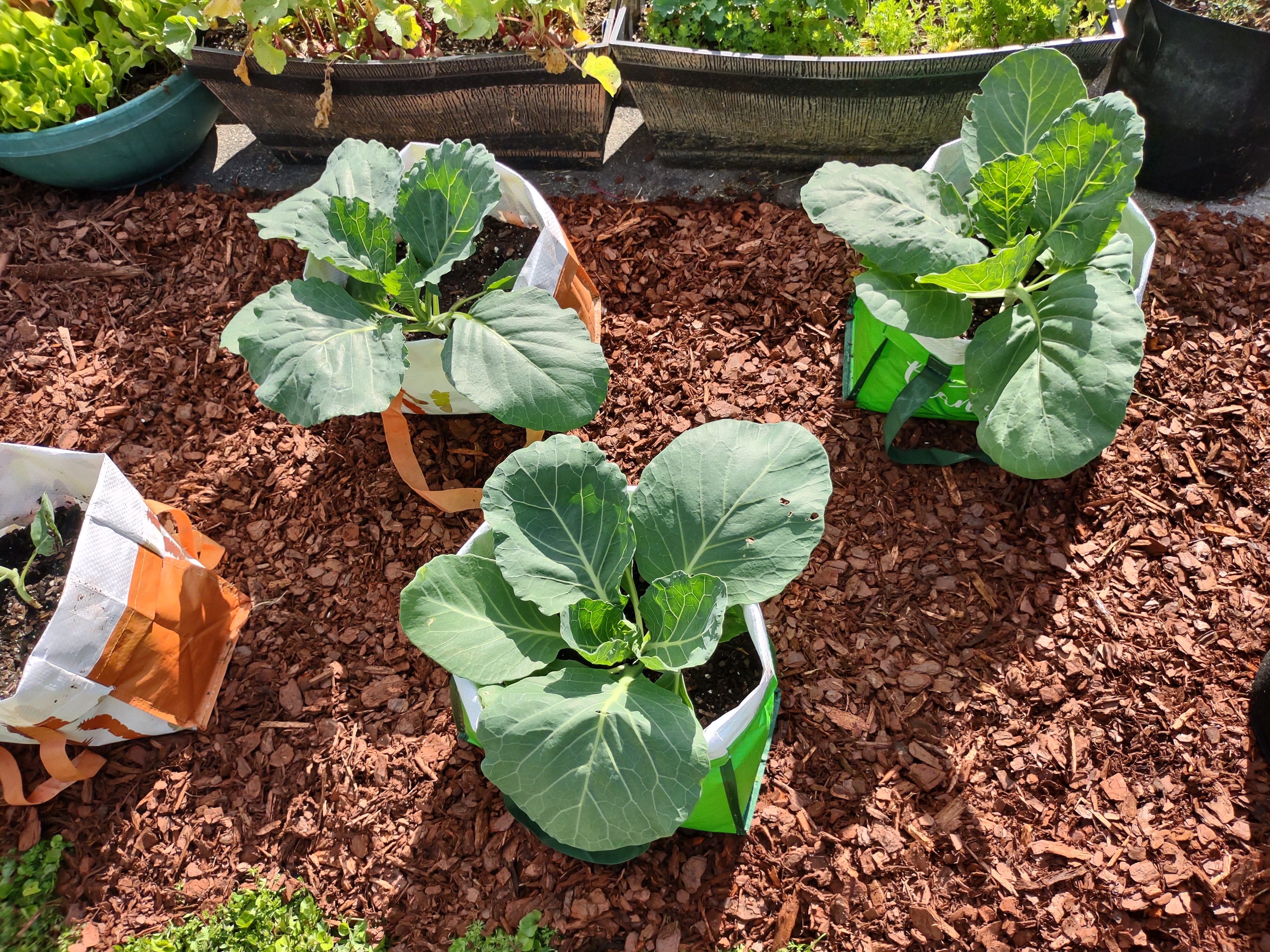
I’ve worked on container gardening this spring. I started seeds with that winter sowing method, but it was really pointless, since I live in zone 8b. However, in the gallon jug I had 5 cabbage plants started. I planted them in Dollar Tree shopping bags (purchased when it was still a dollar) rather than toss them. So far they’re doing fine in these bags:

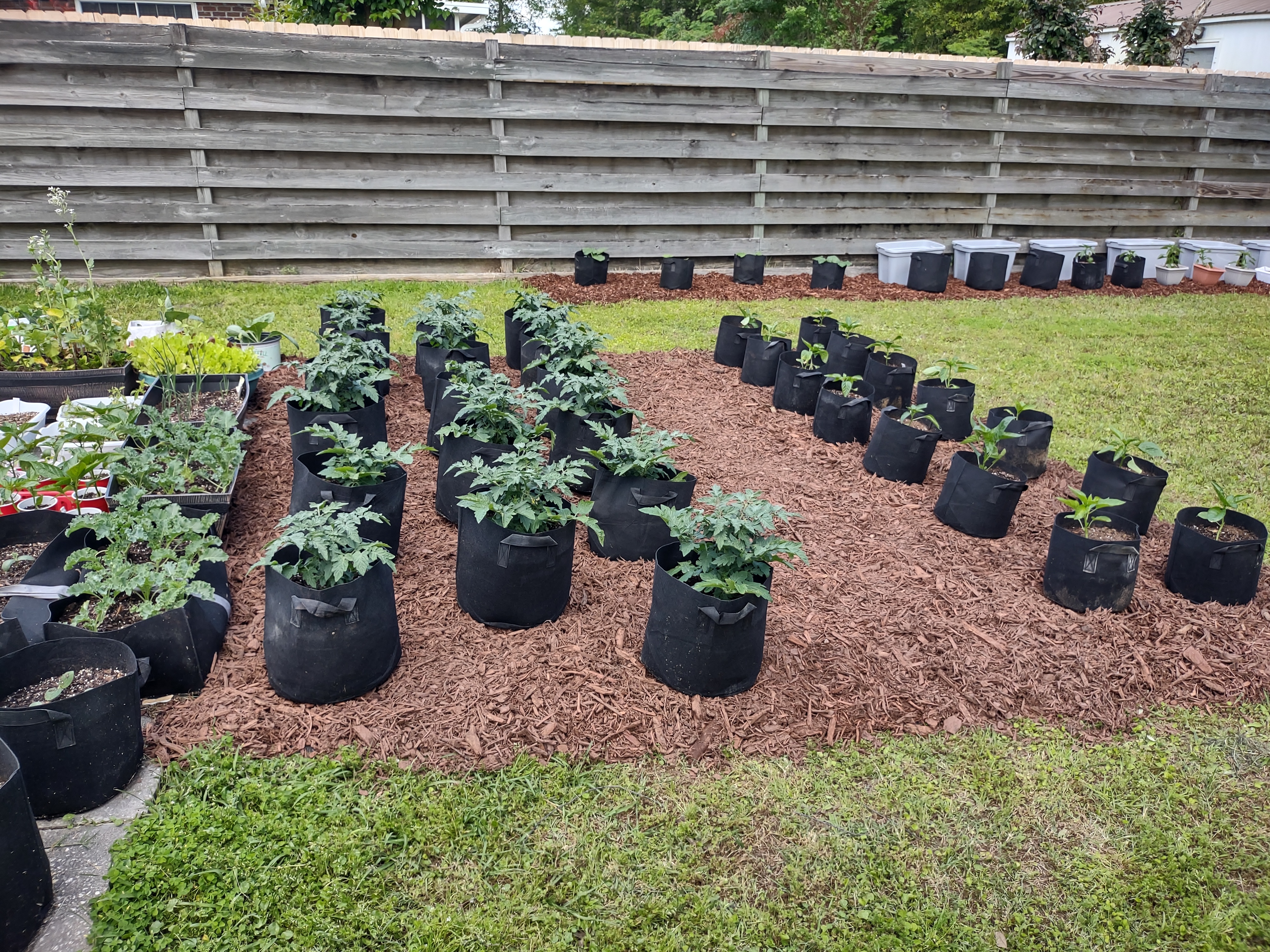
I put cardboard down and bags of wood mulch to spread out my containers, because my patio was getting too crowded with containers and I’m still working on that. I ran out of cardboard and have used weed-block fabric too. I used grow bags I ordered from amazon, various cheap plastic containers and things like these Dollar Tree bags. The most expensive part of this has been buying potting soil.

I apologize for my terrible photography, but here are some pictures of my container garden effort:

I did stupid stuff like I planted the entire pack of patio tomato seeds and pepper seeds, expecting about half to germinate and then when almost every seed sprouted, well, I didn’t thin them out. Now I have a lot, probably too many, patio tomato plants and peppers. I also gave away several patio tomato plants and peppers. Along my fence in cheap 10 gallon totes I’ve got seed potatoes planted, pots of hot peppers and grow bags of zucchinis. I have three blueberry bushes I planted in pots along the fence.

I probably only need one zucchini, but I planted 4 grow bags:

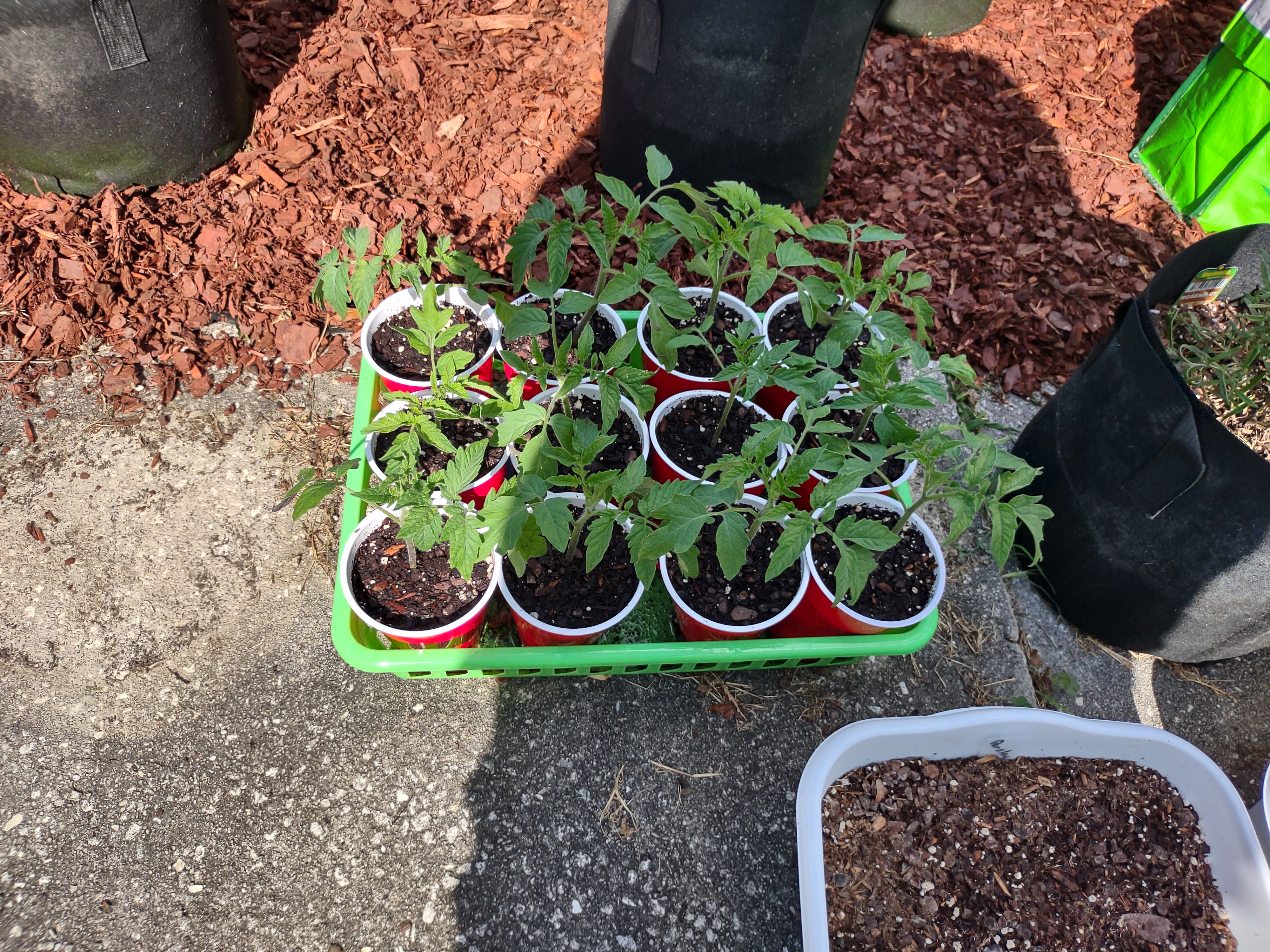
I’ve got grow bags of green beans, cucumbers, okra, yellow squash, scalloped edge pattypan squash, kale, cantaloupe, radishes are going to seed, lettuce, green onions, herbs and flowers too. Oh, and I decided I wanted to try some larger tomatoes, so I planted some Abe Lincoln tomato seeds late (photo below) and transplanted them into grow bags today:

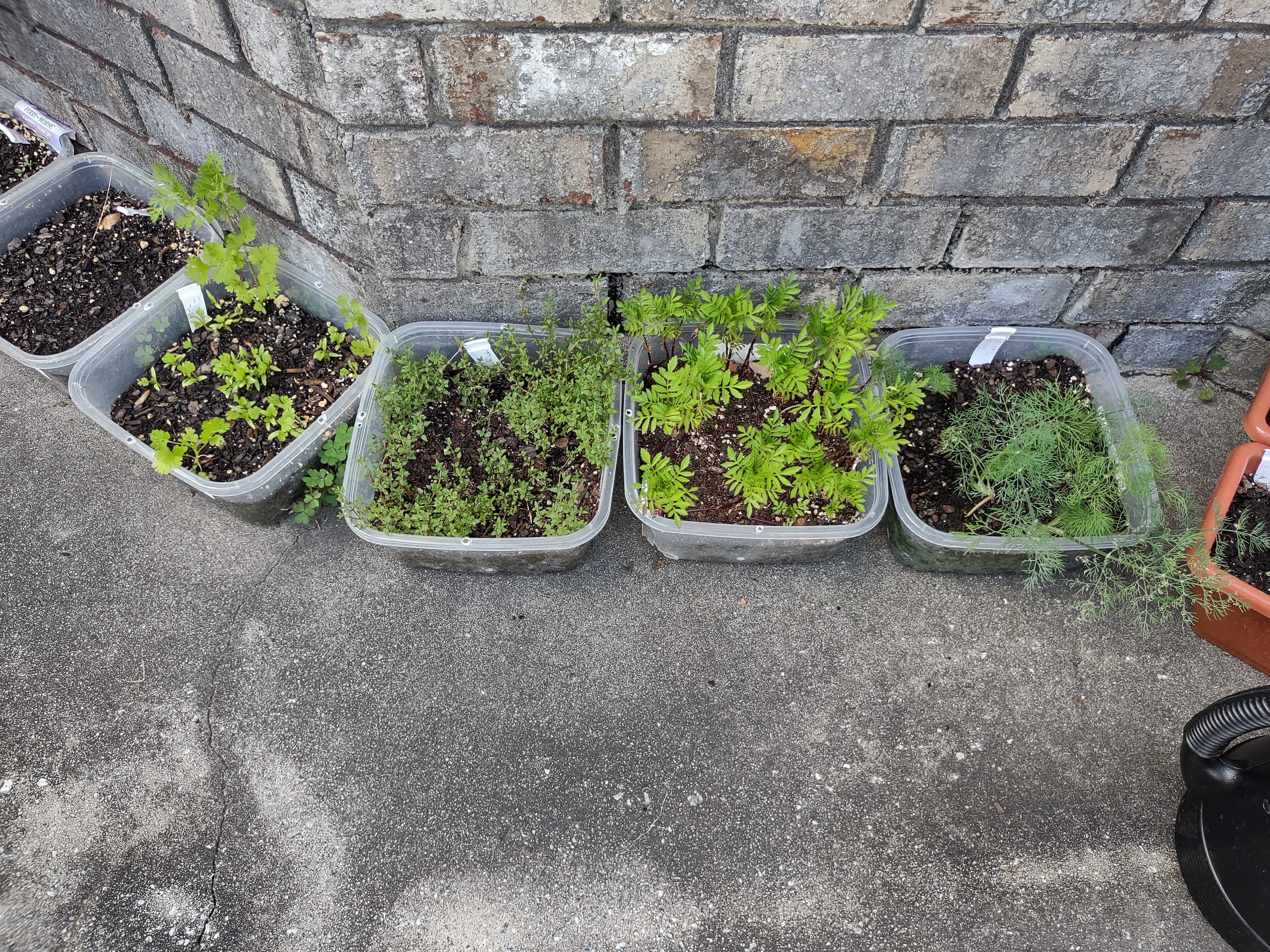
I have herbs and some flowers started in square food containers from Dollar Tree:

The grow bags drain through the fabric, but I poked holes in all the plastic containers and bags from Dollar Tree. Drainage holes are vital.

What I don’t have, yet, are any raised beds, so I just moved ahead with the containers for right now. I planted everything from seed, except I bought the blueberry bushes, obviously and I bought seed potatoes and onion sets. I also have a rosemary plant I bought at Walmart. For potting up seedlings, I put holes in red Solo cups and I washed all of them, so I can use them again. I intend to reuse all these grow bags and cheap Dollar Tree containers. My backyard stays very muddy and kind of swampy after it rains, so I am hoping this wood mulch helps keep things manageable. I heard some gardener guy talking about wood mulch attracts slugs and snails, so I’ll watch and see.

I also started pressure canning chicken and ground beef, even though it’s just me. I already had quite a bit of canned chicken from the store and I have a lot of frozen chicken, but I decided to start pressure canning some too. I pressure canned 16 pints of chicken breasts cut into pieces this past weekend and I also pressure canned 8 pints of ground beef. I’m brand new to pressure canning, but there are loads of excellent how-to videos online and I bought a Ball canning book and the USDA food preservation guide. I followed the steps and didn’t have any problems with this.

I remember helping my mother and great-grandmother can vegetables and pickles as a kid, but that was just doing what they told me to do. On my own, I was a tad wary, but took it step-by-step. I’m 61 and if I can learn how to do this, anyone can.

Any ways people can stock up on food and basics are a good thing. It’s actually been fun working on this container gardening project and learning to pressure can meat. Just try to do a little bit each day and you’ll be surprised how quickly you make progress.

Decided to add that I purchased a pressure canner a few years ago, while my husband was still alive, but with the caregiver demands, I never got started. Now seems like a good time to learn. I’m sure I’ll make some blunders with home canning, but pressure canning chicken and ground beef was much easier than I expected.

Leave a comment

Filed under General Interest

We have the power to control fear

Many people understandably express concern about the worsening economic situation and wonder how bad things will get. I don’t have a crystal ball to consult, but all the economic indicators are trending poorly. The economic situation isn’t really what this blog post is going to be about. I recently started giving people a head’s up what my blog posts are going to be about in the beginning, so they can easily decide to skip reading further or venture on. So, this blog post is going to be about buying into rumors and bad news that fits your personal views on politics, world events, the worsening economic situation. Yes, this is another warning about information and news sources.

Almost daily now there’s more bad news on the economic front, from projected wheat shortages, rice shortages, drought in the US Mid-West, more shipping problems, war and the list goes on and on. We could have hyperinflation and major economic collapses, but let’s look at some Great Depression facts.

Most of us have heard stories of hardship and struggle from old people who grew up during the Great Depression (1929-1933). Loads of novels and movies have been set during that time period too. However, some interesting facts about The Great Depression get lost, because it’s easier to focus on people going hungry, soup kitchens, bared down recipes to struggle by on, and widespread unemployment – all things that happened.

Unemployment in the US rose to 25% during the Great Depression. The US is below 4% unemployment presently, but inflation is rising rapidly.

What’s interesting is that despite the economic crisis, plenty of very successful businesses, like Publix Super Markets and Pendleton Grain Growers started during the Great Depression. The same thing will likely happen during our current economic woes, even if it gets much worse.

With the fertilizer situation, this year many farmers might not plant as much, but I’d expect a big opportunity for organic and plain old manure-based fertilizers to develop quickly. Big agri-business might not adapt rapidly, but plenty of smaller farmers, might see opportunity in this situation. Along with all the hardships and bad things, this current economic crisis will also fuel some new, successful businesses, new opportunities and a lot of innovation as Americans figure out ways to survive and thrive, because that’s what Americans do.

We are still a country with plenty of people who seek opportunity. Millions of people from other countries still flock to America for that very reason. America remains a country with vast material resources. Beyond that, we still remain a country of incalculable human resources and potential. No matter what bad things happen, I believe it’s important to keep this in mind.

With all the economic bad news and worries, a lot of people rush into believing any conspiracy theory that gets passed around online, with no real evidence that events are even connected. For instance, five days ago, the headquarters of Azure Standard, a popular distributor of organic and health food, used and promoted by many YouTube homesteading and prepper channels, burned down. Within hours there were people on YouTube and other social media running wild with a conspiracy theory linking the Azure Standard fire to other food company fires. It was all innuendo about “a lot of fires with food places happening” and rumors run amok.

It seems there are lots of people who want to buy into grand conspiracy theories without any evidence or waiting for an investigation.

That happens a lot online.

If you’re watching a video or TV personality or reading information and it gets you feeling panic or alarm, chances are it’s deliberate, politically-motivated agitation propaganda or clickbait to get people watching or reading or someone reacting out of fear. I’ve read Gavin DeBecker’s, book The Gift of Fear, like millions of other people, and fear or gut instincts can be important to listen to, but when you’re making long-term plans, I still believe it’s wiser to calmly make big spending decisions, plan a budget, and make important financial decisions. In economic crises, being on as stable of personal financial ground as possible improves your chances of faring better than being in a lot of debt and having no money saved.

Along with slowing down on reacting to news, it’s important to slow down about jumping to conclusions about things we see around us too. Ask questions and take your time before getting worked up or rushing to assume the worst.

Ask five eyewitnesses to an event what happened and it’s likely you’ll get five different versions of events. That’s why I’m actively putting the brakes on reacting to alarming news, because many people keep assuming the worst possible economic calamities will befall us. I also am trying not to buy into the “OMG” type social media reactions, where people rush to talk about this “crisis” or that “crisis,” or as in the case of the Azure Standard fire, connect other fires within the food chain as part of some grand conspiracy without a shred of evidence to connect these events or even time for investigators to determine the cause of the Azure Standard fire.

Under-consumption was a problem in the Great Depression, because people couldn’t afford to buy things. Under-consumption also led to massive job losses, as businesses folded.

Mass panic led to bank runs, which forced bank to liquidate loans, which in turn led to bank failures. About 9,000 banks failed between 1930 to 1933.

Mass panic exacerbates and even creates many of the dire events that happen in crises. And mass panic is fueled by rumors, media hysteria and people buying into reacting out of fear. That’s why I keep mentioning it’s important to be calm and try to think through situations, rather than get on a soapbox every day with “the sky is falling” opining.

I don’t have a plan for all the worst-case what-ifs in my life, let alone worrying about what everyone else is going to do, but I do know that getting worked up has never helped anyone make sound decisions, become better prepared, or handle any crisis better. I’ve dealt with lots of crises in my life, just like most people. I’ve had two types of cancer and am thankful to be alive. During that journey, I determined not to let fear control my life. Since then, I look at each day as a bonus and try to be grateful for every moment I am alive. Each crisis you weather makes you a little bit stronger to weather the next one.

You don’t need to solve all the problems of a crisis before the crisis impacts, just try to position yourself to be a little bit better prepared and able to manage than the day before. Set some goals and then each day tackle a little bit more.

Of course, the worst case might happen. People who run around in a panic will probably fare worse in every situation and that goes for developing sound situational awareness, making good decisions, and reacting in ways that will help them or their loved ones survive, especially in the worst case.

Keeping a positive attitude and trying to quell anxiety and fear are as important preparedness skills to work on as stockpiling food, I think. During the pandemic, I saw a lot of Covid hysterics, who inflicted a lot of unnecessary fear and anxiety on their kids and I see signs of that happening with some people concerned about the economic crises unfolding now. There is no need to fill your kids with anxiety and worries every day about shortages. Sure, just like with Covid, it was important to talk to kids about what was happening, but there was no need to allow Covid to consume their daily lives, which many people did.

Interestingly, at the link I mentioned of successful businesses started during the Great Depression, at the beginning of this post, Yellow Book USA, was on that list and introduced yellow pages to help customers compare prices. People had to think about purchases and often had to wait to pull together enough money for basic purchases and compare prices.

My late mother was a child during the Great Depression. She said they didn’t wear shoes in the summertime and got new shoes when school started in the fall. She also said she worked picking potatoes and other vegetables for some nearby farm and handed her pay to her parents, who pooled all the family’s resources including money she, her sister and brothers earned, to buy necessities. She said they had to work as a family to get by.

Mass panic is very contagious and it likely spreads faster than Covid, but luckily we all have the ability to prevent it from taking hold in our lives. I’d hate to see a whole other segment of society go off the deep-end about economic crises, like the segment that went bonkers with fear about Covid.

We have the power to control fear.

2 Comments

Filed under Emergency Preparedness, General Interest

Take some time to enjoy the sunshine

Here’s the first YouTube video that caught my attention today:

Prepper Potpourri offers an important reminder that we live in an aggressive media influencer environment, especially online. Everyone online is influenced by what things pop up on their screens when we click on sites, from the content, to the order of the results in a search engine, to the ubiquitous ads that litter our screens. On TV, the commercial breaks were more obvious, but product placement in movies and in TV shows became a merchandising battlefield. This transcends to sports too, where athletes don certain brands, and ads surround everything from race tracks to ice-skating rinks.

The debate over algorithms has taken on partisan political overtones in recent years. Beyond the marketing aspect, we are all influenced by what we see and hear, but it’s very easy to seek out and gravitate to consuming information that feeds our own beliefs, opinions, concerns and yes, even fears. A lot of people want their fears validated and will seek out ways to prove their fears are reasonable and rational. Funny thing though, if you wander down more and more fearmongering/alarmist information rabbit holes, you could end up living in Alice in Wonderland.. or worse.

With the “shapeshifters” online, well, I have to work constantly to rein in my online shopping impulses, especially since I became more concerned about shortages. I also have to guard against getting alarmed, with so much content geared toward inciting anger and fear. There are endless videos and comments warning about shortages and people offering advice on what to buy and where to buy things, trying to stock up before the mass panic-buying starts. Here’s the thing, I think there are plenty of preppers, who live in panic-buying mode every day and at the first rumor of an item becoming in short-supply, they’re racing to beat the crowd. I’ve been thinking about this shopping behavior for myself, because I can’t possibly make prudent spending decisions, if I react every day to new warnings about items (and lists) of shortages, then rush out to buy those items. Sure, stocking up on those items isn’t a bad thing, but my budget doesn’t allow for me to shop like that. And I don’t want to live like that.

I am trying to cut back on my screen time and enjoy the sunshine and real life, away from the TMI online culture and algorithms.

Leave a comment

Filed under General Interest

Some “on the bright side” videos

Lecturing or trying to scare people into emergency preparedness (or anything else, for that matter) doesn’t really motivate people to make long-term changes. A few people might get alarmed, jump into action, and go out and buy some prepper supplies, but I suspect most of those people might do some shopping, then say they “prepped” and are done or lose interest.

On the bright side, there are lots of people who are well-prepared, who have experience gardening, canning, know how to improvise, know how to make food stretch, etc. and these people could easily become beacons of hope and leaders within their own families, circle of friends, and community in a crisis.

Many of these people are already online, in the homesteading and prepper communities, or you can go on Pinterest, Facebook, YouTube and there are still plenty of cooking, gardening and preparedness blogs & sites around. Just type into a search engine what you want to learn and you’ll find loads of useful information, tips, advice and many excellent how-to (step-by-step) videos, blog posts, articles, etc. I’m constantly learning new things and better ways to make things, grow things, stock up, store things, and organize by watching videos, reading information online and in books – even in some of my old cookbooks.

In the past week or so, I’ve come across several videos I want to share in this blog post. First, I recently came across this homestead channel, The Hollar Homestead, that I had never seen before. In the video the man was fabricating his own contraption to pull logs and his making stuff with junk appealed to my “trash to treasure” nature. I watched some of their other videos. Here’s one I’d like to share:

I believe everyone should be learning new skills and stocking up on food and basic supplies and working to become better prepared for emergencies. I’ve always believed that. I also believe working hard to get your personal finances in order, cut expenses and eliminate as much personal debt are not only important preparedness tasks, but can relieve a lot of stress in your life and open the door to opportunity. Dave Ramsey’s approach to getting out of debt works and while I didn’t follow it to the letter, I did stick pretty close to it to pay off all my personal debt, put money in savings and pay off my house. I read his Financial Peace book many years ago, when I found it at a yard sale, but it took me many years to really get serious about eliminating personal debt and I’m still working to change my spending habits and develop better saving/frugal-living habits.

For a glimmer of hope on building community, here’s a video by a nice lady, Jess, at Roots and Refuge Farm. I’ve enjoyed her gardening videos over the past few years:

A lot of videos are lists and I saw this list video yesterday at Homestead Corner and agree with this lady’s 10 things, although I haven’t invested in precious metals and probably won’t (just a personal view). I want to mention though that in many countries with currency instability, people invest their money in items that have value, which they can use to trade or pay for items. That approach of owning things with intrinsic value, besides piles of money, that may become worthless in a currency crisis, has merit. I just have always had a lot of faith in the US dollar, but these days not nearly as much as I used to. I still cling to hope America is not Argentina, Venezuela, Zimbabwe or Russia. In Russia it’s common for people to invest their money in items of value they can trade when there’s a currency crisis. Here’s her video:

Instead of getting angry or upset with people who aren’t preparing for emergencies or doing it how I think they should, I’m trying to stay positive each day.

An economic collapse inflicts long-term pain and the actual situations people face can change over time, but it can also vary regionally and especially differing impacts on rural people vs. urban dwellers. There isn’t any perfect preparedness plan, because there assuredly will be all sorts of other emergencies and crises that could (and likely would) impact us, beyond food shortages. If you’re a “what if” type person like me, the alarming scenarios that cross your mind can make you want to bury your head under your pillow and that’s definitely not a good way to prepare or face adversities.

To buckle down for the long-haul takes a long-term approach – not rushing around in a panic, trying to buy this or buy that every day, in hopes of beating the panic-buying or collapse many people predict is coming soon. People who try to do too many things at once, out of fear, often burn themselves out quickly (and make a lot of poor decisions). It’s important to pace yourself for the long-haul. And yes, both panic-buying, which could clear out grocery store shelves quickly and an economic collapse are very real possibilities in the very near future.

Before 2020, lockdowns and massive civil unrest didn’t seem probable to me, but since then I’ve worked continuously on stocking up more, trying to learn new skills, plus brush up on old ones. During that Covid craziness of 2020, I focused on having all the things I needed for my husband’s care while he was on home hospice care and it was much harder for me to get out to the store. I had to arrange for one of my sons to be here with my husband, to go anywhere, so I made lists and did a lot of shopping online.

Now, we’re facing worsening financial chaos and I’m prepping for one person, but I think about my kids, grandkids, other family and friends when I’m stocking up on food and supplies. I am sure they likely have items or skills that I lack and will help me too, even though some of them aren’t stocking up on as much food as I think is prudent.

It’s important to not only work to figure out ways to boost your survivability chances in an emergency, but to preserve as much of your quality of life as possible too. We should all want to strive for long-term sustainability, not just focus on crisis-planning everyday.

There have been people mentioning their grocery stores being out of saltine crackers and I noticed that a few times where I live, so I printed out several homemade cracker recipes and they’re going into a three-ring binder I started for recipes and information I print out or write down. In case the internet goes down in an emergency, I want to have paper copies of stuff, so the binder was an easy, cheap solution. Here’s Miss Lori, a wonder of down-home cooking, at Whippoorwill Holler, with a homemade cracker video:

I absolutely love Miss Lori’s YouTube channel and have been watching a long time. She makes me feel like I’m sitting right there in her cozy kitchen watching her cook.

All across America, and beyond, there are good and kind people, many of them online, sharing ideas, finding solutions to problems and offering up heaps of good cheer… and good cooking too.

Leave a comment

Filed under Emergency Preparedness, General Interest

Happy Easter!

Image courtesy of The Graphics Fairy

Leave a comment

Filed under General Interest

Goodwill and charity still exist

I posted a YouTube video by a nice prepper lady, AlaskaGranny, who I’ve watched for a couple years. She mentioned active listening and that’s going to be sort of a stepping off point for this blog post.

I have lots of opinions – many of them about politics, foreign policy and the culture war stuff going on in America, but none of that stuff really matters when it comes to if there’s an emergency situation. What’s going to matter is taking care of my family, friends, neighbors and the people around me in my community and I think that’s how it is for most people.

Often in YouTube communities, regardless which community, there’s a lot of copycat stuff or a topic that one person does that gets a lot of attention, then other YouTubers in that community will jump on the bandwagon and do a video about the same thing. I’ve seen this happen in crafting and needlework communities too, not just preppers and homesteaders. I suppose it’s just human nature and how trends work.

Some common themes I’ve heard mentioned on prepper channels are Argentina’s collapse, Venezuela’s lawlessness, planning for marauding bands of thieves, and warnings about how dangerous the unprepared, starving people will be. None of these outcomes is preordained if America has some major economic turmoil, serious shortages or other financial upheavals.

No one (especially the Russians) was expecting the Ukrainians to put up this much of a fight when Russia launched a full-scale invasion over a month ago. Zelensky was not a popular leader at home and no one ever expected him to rise to the occasion like he has. That’s the thing, people can often surprise you and all these experts or studies saying “this group of people will behave this way or that way during a crisis,” often don’t turn out that way.

I’ve read interesting accounts about WWII Londoners and how they survived the German bombing raids, which started in the fall of 1940 and didn’t ease up until May of 1941. Sebastian Junger, in his book, Tribe, explained how British experts and authorities expected mass hysteria in the run-up to the German aerial bombardment. The Churchill government expected economic production to plummet and people to fall apart

Exactly the opposite happened. Junger writes, “Not only did these experiences fail to produce mass hysteria, they didn’t even trigger much individual psychosis. Before the war, projections for psychiatric breakdowns in England, ran as high as four million people, but as the Blitz progressed, psychiatric hospitals saw admissions go down.”(p. 47) He explains that psychiatrists were puzzled as long-standing patients saw their symptoms subside during the intense air raids. Junger mentions one doctor during the Blitz commented that chronic neurotics of peacetime now drive ambulances. (p. 48).

Junger goes on, “Psychiatric wards in Paris were strangely empty during both world wars and that remained true even as the German army rolled into the city in 1940.”(p. 48)

Many ordinary Londoners during the Blitz went to work during the day, trudged to the bomb shelters at night, then emerged in the morning and headed back to work. All sorts of people with no training self-organized and worked to help clear rubble, assist the wounded, and help in whatever way they could. I’ve read numerous books on the French Resistance and they’re filled with stories of unlikely heroism by ordinary French citizens, many of them women.

Here’s something else I’ve been thinking about and that’s how we often expect other people to view things the same way we do and to take the same actions we’re taking This goes from lifestyle choices, child-rearing (oh, boy do people have strong opinions on that topic), how to manage money, and it goes on and on. In the past two years there’s even definite strong opinions on how we should interact in public since Covid arrived.

It’s hard sometimes not to be alarmed if you follow the news or gravitate to social media content that incites, inflames, or that’s fearmongering for clicks, or listen to people all worked up or angry at some particular type of person or groups of people constantly.

The whole point of emergency preparedness is not just so you can survive a crisis, but also so that you can preserve your quality of life as much as possible. British people during those WWII air raids were still having their tea – even in the air raid shelters and then going to work the next day. They did laundry, cooked meals, took care of their children and all the other normal tasks of living. The same is happening in Ukraine right now. There are even farmers still trying to plant their crops, families caring for their children and elderly family members, doctors and nurses caring for the sick, truck drivers showing up for work, and the list goes on.

Something I’ve been thinking about is, while severe shortages do sound very alarming and could cause a whole lot of disruptions and hardships, America is a very large country with vast natural and human resources. We are a country with a great deal of creative energy and innovators. I suspect that rather than sit around and starve or wait for Washington to figure something out, there will be plenty of Americans, who will jump into action and start creating their own small-scale systems to manage, if the global and national systems fail to meet the challenge.

During several floods, I’ve seen news stories of men coming with their own boats and launching rescue operations to help emergency officials. I’ve seen civilians get in their own vehicles and head to the next town or county to help out in an emergency situation. It’s very common for concerned citizens to join in search efforts when there’s a missing child or travel to assist other firefighters.

While it’s easy to see a lot of disturbing online social media behaviors, there’s also a wealth of goodwill and charity too, especially during emergencies. I’ve seen fundraisers set-up within online communities. A year or so ago a YouTube homesteader family was in a terrible car accident. The man died and his wife was seriously injured. Other online homesteaders immediately started raising money to help that family. I’ve seen people on Twitter and facebook do the same thing.

People often spontaneously organize and figure out solutions, especially in a crisis. And the thing is these types of local leaders and community action don’t come from policy experts, local government, and certainly not from Washington politicians. They come from ordinary people, who got concerned about a problem and decided to take action.

It’s amazing how quickly goodwill and charity can spread and there’s still an abundance of that in America, no matter what other shortages we might face. Volunteerism and civic action in crises really are part of the American DNA and that’s why I remain hopeful for our future.

1 Comment

Filed under Emergency Preparedness, General Interest

Some good advice:

Leave a comment

Filed under Emergency Preparedness, Food for Thought, General Interest