Category Archives: American History

Why America needs gentlemen…. and ladies too

The other day I posted a link to a blunt article on feminism’s ruinous effect on boys written by Fred Reed (here), so now I’d like to take a few minutes to wax on about manners and child-rearing, which maybe, is the one topic where I have some real credentials, after spending 18 years as a homemaker.  Children come into this world completely dependent on adults to care for all of their needs and they also come devoid of all those finer virtues, upon which civilization depends.

The ancient Greeks kept their cardinal virtues to four: temperance, prudence, courage, and justice, but with the advent of Christianity, the list grew to seven: chastity, temperance, charity, diligence, patience, kindness, and humility.  Of course, many other cultures and religions around the world offer up some varied assortment of similar virtues, although there are some examples, if you care to be an honest observer, where the cultural norms seem to be a mishmash of extremes, allowing barbarism to return and life for the weak in these places becomes a precarious struggle, fraught with danger.

Being the mother of two sons and two daughters and spending many, many hours amongst babies and small children (my own and many others) let’s agree that despite all the feminist bullshit to the contrary, boys and girls are very different and not just in the obvious anatomical sense.  Boys and girls react differently to the world, they play differently and they think differently.

I abhor violence and I refused to buy my sons toy guns when they were very young, thinking that teaching them not to fight is a good thing.  Well, how did that work out?  My sons, even as toddlers, turned everything, even their sister’s Barbie dolls into a weapon of some sort, gun or club, it mattered not.  Boys like actively interacting with their world, often in surprising and destructive ways.

Quickly, I realized my idea had little real merit and as they began to play with other children, it dawned on me that sometimes fighting is the right course of action, especially when confronted by barbarians who lacked parenting and behaved like bullies.  So, my “no fighting” idea needed some refinement and the trickier moral lessons weren’t as simple to teach as I had originally thought.

Sometimes you should fight back.  Finding this point on the scale, between complete pacifism and barbarism, where civilized behavior holds culture’s high ground position and barbarism falls to an outcast behavior, reviled, shunned and unaccepted by the majority of citizens, isn’t etched in stone, but we must agree on a small range on this scale for civilization to advance (or survive in our own sad case).  The sociologists refer to this informal, commonly accepted range of acceptable behavior, as social norms. –>

3 Comments

Filed under American Character, American History, Culture Wars, Food for Thought, Politics

On the march with some old Romans

Here is the quote I was looking for on restoring a republic, from “Discourses on Livy” by Niccolo Machiavelli, Book III, Chapter 1:

“A republic may, likewise, be brought back to its original form, without recourse to ordinances for enforcing justice, by the mere virtues of a single citizen, by reason that these virtues are of such influence and authority that good men love to imitate them, and bad men are ashamed to depart from them.”

Machiavelli goes on to list some illustrious Romans of great virtue, who changed the course of the republic by virtue of their upstanding characters, so it’s not like he’s spouting idealistic theories.

For more inspiring Romans, I always turn to “The Meditations”  by Marcus Aurelis, which begins:

“From my grandfather Verus I learned good morals and the government of my temper.

From the reputation and remembrance of my father, modesty and a manly character.

From my mother, piety and beneficence, and abstinence, not only from evil deeds, but even from evil thoughts; and further, simplicity in my way of living, far removed from the habits of the rich.”

Now if that doesn’t demonstrate the timelessness of family values coming from the second century (161 AD or I guess CE is the preferred method now), I don’t know what does.

Now just when you think you’ve heard as much about the Romans as you might wish to know, here’s the Roman connection of my hero, George Washington to Cincinnatus, the Roman general called from his retirement as a simple farmer to once more lead the Romans to defeat the Aequians.  Right from the Mount Vernon website (here), “For Romans and Americans alike, Cincinnatus represented the ideal republican simplicity, an enlightened poverty that spurned luxury and cultivated a simple nobility of spirit.”  This comparison of George Washington to Cincinnatus led to the formation of the Society of the Cincinnati, composed of former Revolutionary War officers, with naturally, Washington being the first elected president of the society.  The Mount Vernon website states the society adopted the Latin motto, Omnia reliquit servare rem publicam (“He gave up everything to serve the republic”) alluding to the story of Cincinnatus.

If all these Roman names are a mystery to you, spend a few minutes googling, but as most of my readers seem to read more history than me, that probably won’t be necessary.  I have mentioned this book before, but since here’s another opportunity to wax on about a book that makes learning about the Romans fun.  Yes, really  this book is written tongue-in-cheek and it will bring a smile to your face and you’ll be anxiously wanting to sign up to be a legionary too.  The book is called, “Legionary; the Roman Soldier’s (Unofficial) Manual”.

3 Comments

Filed under American History, Food for Thought, History, Military

“Watch them flourish and fall”?

The indefatigable Justin posted two links on my October Daily Chat.  The first article, from the Foreign Policy Institute,“The Crisis Of American Conservatism: Inherent Contradictions And The End Of The Road”, delves into a lengthy history of American conservatism and ends with suggesting that unless and until American conservatism can get a buy-in from a large segment of American women (particularly white women), who largely remain independent, but see issues through a gender-focused lense, it will become continually harder for conservatives to win national elections.  The second article, “Is Max Hastings right?  Will America shut down for REAL?”, from a British perspective on American politics, comes from David Duff’s blog, Duff and Nonsense and offers many excellent historical parallels to consider too.

Here are some links from Malcolm Pollack’s blog worth a look:

Some pictures of a deserted Detroit library (Malcolm notes the books are safe from looters – go figure).

Patrick J. Buchanan article, “Is Red State America Seceding?”, which brings the cultural divide in America into clear focus, not with some fancy psychological mumbo-jumbo, but simply by geography.  That old saying that demographics is destiny, does sure seem to hold true.

Mark Steyn’s take on “public lands” vs. King Obama’s decrees”

Hopefully, today I can write something original about the sorry state of America – still mulling over all these disturbing optics and since we live in a media-driven culture, which images makes it on the airwaves, regardless of  veracity,  propels our culture.  Ever wonder why these leftists running this cuckoo’s nest so zealously try to create “narratives” and “composite characters”, well there you have it – they know that he who controls the media controls the people…….. even in America now.  Why, you might ask or even how could this be in a Republic founded to promote individual liberty……….. to quote Justin again, “anyway in whole cloth it’s a very long complicated story (1937 to now)”, definitely time to recite the Rudyard Kipling poem.

“The Gods of the Copybook Headings”

AS I PASS through my incarnations in every age and race,
I make my proper prostrations to the Gods of the Market Place.
Peering through reverent fingers I watch them flourish and fall,
And the Gods of the Copybook Headings, I notice, outlast them all.

We were living in trees when they met us. They showed us each in turn
That Water would certainly wet us, as Fire would certainly burn:
But we found them lacking in Uplift, Vision and Breadth of Mind,
So we left them to teach the Gorillas while we followed the March of Mankind.

We moved as the Spirit listed. They never altered their pace,
Being neither cloud nor wind-borne like the Gods of the Market Place,
But they always caught up with our progress, and presently word would come
That a tribe had been wiped off its icefield, or the lights had gone out in Rome.

With the Hopes that our World is built on they were utterly out of touch,
They denied that the Moon was Stilton; they denied she was even Dutch;
They denied that Wishes were Horses; they denied that a Pig had Wings;
So we worshipped the Gods of the Market Who promised these beautiful things.

When the Cambrian measures were forming, They promised perpetual peace.
They swore, if we gave them our weapons, that the wars of the tribes would cease.
But when we disarmed They sold us and delivered us bound to our foe,
And the Gods of the Copybook Headings said: “Stick to the Devil you know.”

On the first Feminian Sandstones we were promised the Fuller Life
(Which started by loving our neighbour and ended by loving his wife)
Till our women had no more children and the men lost reason and faith,
And the Gods of the Copybook Headings said: “The Wages of Sin is Death.”

In the Carboniferous Epoch we were promised abundance for all,
By robbing selected Peter to pay for collective Paul;
But, though we had plenty of money, there was nothing our money could buy,
And the Gods of the Copybook Headings said: “If you don’t work you die.”

Then the Gods of the Market tumbled, and their smooth-tongued wizards withdrew
And the hearts of the meanest were humbled and began to believe it was true
That All is not Gold that Glitters, and Two and Two make Four
And the Gods of the Copybook Headings limped up to explain it once more.

As it will be in the future, it was at the birth of Man
There are only four things certain since Social Progress began.
That the Dog returns to his Vomit and the Sow returns to her Mire,
And the burnt Fool’s bandaged finger goes wabbling back to the Fire;

And that after this is accomplished, and the brave new world begins
When all men are paid for existing and no man must pay for his sins,
As surely as Water will wet us, as surely as Fire will burn,
The Gods of the Copybook Headings with terror and slaughter return!

4 Comments

Filed under American History, Culture Wars, Politics, The Constitution

George Friedman offers excellent analysis on the Government Shutdown

Gladius sent this excellent George Friedman piece from today’s Stratfor, which offers the best explanation I’ve come across on how we’ve gotten to this sad state of political affairs in America:

The Roots of the Government Shutdown
Geopolitical Weekly
Tuesday, October 8, 2013 – 04:04 Print Text Size
Stratfor

By George Friedman

In general, Stratfor deals with U.S. domestic politics only to the extent that it affects international affairs. Certainly, this topic has been argued and analyzed extensively. Nevertheless, the shutdown of the American government is a topic that must be understood from our point of view, because it raises the issue of whether the leading global power is involved in a political crisis so profound that it is both losing its internal cohesion and the capacity to govern. If that were so, it would mean the United States would not be able to act in global affairs, and that in turn would mean that the international system would undergo a profound change. I am not interested in the debate over who is right. I am, however, interested in the question of what caused this shutdown, and ultimately what it tells us about the U.S. capacity to act.

That is one reason to address it. A broader reason to address it is to understand why the leading global power has entered a period when rhetoric has turned into increasingly dysfunctional actions. The shutdown of the government has thus far not disrupted American life as a whole, although it has certainly disrupted the lives of some dramatically.

It originated in a political dispute. U.S. President Barack Obama proposed and Congress approved a massive set of changes in U.S. health care. These changes were upheld in court after legal challenges. There appears to be significant opposition to this legislation according to polls, but the legislation’s opponents in Congress lack the ability to repeal it and override a presidential veto. Therefore, opponents attached amendments to legislation funding government operations, and basically said that legislation would only be passed if implementation of health care reform were blocked or at least delayed. Opponents of health care reform had enough power to block legislation on funding the government. Proponents of health care reform refused to abandon their commitment for reform, and therefore the legislation to fund the government failed and the government shut down.
Shutdowns and Shifts in the U.S. Political System

Similar shutdowns happened during the 1990s, and I am not prepared to say that divisions in our society have never been so deep or partisanship so powerful. I’ve written in the past pointing out that political vituperation has been common in the United States since its founding. Certainly nothing today compares to what was said during the Civil War, and public incivility during the Vietnam War was at least as intense.

What has changed over time is the impact of this incivility on the ability of the government to function. Consider the substantial threat that the United States might refuse to pay the debts it has incurred by consent of Congress and presidents past and present. In private life, refusal to pay debts when one can pay them is fairly serious. Though this is no less serious in public life, this outcome in the coming weeks seems conceivable. It is not partisanship, but the consequences of partisanship on the operation of the government that appear to have changed. The trend is not new, but it is intensifying. Where did it start?

From where I sit, there was a massive shift in the 1970s in how the American political system operates. Prior to then, candidate selection was based on delegates to national conventions, and the delegates to conventions were selected through a combination of state conventions and some primaries. Political bosses controlled the selection of state convention delegates, and therefore the bosses controlled the delegates to the national convention — and that meant that these bosses controlled the national conventions.

There was ample opportunity for corruption in this system, of course. The state party bosses were interested in enhancing their own security and power, and that was achieved by patronage, but they were not particularly ideological. By backing someone likely to be elected, they would get to appoint postmasters and judges and maybe even Cabinet secretaries. They used the carrot of patronage and the stick of reprisals for those who didn’t follow the bosses’ line. And they certainly were interested in money in exchange for championing business interests. They were ideological to the extent to which their broad constituencies were, and were prepared to change with them. But their eyes were on the mood of the main constituencies, not smaller ones. These were not men given to principled passion, and the dissident movements of the 1960s accordingly held men like Chicago’s Richard J. Daley responsible for repressing their movements.

The reformers wanted to break the hold of the party bosses over the system and open it to dissent, something party bosses disliked. The reformers did so by widely replacing state conventions with primary systems. This severely limited the power of state and county chairmen, who could no longer handpick candidates. These people no longer controlled their parties as much as presided over them.

Political parties ceased being built around patronage systems, but rather around the ability to raise money. Money, not the bosses’ power, became the center of gravity of the political system, and those who could raise money became the power brokers. More important, those who were willing to donate became candidates’ main constituency. The paradox of the reforms was that in breaking the power of the bosses, money became more rather than less important in the selection of candidates. Money has always been central to American politics. There has never been a time when it didn’t matter. But with the decline of political bosses, factors other than money were eliminated.

Through the next decade, reformers tried to get control over money. Though they had gotten rid of the bosses, getting money out of politics proved daunting. This put power in the hands of business, which by hook or crook, Citizens United or not, was going to pursue its interests through the political system. But in general its interests were fairly narrow and were not particularly ideological. Where before business gave to party bosses, it now donated to candidates and political action committees. Of course, if this route were closed down, still another route would be found. The candidates need money, businesses need to protect their political interests. Fortunately, most businessmen’s imagination stops at money, limiting the damage they can do.
An Unexpected Consequence

There was, however, an unexpected consequence. The reformers’ vision was that the fall of the bosses would open the door to broad democratic participation. But the fact was that the American people did not care nearly as much about politics as the reformers thought they ought to. Participation in presidential primaries was frequently well below 50 percent, and in state and local elections, it was far lower.

For most Americans, private life is more important than public life. There is only so much time and energy available, the issues are arcane and rarely involve things that will change ordinary citizens’ lives much, and there is little broad-based ideological passion. Citizens frequently don’t know or care who their congressman is, let alone who their state senator is. They care about schools and roads and taxes, and so long as those are functioning reasonably well, they are content.

This greatly frustrated the reformers. They cared deeply about politics, and believed that everyone should, too. But in the country our founders bequeathed us, it was expected that most people would concern themselves with private things. And in fact they do: They do not vote in primaries or even in general elections.

The primaries were left to the minority who cared. At the beginning, these were people who felt strongly about particular issues: corporate greed, the environment, war, abortion, taxes, and so on. Over time, these particular issues congealed into ideology. An ideology differs from issue-oriented matters in that ideology is a package of issues. On the right, low taxes and hostility to abortion frequently are linked. On the left, corporate greed and war are frequently linked. Eventually, a bond is created showing that apparently disparate issues are in fact part of the same package.

Particular issues meld to form ideological factions. The ideological factions take common positions on a wide range of issues. The factions are relatively small minorities, but their power is vastly magnified by the primary system. Ideologues care because ideologies contain an apocalyptic element: If something is not done soon, the argument goes, catastrophe will ensue. The majority might well feel some unease regarding particular topics, and some may feel disaster is afoot, but they do not share the ideologue’s belief that redemption can come from the political process.

This in part might be because of a sense of helplessness, and in part it might reflect a deeper sophistication about how the world really works, but either way, this type of person doesn’t vote in primaries. But ideologues do. Perhaps not all do, and not everyone who votes is an ideologue, but it is ideology that generates a great deal of the energy that contributes to our political process. And it is ideology that, for example, links the deep and genuine passion over abortion to other issues.

A candidate in either party does not need the votes of the majority of registered voters. He needs the votes of the majority of voters who will show up. In the past model, voters showed up because, say, they got their job on the highway crew from the county boss, and they had to appear at the polls if they wanted to keep it. Those days are gone. Now, people show up because of their passionate belief in a particular ideology, and money is spent convincing them that a candidate shares their passionate commitment.

After raising the funds by convincing primary voters of their ideological commitment, the general election can turn into a race between two ideological packages. The winner will only be re-elected if primary voters see him as having been sufficiently loyal to their ideology while in office.
Bosses vs. Ideology

Bosses were corrupt, and in that corruption they were moderate through indifference. Contemporary politicians — not all of them but enough of them — live within a framework of ideology where accommodation is the epitome of lacking principle. If you believe deeply in something, then how can you compromise on it? And if everything you believe in derives from an ideology where every issue is a matter of principle, and ideology clashes with ideology, then how can anyone fold his cards? You can’t go back to voters who believe that you have betrayed them and expect to be re-elected.

In the 20th century, the boss system selected such presidents as Theodore Roosevelt, Woodrow Wilson, Franklin Roosevelt, Harry Truman, Dwight Eisenhower and John Kennedy. I was struck at how a self-evidently corrupt and undemocratic system would have selected such impressive candidates (albeit along with Warren Harding and other less impressive ones). The system should not have worked, but on the whole, it worked better than we might have imagined. I leave to others to judge how these compare to post-reform candidates like Jimmy Carter, Ronald Reagan, George H.W. Bush, Bill Clinton, George W. Bush or Barack Obama.

There is a vast difference between principle and ideology. Principles are core values that do not dictate every action on every subject, but guide you in some way. Ideology as an explanation of how the world works is comprehensive and compelling. Most presidents find that governing requires principles, but won’t allow ideology. But it is the senators and particularly the congressmen — who run in districts where perhaps 20 percent of eligible voters vote in primaries, most of them ideologues — who are forced away from principle and toward ideology.

All political systems are flawed and all political reforms have unexpected and frequently unwelcome consequences. In the end, a political system must be judged on the results that it brings. When we look at those elected under the old system, it is difficult to argue that reforms have vastly improved the leadership stock. The argument is frequently made that this is because of the pernicious effect of money or the media on the system. I would argue that the problem is that the current system magnifies the importance of the ideologues such that current political outcomes increasingly do not reflect the public will, and that this is happening at an accelerated pace.

It is not ideology that is the problem. It is the overrepresentation of ideologues in the voting booth. Most Americans are not ideologues, and therefore the reformist model has turned out to be as unrepresentative as the political boss system was. This isn’t the ideologues fault; they are merely doing what they believe. But most voters are indifferent. Where the bosses used to share the public’s lack of expectation of great things from politics, there is no one prepared to limit the role of ideology. There is no way to get people to vote, and the reforms that led to a universally used primary system have put elections that most people don’t participate in at center stage.

Each faction is deeply committed to its beliefs, and feels it would be corrupt to abandon them. Even if it means closing the government, even if it means defaulting on debt, ideology is a demanding mistress who permits no other lovers. Anyone who reads this will recognize his enemy at work. I, however, am holding everyone responsible, from left to right — and especially the indifferent center. I hold myself accountable as well: I have no idea what I could do to help change matters, but I am sure there is something.

Editor’s Note: An earlier version of this column misstated the first name of 1960s-era mayor, Richard J. Daley.
Send us your thoughts on this report.
2243 217 googleplus61 3208 555
Reprinting or republication of this report on websites is authorized by prominently displaying the following sentence, including the hyperlink to Stratfor, at the beginning or end of the report.
“The Roots of the Government Shutdown is republished with permission of Stratfor.”

Leave a comment

Filed under American History, Politics

Send in the clowns, oh wait, they’re here….

A few thoughts crossed my mind in the wake of President Obama’s rather dramatic retreat (August 31, 2013)  from engaging in military action in Syria, until Congress weighs in on the matter (story here).  So often, we Americans view the world only from our rather ego-centric “we are the greatest” vantage point, that we fail to even consider trying to understand the world from where others’ stand.  I’ve mentioned this idea before, of trying to step into other world leaders’ shoes and look at the world from where they stand.  Most Americans truly lack any understanding of history and for decades military history has been relegated to a niche corner of historical study in most college and university history departments.  Along with our national lack of taking the study of military history seriously, we also have so many elected officials, to include this American president, who reside in a hazy, feel-good strategic vacuum, lacking even a rudimentary understanding of international relations or serious strategic-thinking.

For decades Americans continue to meander along this path of grasping at emotional catchphrases rather than taking the time to read some history, especially the history of our adversaries.  What the politicians delight in spreading falls into the category of malicious gossipy releases of dubious “intelligence” that they present to create a larger-than-life nemesis for us to rally against.  If we were presented with more facts, rounded out with well-researched historical data, more Americans would begin to understand that the world does not revolve around America and that other people in the world possess legitimate hopes, dreams, aspirations, grievances, and a long history worth listening to.

Calling Bashar Assad another “Hitler” doesn’t really articulate a national vital American interest.  President Obama’s flunky who dropped this lame-brained rationale, “just muscular enough not to get mocked” (LA Times story here), as to the scope of the military action the President has in mind, demonstrates the shocking shallowness of his strategic understanding.  He views military action as a personal face-saving exercise, not from a serious national security view.

B.H. Liddell Hart, the famous British military historian and military theorist, suggested that the advisory organs of government might benefit from establishing an “enemy department” (Strategy by B.H. Liddell Hart, chapter XV, Hitler’s Strategy – available here).  He stated it would be useful to study the war from the enemy’s viewpoint in a detached analytical way.  Our elected officials allow sheer political posturing of the worst sort to substitute for presenting the public with unvarnished, unemotional facts.  Watching this latest Obama circus move from one ring to the next,  where at the end we have Secretary of State, John Kerry, left on the high-wire, with his footing thrown off-balance, valiantly trying to save face for this President and avoid an embarrassing public free-fall, where the safety net might not be waiting, leaves one stunned by the amateurish moves by this President.  It’s been obvious for years that this President rode the Affirmative Action train to power and while many will scream racism at this statement, what it means is Affirmative Action should be coupled with demanding bringing minority students up to par with other students, not doling out degrees without commensurate scholastic merit.   This man has a Harvard degree, which he flaunts constantly, but he is completely clueless on American history, world history, military history and his overblown ego makes him unfit to lead this country.  It isn’t just he who loses credibility for his endless bungling on the world stage; it’s America’s reputation and standing in the world that keeps taking these harsh blows to our national credibility.  For those who want to toss out Vladimir Putin as the evil, on-the-move force on the world stage, well, no wonder when he is faced with this American circus.  What a bunch of clowns in this White House!!!

Leave a comment

Filed under American History, Foreign Policy, Military, Politics

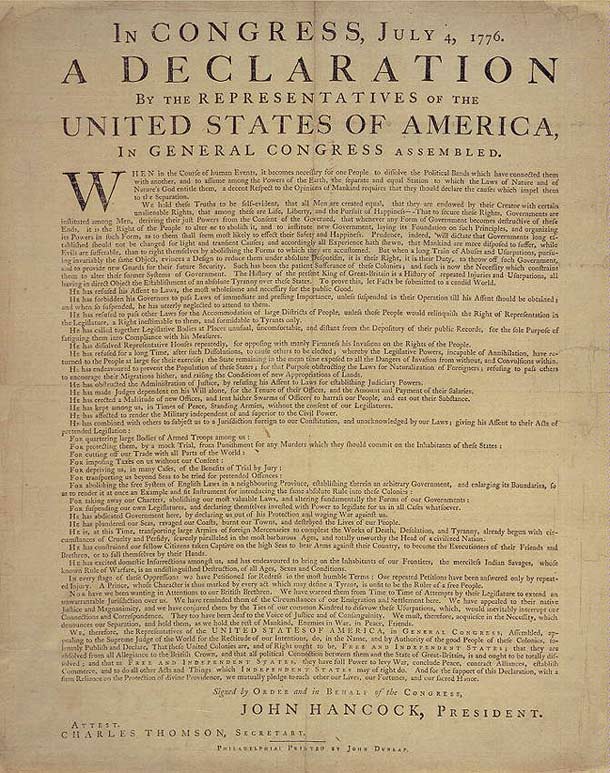
The Dunlap Broadside Copy

dunlap_broadside

Leave a comment

July 3, 2013 · 10:21 am

Pledge to read the Declaration of Independence

Hillsdale College started a pledge drive to encourage Americans to read the Declaration aloud with their family and friends this 4th of July (announcement here).  Hillsdale College offers many interesting free online history courses to build on your understanding of our American heritage.  I’ve been working my way through the History 101 series (Western Heritage- From the Book of Genesis to John Locke) and each lecture is an hour or so and definitely worth your time.  It put the advances of western civilization in a logical timeline, so you can begin to see that our American ideological underpinnings come from a lengthy history of man’s, sometimes faltering, but relentless nonetheless, steps forward in the  quest for individual freedom. (Info here).

Here’s a copy of the Declaration of Independence from the Our Documents website (here):

*IN CONGRESS, July 4, 1776.* *The unanimous Declaration of the thirteen united States of America,* When in the Course of human events, it becomes necessary for one people to dissolve the political bands which have connected them with another, and to assume among the powers of the earth, the separate and equal station to which the Laws of Nature and of Nature’s God entitle them, a decent respect to the opinions of mankind requires that they should declare the causes which impel them to the separation. We hold these truths to be self-evident, that all men are created equal, that they are endowed by their Creator with certain unalienable Rights, that among these are Life, Liberty and the pursuit of Happiness.–That to secure these rights, Governments are instituted among Men, deriving their just powers from the consent of the governed, –That whenever any Form of Government becomes destructive of these ends, it is the Right of the People to alter or to abolish it, and to institute new Government, laying its foundation on such principles and organizing its powers in such form, as to them shall seem most likely to effect their Safety and Happiness. Prudence, indeed, will dictate that Governments long established should not be changed for light and transient causes; and accordingly all experience hath shewn, that mankind are more disposed to suffer, while evils are sufferable, than to right themselves by abolishing the forms to which they are accustomed. But when a long train of abuses and usurpations, pursuing invariably the same Object evinces a design to reduce them under absolute Despotism, it is their right, it is their duty, to throw off such Government, and to provide new Guards for their future security.–Such has been the patient sufferance of these Colonies; and such is now the necessity which constrains them to alter their former Systems of Government. The history of the present King of Great Britain is a history of repeated injuries and usurpations, all having in direct object the establishment of an absolute Tyranny over these States. To prove this, let Facts be submitted to a candid world. He has refused his Assent to Laws, the most wholesome and necessary for the public good. He has forbidden his Governors to pass Laws of immediate and pressing importance, unless suspended in their operation till his Assent should be obtained; and when so suspended, he has utterly neglected to attend to them. He has refused to pass other Laws for the accommodation of large districts of people, unless those people would relinquish the right of Representation in the Legislature, a right inestimable to them and formidable to tyrants only. He has called together legislative bodies at places unusual, uncomfortable, and distant from the depository of their public Records, for the sole purpose of fatiguing them into compliance with his measures. He has dissolved Representative Houses repeatedly, for opposing with manly firmness his invasions on the rights of the people. He has refused for a long time, after such dissolutions, to cause others to be elected; whereby the Legislative powers, incapable of Annihilation, have returned to the People at large for their exercise; the State remaining in the mean time exposed to all the dangers of invasion from without, and convulsions within. He has endeavoured to prevent the population of these States; for that purpose obstructing the Laws for Naturalization of Foreigners; refusing to pass others to encourage their migrations hither, and raising the conditions of new Appropriations of Lands. He has obstructed the Administration of Justice, by refusing his Assent to Laws for establishing Judiciary powers. He has made Judges dependent on his Will alone, for the tenure of their offices, and the amount and payment of their salaries. He has erected a multitude of New Offices, and sent hither swarms of Officers to harrass our people, and eat out their substance. He has kept among us, in times of peace, Standing Armies without the Consent of our legislatures. He has affected to render the Military independent of and superior to the Civil power. He has combined with others to subject us to a jurisdiction foreign to our constitution, and unacknowledged by our laws; giving his Assent to their Acts of pretended Legislation: For Quartering large bodies of armed troops among us: For protecting them, by a mock Trial, from punishment for any Murders which they should commit on the Inhabitants of these States: For cutting off our Trade with all parts of the world: For imposing Taxes on us without our Consent: For depriving us in many cases, of the benefits of Trial by Jury: For transporting us beyond Seas to be tried for pretended offences For abolishing the free System of English Laws in a neighbouring Province, establishing therein an Arbitrary government, and enlarging its Boundaries so as to render it at once an example and fit instrument for introducing the same absolute rule into these Colonies: For taking away our Charters, abolishing our most valuable Laws, and altering fundamentally the Forms of our Governments: For suspending our own Legislatures, and declaring themselves invested with power to legislate for us in all cases whatsoever. He has abdicated Government here, by declaring us out of his Protection and waging War against us. He has plundered our seas, ravaged our Coasts, burnt our towns, and destroyed the lives of our people. He is at this time transporting large Armies of foreign Mercenaries to compleat the works of death, desolation and tyranny, already begun with circumstances of Cruelty & perfidy scarcely paralleled in the most barbarous ages, and totally unworthy the Head of a civilized nation. He has constrained our fellow Citizens taken Captive on the high Seas to bear Arms against their Country, to become the executioners of their friends and Brethren, or to fall themselves by their Hands. He has excited domestic insurrections amongst us, and has endeavoured to bring on the inhabitants of our frontiers, the merciless Indian Savages, whose known rule of warfare, is an undistinguished destruction of all ages, sexes and conditions. In every stage of these Oppressions We have Petitioned for Redress in the most humble terms: Our repeated Petitions have been answered only by repeated injury. A Prince whose character is thus marked by every act which may define a Tyrant, is unfit to be the ruler of a free people. Nor have We been wanting in attentions to our Brittish brethren. We have warned them from time to time of attempts by their legislature to extend an unwarrantable jurisdiction over us. We have reminded them of the circumstances of our emigration and settlement here. We have appealed to their native justice and magnanimity, and we have conjured them by the ties of our common kindred to disavow these usurpations, which, would inevitably interrupt our connections and correspondence. They too have been deaf to the voice of justice and of consanguinity. We must, therefore, acquiesce in the necessity, which denounces our Separation, and hold them, as we hold the rest of mankind, Enemies in War, in Peace Friends. We, therefore, the Representatives of the united States of America, in General Congress, Assembled, appealing to the Supreme Judge of the world for the rectitude of our intentions, do, in the Name, and by Authority of the good People of these Colonies, solemnly publish and declare, That these United Colonies are, and of Right ought to be Free and Independent States; that they are Absolved from all Allegiance to the British Crown, and that all political connection between them and the State of Great Britain, is and ought to be totally dissolved; and that as Free and Independent States, they have full Power to levy War, conclude Peace, contract Alliances, establish Commerce, and to do all other Acts and Things which Independent States may of right do. And for the support of this Declaration, with a firm reliance on the protection of divine Providence, we mutually pledge to each other our Lives, our Fortunes and our sacred Honor. ———————————————————————— /The 56 signatures on the Declaration appear in the positions indicated:/ *Column 1* *Georgia:* Button Gwinnett Lyman Hall George Walton *Column 2* *North Carolina:* William Hooper Joseph Hewes John Penn *South Carolina:* Edward Rutledge Thomas Heyward, Jr. Thomas Lynch, Jr. Arthur Middleton *Column 3* *Massachusetts:* John Hancock *Maryland:* Samuel Chase William Paca Thomas Stone Charles Carroll of Carrollton *Virginia:* George Wythe Richard Henry Lee Thomas Jefferson Benjamin Harrison Thomas Nelson, Jr. Francis Lightfoot Lee Carter Braxton *Column 4* *Pennsylvania:* Robert Morris Benjamin Rush Benjamin Franklin John Morton George Clymer James Smith George Taylor James Wilson George Ross *Delaware:* Caesar Rodney George Read Thomas McKean *Column 5* *New York:* William Floyd Philip Livingston Francis Lewis Lewis Morris *New Jersey:* Richard Stockton John Witherspoon Francis Hopkinson John Hart Abraham Clark *Column 6* *New Hampshire:* Josiah Bartlett William Whipple *Massachusetts:* Samuel Adams John Adams Robert Treat Paine Elbridge Gerry *Rhode Island:* Stephen Hopkins William Ellery *Connecticut:* Roger Sherman Samuel Huntington William Williams Oliver Wolcott *New Hampshire:* Matthew Thornton * Page URL: * http://www.ourdocuments.gov/doc.php?doc=2&page=transcript *U.S. National Archives & Records Administration* 700 Pennsylvania Avenue NW, Washington, DC 20408 • 1-86-NARA-NARA • 1-866-272-6272

Leave a comment

Filed under American History, Education

George Will on constitutional limits – time for some choke collars

The incomparable, George Will, perfectly explains the Constitutional fork in the road in America’s last century, in a column titled, “Slipping the constitutional leash” .   This “must-read” column lays out the history of our abandonment of the 10th Amendment (Washington Post column here) and the road not taken.

Leave a comment

Filed under American History, Politics, The Constitution

Story of the Week: The Day I Sprouted Wings

Here’s a great short story about the first black man to become a licensed pilot in the United States in the 1920s.  James Herman Banning ran his own small auto repair shop in Iowa and his heart’s desire was to learn to fly.  He didn’t go whining to the government about being a victim or expect anyone to help him achieve his dream.  He watched the newspapers for government sales of old airplane parts and gradually built his own airplane in his cow pasture.  This in one of those truly inspirational American self-reliance stories of what an individual can do if he breaks free of a defeatist mindset.

Story of the Week: The Day I Sprouted Wings.

Leave a comment

Filed under American History, Food for Thought

Remember the cost of freedom

memorial day

Leave a comment

May 25, 2013 · 5:04 pm